
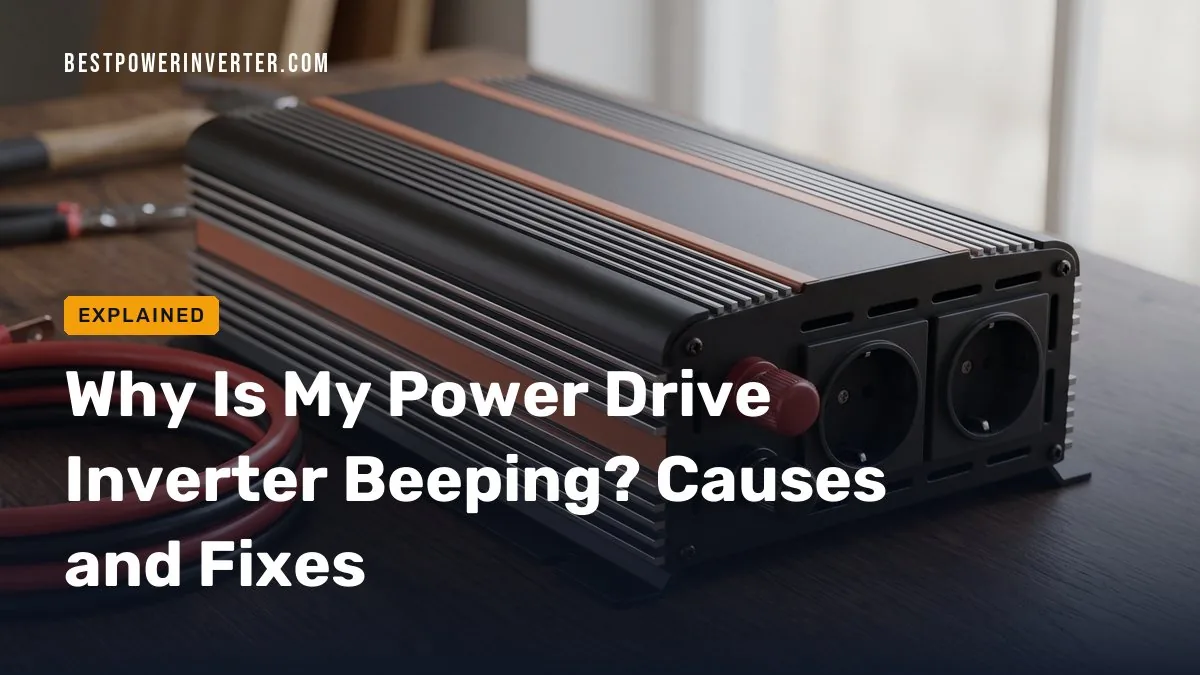
If you own a Power Drive or similar DC-to-AC inverter and it just started beeping, the alarm is a warning, not a random noise. Most often it means low input voltage (about 10.0-10.5V on a 12V unit), overload, or overheating, and a continuous beep usually comes right before shutdown. Check the battery voltage, cables, load and airflow first, then match the beep to your manual.
Quick answer
Your inverter is beeping because it sees a problem: low battery voltage, too much load, too much heat, or too-high input voltage. Turn off the load, measure the battery with a multimeter, and check cables and ventilation. Then compare the beep and LED to your model’s manual.
- Low voltage is the most common cause. A slow, repeating beep is usually a warning; a steady beep usually means shutdown is close.
- A battery that reads fine at rest can still sag under load and trigger the alarm.
- Thin, long or loose cables cause voltage drop, which looks just like a weak battery.
- Motors and compressors can pull 2-3 times their running watts at startup.
- Do not disable the buzzer. Fix the cause instead.
- Why is my Power Drive inverter beeping?
- Continuous beep vs intermittent beep
- Does beeping mean the battery is low?
- How do I know if the inverter is overloaded?
- Can overheating make an inverter beep?
- What if the input voltage is too high?
- Could cables cause the beeping?
- Why does my inverter beep with nothing plugged in?
- How do I reset and diagnose a beeping inverter?
- Can I turn the alarm off?
- When is it time to replace the inverter?
- What do owners say?
- Frequently Asked Questions
Why is my Power Drive inverter beeping?
It is beeping because a protection circuit has seen a limit crossed. The five usual triggers are low input voltage, overload, overtemperature, high input voltage, and an internal or wiring fault. The table below is a starting point. Beep patterns vary by model, so verify against your manual. The Power Drive PWD1000P manual is one example of what a model-specific guide looks like.
| Beep / LED | Likely cause | How to confirm | Fix |
|---|---|---|---|
| Slow, repeating beep, normal operation | Low battery warning | Measure at the inverter terminals while running | Reduce load, start the engine, recharge |
| Continuous beep, then shutdown | Low voltage cutoff | Battery near 10V under load | Recharge, check cables |
| Beep plus overload LED | Too many watts or startup surge | Add up appliance watts | Unplug items, use a bigger inverter |
| Beep plus thermal LED, fan running hard | Overtemperature | Case is very hot | Cool, add airflow, cut load |
| Beep right after connecting to a charging system | High input voltage | Reads over 15V with engine on | Test alternator and regulator |
| Beep with no load | Weak battery, bad connection, or internal fault | Voltage drop at terminals | Clean, tighten, then test |

What does a continuous beep vs an intermittent beep mean on an inverter?
An intermittent beep is usually an early warning. A continuous beep usually means the unit is about to shut down, or already has. Treat the first as a chance to act and the second as an urgent stop.
Some models flip this, or use a different count of beeps for each fault. That is why the manual matters. Buyers often complain that manuals do not explain each pattern clearly, so write down what you hear and which LED is lit before you touch anything.
Does beeping mean the battery is low, and at what voltage does the alarm sound?
Often, yes. Most 12V inverters sound a low-voltage warning around 10.0-11.0V and shut down around 9.5-10.0V, depending on the model. That is a manufacturer-dependent range, so check yours.
Now the trap: voltage sag. A battery can read 12.6V at rest and still drop below 11V the moment a load starts. A fully charged 12V lead-acid battery rests at about 12.6-12.8V, and about 12.0V is roughly 50% charged. A tired or small battery falls fast under current.
To measure it right:
- Set a multimeter to DC volts.
- Read the battery at rest and write it down.
- Run the load and read again at the inverter’s own DC terminals.
- A big drop between rest and load points to a weak battery or poor cables.
How do I know if the inverter is overloaded, and how many watts can it actually run?
Add up the running watts of everything plugged in. If the total is near the rating, or a motor just started, overload is likely. Use the continuous rating for steady loads and the peak (surge) rating only for brief startups.
Motor loads such as compressors, fridges and pumps can draw 2-3 times their running watts at startup. The figures below are typical ranges, so check the label on your device.
| Appliance | Typical running watts | Typical startup watts |
|---|---|---|
| Laptop charger | 45-90 | Same |
| LED TV | 50-150 | Same |
| Mini fridge | 80-150 | 2-3x running |
| Small pump | 200-400 | 2-3x running |
| Power drill | 400-800 | Higher briefly |
| Small air compressor | 600-1000 | 2-3x running |
Cheap plug-in units are a special case. A cigarette-lighter socket is normally fused at 10-15A, which limits a plug-in inverter to roughly 120-180W. Plug a coffee maker into one and it will beep or blow the fuse.
Can overheating make an inverter beep, and how do I cool it down?
Yes. Typical overtemperature shutdown occurs at roughly 60-70°C (140-158°F) internally, depending on the model. Switch off the load and let the unit rest until it cools.
- Keep the fan vents clear. Do not bury the unit under bags or blankets.
- Move it out of direct sun and away from engine heat.
- Leave a few inches of open space on all vent sides.
- Run it below its continuous rating for long sessions.
A fan that runs hard and loud with a warm case is telling you the load is too high for the space it sits in.
What if the input voltage is too high?
High input voltage also triggers an alarm. On 12V units the shutdown is typically around 15-16V. This usually happens with the engine running, when a faulty voltage regulator or alternator sends too much charge. Measure at the battery with the engine on. A healthy system usually reads in the low-to-mid 14V range. If it reads over 15V, have the charging system checked before blaming the inverter.
Could loose, corroded or undersized cables cause beeping?
Yes, and it is a hidden cause on many setups. Resistance in a cable wastes voltage as heat, so the inverter sees a lower voltage than the battery has. Long, thin or corroded cables make a healthy battery look weak.
Here is a worked example. Inverter DC current is about watts ÷ (battery voltage × efficiency). For a 1000W inverter at 85% efficiency and 11V: 1000 ÷ 0.85 ÷ 11 ≈ 107A. That is the current your cables and fuse must handle. Many 1000W units call for heavy cable, often in the 4 AWG to 2 AWG range, with a fuse sized slightly above the maximum draw. Follow your manual’s chart, and keep the run as short as you can.
From the Shop
A common pattern in owner reports: the inverter runs a small load fine, then beeps and shuts off when a bigger tool starts. The battery tests fine at rest. The cause is often thin or long cables, or a loose clamp that adds resistance only under heavy current. Cleaning the terminals and shortening the run usually fixes it.

Why does my inverter beep when nothing is plugged in?
With no load, beeping usually points to a low or failing battery, a bad connection, or an internal fault. Standby draw alone can drain a weak battery over time.
- Measure battery voltage. Low means recharge it.
- Check the clamps for looseness or corrosion.
- Confirm the polarity and the grounding as the manual describes.
- If voltage and wiring are good and it still beeps, suspect an internal fault.
How do I reset an inverter that is beeping and has shut down?
Turn it off, unplug all loads, fix the cause, wait a minute or two, then switch it back on. Do not just restart it, or it will trip again. Work through these seven checks, from least to most effort:
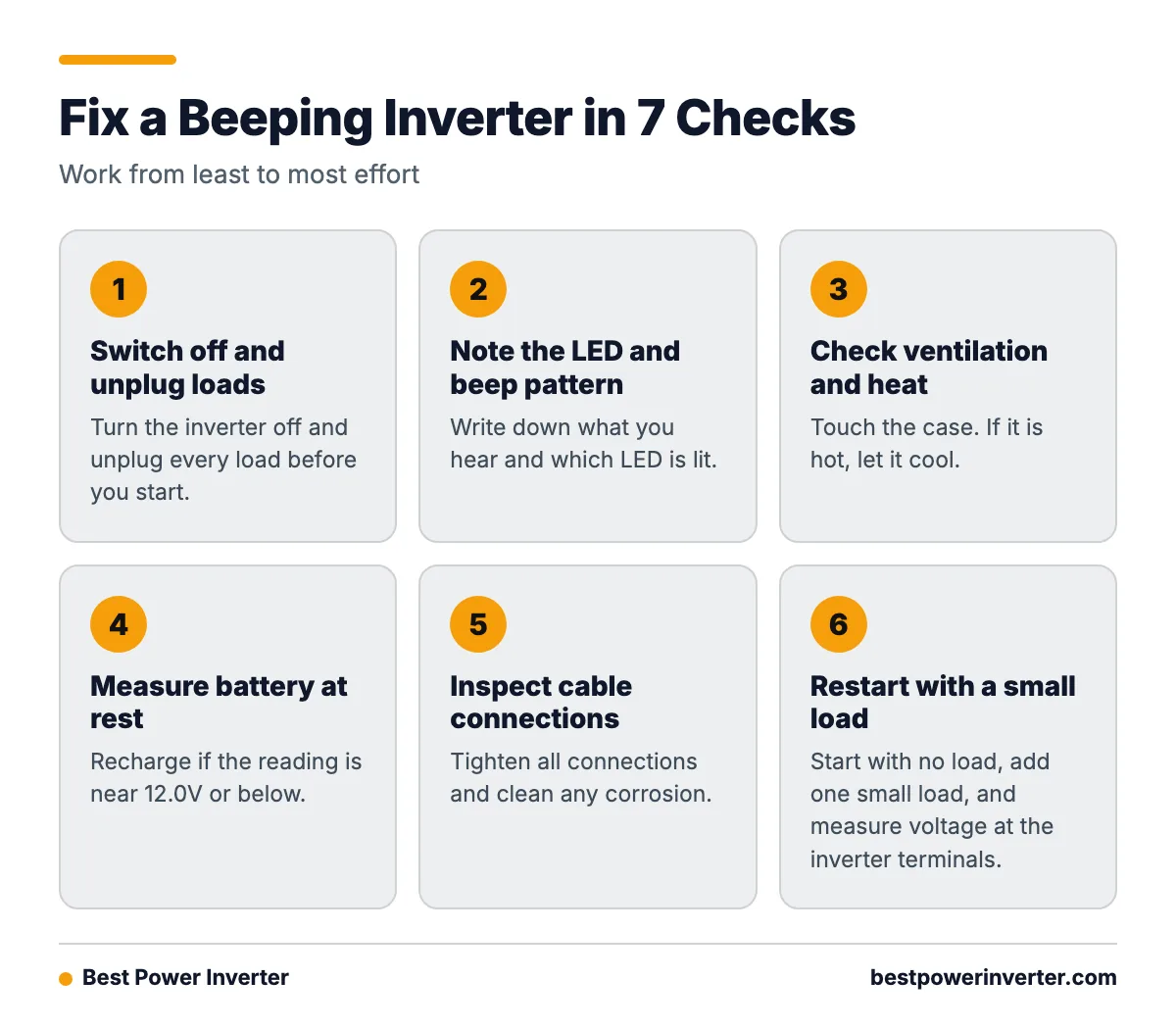
- Switch off the inverter and unplug every load.
- Look at the LED and note the beep pattern.
- Check ventilation and touch the case. If hot, let it cool.
- Measure battery voltage at rest. Recharge if near 12.0V or below.
- Inspect and tighten all cable connections. Clean corrosion.
- Restart with no load, then add one small load and measure voltage at the inverter terminals.
- Add the real load. If it beeps, compare watts to the rating and check startup surge.
Stop condition: if you smell burning, see melted insulation, or the unit is hot with no load, disconnect it and do not use it until it is checked.
If it beeps right after start-up of a motor: overload or sag. Use a bigger inverter or soft-start the load.
If it beeps with the engine running: check for high voltage.
If it beeps hot: cool it and cut the load.
If it beeps with no load and good wiring: suspect an internal fault.
How do I stop the beeping safely, and can I turn the alarm off?
Stop it by removing the cause. Many cheap units have no way to silence the alarm, and owners often find it loud. If your model has a mute switch, the manual will say so. Do not cut or disable the buzzer. It is your only warning before a shutdown, and it protects the inverter and battery from deep discharge and heat damage.
When is the beeping a sign the inverter is faulty and needs replacing?
Replace it when the battery tests healthy, the cables are correct and short, the load is well under the rating, the unit is cool, and it still beeps or shuts down. Also replace it if it overheats at no load, smells burnt, or trips the fuse repeatedly.
Often the better fix is a correct size. Pick an inverter with a continuous rating about 20-25% above your real load, pair it with a battery that can hold voltage under that current, and use the cable and fuse the manual lists. If you need more than a plug-in unit’s 120-180W, go to a hardwired model connected straight to the battery.
What do owners say?
Owners like
- The alarm warns them before a shutdown, so they can act.
- Small loads such as phone and laptop chargers usually run fine.
Common complaints
- Inverter beeps and shuts off when a heavy load starts even though the battery seems charged.
- The alarm is loud and cannot be silenced on many cheap units.
- Plug-in units trip or beep on cigarette-socket power with anything above a small load.
- Manuals do not clearly explain what each beep pattern means.
- Fans and alarms trigger with thin or long cables.
Summarised from owner reviews and long-term user reports; individual experiences vary.
Frequently Asked Questions
Why is my Power Drive inverter beeping?
It is warning you about low battery voltage, overload, overheating, or high input voltage. Check the battery, cables, load and airflow, then match the beep and LED to your model’s manual, since patterns vary.
Why is my power inverter beeping?
The most common reason is low input voltage, often around 10.0-11.0V on a 12V unit. Voltage sag under load, thin cables, and loose connections can trigger it even when the battery looks fine at rest.
Why is my inverter beeping?
Any inverter beeps when a protection limit is hit. Turn off the loads, measure voltage at the inverter terminals, let it cool, and follow the seven-step checklist above. If it beeps with no load and the wiring is good, the unit may be faulty.
Can I keep using the inverter while it beeps?
Only briefly, and only to reduce the load or start the engine. Continuing to run it risks shutdown, and a deeply drained battery can be damaged.