

Drivers, road-trippers and remote workers who want to charge a laptop, phone or camera battery from a car need a small inverter, and for most of them 150 to 300W is enough. A 12V accessory socket is usually fused at 10 to 15A, which caps it at roughly 120 to 180W, so anything bigger has to connect straight to the battery. This guide covers five Amazon models and shows how to size one for your own devices.
Quick answer
Most drivers should buy a 150 to 300W inverter with built-in overload and low-voltage protection. Treat 150W as the practical limit for a socket plug. Mini fridges and tools need a battery-clamp model.
- Best overall: Pro Chaser 400W, 800W peak rating
- Best for many devices: 300W model with 6 outputs
- Best budget: PiSFAU 200W, close to the socket limit
Our Winner: Pro Chaser 400W Power Inverters for Vehicles DC 12v to AC 110v Car Inverter
Based on the listing, it pairs a 400W continuous rating with an 800W peak, dual AC outlets, two USB ports, a 30-inch cord, multiple protections and a 12-month warranty. It holds a 4.5/5 rating on Amazon. The peak figure matters for loads with startup surge. Keep socket use near 150W, or use a connection that bypasses the socket fuse.
How We Compared These Models
Based on the listing specifications and buyer ratings, we compared four things: stated continuous and peak wattage, safety protections, outlet and USB layout, and size or warranty. The Amazon data does not state waveform type for any of these units, so check the product page before powering sensitive gear. The last two products had no feature text in the data, so they are marked as limited-information picks.
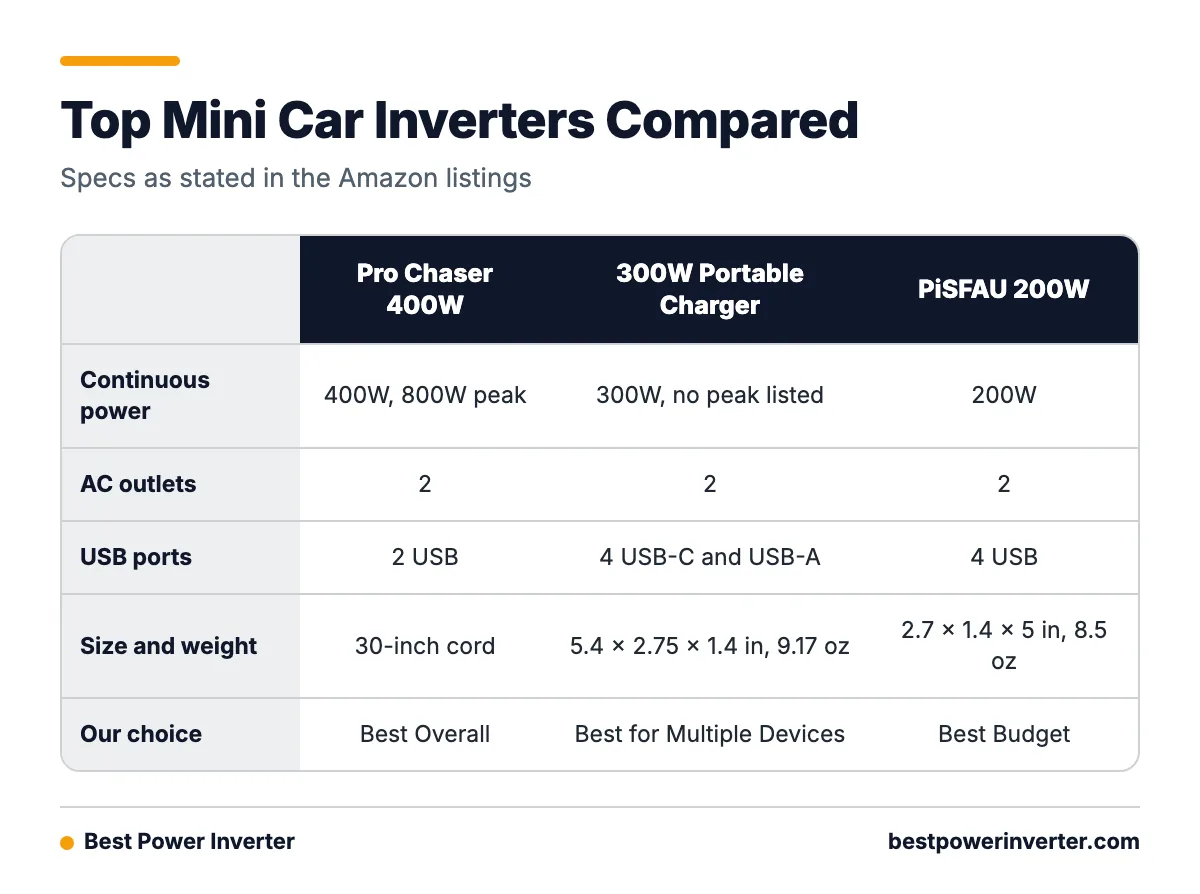
| Product | Key Specs | Our Choice | Action |
|---|---|---|---|
| Pro Chaser 400W | 400W, 800W peak, 2 AC, 2 USB, 30-inch cord, 12-month warranty | Best Overall | |
| 300W Portable Charger Inverter | 300W, 2 AC, 4 USB-C/A, 5.4 x 2.75 x 1.4 in, 9.17 oz | Best for Multiple Devices | |
| PiSFAU 200W | 200W, 2 AC, 4 USB, 2.7 x 1.4 x 5 in, 8.5 oz | Best Budget | |
| Mini power inverter (B004MDXS0U) | 4.5/5 rating, specs not listed in data | Also Consider | |
| Mini power inverter (B0H5C6KTNW) | 4.5/5 rating, specs not listed in data | Also Consider |
How big of a power inverter do I need for a 12V car?
For laptops, phone chargers and camera batteries, 150 to 300W is enough. Add up the running watts of everything you plug in at once, then allow extra for startup surge.
Power equals volts times amps. At 12V, every 100W of AC load pulls roughly 9 to 10A from the car’s DC side once conversion losses are counted. That DC current is what limits a socket, not the number printed on the inverter.
Can I plug an inverter into the cigarette lighter socket?
Yes, within limits. Vehicle accessory sockets are commonly fused at 10 to 15A, which works out to about 120 to 180W at 12V, and many manufacturers recommend staying at or below 150W. A unit labeled 300W or 400W that plugs into the socket cannot deliver that rating through the car’s wiring.
Crutchfield’s car inverter guide covers the same socket limitation and when to wire to the battery.
Decision chart: socket, clamp or permanent install
| Load | Connection | Cable and fuse guidance |
|---|---|---|
| Up to 150W | Plug into the 12V socket | Uses the car’s own socket fuse (10 to 15A) |
| 300 to 1000W | Clamp or ring terminals to the battery | Dedicated cable and inline fuse near the battery positive terminal, sized to the manual |
| 1500W and up | Permanent installation | Thick copper cable, fuse or breaker close to the battery, ideally a deep-cycle battery |
How do I calculate the inverter size for my devices?
Add the running watts of all devices, then add surge for anything with a motor or compressor. Convert to DC amps with this formula: watts ÷ 0.87 (a mid-range efficiency of 85 to 90%) ÷ 12.
| Device | Running watts | Surge watts | DC amps at 12V | Suggested inverter |
|---|---|---|---|---|
| Phone charger | About 20W | None | About 1.9A | 150W, socket |
| Camera battery charger | About 15W | None | About 1.4A | 150W, socket |
| Laptop charger | 65W | None | About 6.2A | 150W, socket |
| Thermoelectric cooler | 40 to 60W | None | About 4.8A at 50W | None, run it on 12V directly |
| Tool battery charger | About 100W | Varies | About 9.6A | 150 to 300W |
| Compressor mini fridge | About 60W | 3 to 7x (180 to 420W) | 5.7A running, 17 to 40A at surge | 300 to 600W, battery clamp |
Wattage figures are typical values. Always confirm against the label on your own charger or appliance.
Worked example: mini fridge plus laptop
- Running load: 60W fridge + 65W laptop charger = 125W.
- Startup surge: fridge at 3x is 180W, plus 65W = about 245W briefly.
- DC current: 125 ÷ 0.87 ÷ 12 is about 12A running. The surge is about 23 to 24A.
- Socket check: 12A sits at the edge of a 10 to 15A fuse, and the surge goes past it. Use a 300W inverter clamped to the battery.
- Fuse check: a 300W inverter can draw about 29A at full load, so the inline fuse must be sized to the manual.
Will an inverter drain my car battery?
Yes, and quickly with the engine off. These are arithmetic estimates, not measurements. Assume a 50Ah battery, which holds about 600Wh at 12V.
Starting lead-acid batteries are not built for deep discharge, and going much below 50% shortens their life. Using only half (about 300Wh), a 125W load drawing roughly 144W from the battery lasts about 2 hours. A 300W load drawing about 345W lasts under an hour. A 65W laptop alone lasts around 4 hours.
Many inverters sound a low-voltage alarm around 10 to 11V and shut down near 10V. Run the engine whenever the load is more than a phone or laptop charger.
Pure sine wave or modified sine wave: which should I buy for a car?
Buy pure sine wave if you can. It outputs a waveform close to utility power and suits sensitive electronics, CPAP machines and compressor motors. Modified sine wave units are cheaper but can cause buzzing, extra heat or malfunction in some loads. None of the five listings here state waveform in the data provided, so confirm it on the Amazon page before connecting anything sensitive.
How big of a power inverter do I need for a mini fridge?
A compressor mini fridge typically needs a 300 to 600W inverter. The compressor can draw about 3 to 7 times its running wattage for a moment at startup, so surge rating matters as much as continuous rating.
Thermoelectric (Peltier) coolers behave differently. They draw about 40 to 60W continuously and often run directly from 12V, so an inverter may be unnecessary.
Is a 3000W car power inverter realistic?
For a normal car, no. A 3000W load draws roughly 250A at 12V before losses, or about 275 to 290A at 85 to 90% efficiency. A cigarette-lighter socket cannot carry that. It needs heavy copper cable, a large inline fuse or breaker near the battery, and a battery setup built for the load. A 3000W unit is a different product class from the mini inverters reviewed here.
What size cables and fuse do I need when connecting an inverter directly to the battery?
Size both from the inverter’s maximum DC current, then follow the manufacturer’s cable chart. High-power inverters (1000W+) are normally wired directly to the battery with thick copper cable and an inline fuse or breaker placed close to the battery positive terminal. The fuse protects the cable, so place it as close to the battery as practical. The Parksafe installation guide covers wiring layout in more detail.
Is it safe to use a power inverter in your car?
Yes, with sensible habits. Keep the unit dry and ventilated, never cover it with bags or clothing, and avoid leaving it running in a hot parked car. Mount it where the fan can breathe and the cord cannot snag. The car battery inverter guide has further safety notes.
Pre-purchase checklist
- Waveform type (pure sine preferred for sensitive gear).
- Continuous rating versus peak rating.
- USB-C PD output if you charge a modern laptop or phone.
- Low-voltage, overload, overheating and short-circuit protection.
- Fan noise under load.
- Certifications such as ETL or UL listing.
In-Depth Reviews

1. Pro Chaser 400W Power Inverters for Vehicles – Best Overall
Our Verdict: The strongest all-round listing here, thanks to its 800W peak rating, protections and warranty.
Based on the specifications, it offers 400W continuous and 800W peak output, dual 110V AC sockets and two USB ports. The listing quotes both 3.1A and 4.8A for the USB ports, so confirm the figure on the product page. The 30-inch cord makes placement flexible, and the fan is stated to start at 113°F (45°C).
The listing says the AC outlets handle 300 to 400W devices. In a car, that only holds if the unit is connected in a way that bypasses the socket fuse limit. For socket use, keep the load near 150W. The listing does not state waveform or battery clamps.
Why We Like It
- Peak rating helps with brief startup surges.
- Protection against overload, voltage problems and overheating.
- 12-month warranty and a 4.5/5 Amazon rating.
Pros & Cons
Pros
- Highest stated capacity of the detailed listings
- Dual AC outlets and two USB ports
- Cell-phone-sized body
Cons
- Waveform not stated
- 400W cannot pass through a typical 12V socket

2. 300W Portable Charger Car Power Inverters for Vehicle – Best for Multiple Devices
Our Verdict: The best fit for charging several gadgets at once on a trip.
The listing describes 6 outputs: two 110V AC outlets and four USB-C and USB-A ports rated at 24W. It measures 5.4 x 2.75 x 1.4 inches and weighs 9.17 oz. The upgraded cooling fan is described as stable and quiet.
The listing itself warns against hair dryers and electric heaters because they may blow the fuse. That matches the socket limit described above. Treat 300W as a ceiling, and keep real use well under it when plugged into the socket.
Why We Like It
- Four USB ports reduce the need for extra chargers.
- Light and compact for a glovebox.
- Clear warning about high-power appliances.
Pros & Cons
Pros
- USB-C and USB-A plus two AC outlets
- Light at 9.17 oz
- 4.4/5 rating
Cons
- Waveform not stated
- No peak rating listed

3. PiSFAU 200W Car Power Inverter – Best Budget
Our Verdict: The most realistic match for a cigarette-lighter socket, which makes it the sensible value pick.
At 200W, it sits just above the practical 150W socket guideline, so it suits laptops, tablets and phones. It has two U.S. AC outlets and four USB ports, and measures 2.7 x 1.4 x 5 inches at 8.5 oz. The insulated ABS shell and protection against overheating, undervoltage, overvoltage, overload and short circuit are listed. The seller also states it accepts returns and exchanges.
Why We Like It
- Rating matches what a socket can deliver.
- Full list of protections.
- Lightest of the detailed listings.
Pros & Cons
Pros
- Two AC outlets and four USB ports
- Insulated ABS housing
- 4.4/5 rating
Cons
- Too small for compressor fridges
- Waveform not stated

4. Mini Power Inverter for Car (B004MDXS0U) – Also Consider
Our Verdict: A 4.5/5 rated listing, but the data provided has no wattage, port or waveform details.
We cannot confirm output rating, outlets or protections from the information available. Open the Amazon page and check the wattage, waveform and safety certifications against the checklist above before buying.
Why We Like It
- 4.5/5 rating on Amazon.
- Listed under the mini inverter category.
Pros & Cons
Pros
- Strong buyer rating
Cons
- Specs and features not available to verify

5. Mini Power Inverter for Car (B0H5C6KTNW) – Also Consider
Our Verdict: Another 4.5/5 rated option with limited listing data, so verify details before you commit.
As with the previous unit, the data has no wattage, ports or protections. Confirm continuous and peak ratings, waveform and certifications on the product page, and match them to the sizing table above.
Why We Like It
- 4.5/5 rating on Amazon.
- Positioned as a mini car inverter.
Pros & Cons
Pros
- Strong buyer rating
Cons
- Specs and features not available to verify
What do owners say?
Owners like
- Compact size that fits in a cupholder or glovebox and charges laptops and camera batteries on the road
- Built-in USB-A and USB-C PD ports that remove the need for a separate charger
- Quiet operation on low loads, with fans staying off or spinning slowly
- Pure sine wave models running CPAP machines and sensitive electronics without buzzing
Common complaints
- Rated wattage is overstated, or the unit shuts off under a load close to its rating
- Socket-plugged units blow the car’s 12V fuse when pushed past about 150W
- Fan noise gets loud under sustained load and units run hot
- Modified sine wave units cause buzzing in audio gear or fail with certain chargers and motors
- Cheap unbranded units fail within months or ship with weak clamps and thin cables
Summarized from owner reviews and long-term user reports; individual experiences vary.
Frequently Asked Questions
How big of power inverter for 12V car?
For phones, laptops and camera chargers, 150 to 300W is enough. Keep socket-plugged use at or below about 150W, and use a battery connection for anything larger.
How big of a power inverter for a mini fridge?
A compressor mini fridge typically needs 300 to 600W because of startup surge. A thermoelectric cooler draws about 40 to 60W and can often run straight from 12V.
Is a 3000W car power inverter realistic?
Not for a standard car. A 3000W load draws roughly 250A at 12V before losses, so it needs heavy cable, a large fuse or breaker and a battery system built for it. A 3000W car power inverter is not a mini product.
Is using a power inverter in your car safe?
Yes, if the load stays within the inverter and socket limits, the unit has ventilation, and a fuse protects any direct battery wiring. Run the engine for loads beyond a small charger. The guide to using a car power inverter adds practical tips.
Conclusion
For most drivers, a 150 to 300W inverter covers laptops, phones and cameras. The Pro Chaser 400W is the best overall pick for its peak rating, protections and warranty. The 300W six-output model suits multi-device charging, and the PiSFAU 200W is the budget pick closest to what a socket can supply. Size your load with the table, keep socket use near 150W, and move to a battery connection for fridges and tools.
Sources
Affiliate Disclosure: As an Amazon Associate, we may earn commissions from qualifying purchases from Amazon.com. This comes at no extra cost to you and helps support our research.