

Most people pick an inverter by the drill’s horsepower or by guessing, and then the inverter trips the moment the trigger is pulled. The fix is simple: read the amps on the tool’s label and multiply by volts. For most corded drills, buy a pure sine wave inverter rated for at least 1,000 continuous watts and about 2,000 surge watts. A sump pump needs far more, because its motor draws a big jolt at startup.
Quick answer
For a standard corded drill, choose a pure sine wave inverter with 1,000 continuous watts and about 2,000 surge watts. For a 1/3-hp sump pump, plan on at least 2,500 to 3,000 surge watts, because the pump may need about 2,100 starting watts.
- Best for a standard drill: 1,000 W continuous, 2,000 W surge
- Best for a sump pump: 1,500+ W continuous, 3,000 W surge
- Watts = volts x amps. An 8-amp, 120-volt drill uses about 960 watts.
- Motors need extra power for a split second at startup. Size for that surge, not just running watts.
- Pure sine wave output is the safer match for drills and the better match for pumps.
- A 1,000-watt load pulls more than 83 amps from a 12-volt battery, and real current is higher.
- Cordless drills do not need an inverter to work. They only need one to charge.
- How big of an inverter do I need to run a corded drill?
- How do I calculate inverter watts from the tool’s amp rating?
- Do I need to account for a drill’s startup surge?
- Will a modified-sine-wave inverter run a drill safely?
- What inverter size is needed for a sump pump?
- Can a 12-volt battery run a drill or sump pump?
- How long will a battery run a drill through an inverter?
- Can the inverter run the drill and sump pump at the same time?
- Pre-purchase checklist
- Frequently Asked Questions
How big of an inverter do I need to run a corded drill?
Most corded drills run well on a 1,000-watt continuous, 2,000-watt surge inverter. Heavier tools need more. The right size depends on the amp number printed on the tool.
Corded drills usually draw somewhere between 3 and 13 amps. DEWALT lists its 120V drill drivers by voltage, and the nameplate on your own tool is the number to trust. These sizes are planning estimates based on the 2x starting-power rule described below.
| Drill type | Typical amps | Running watts | Suggested inverter (continuous / surge) |
|---|---|---|---|
| Compact corded drill | 3 to 5 A | 360 to 600 W | 700 W / 1,400 W |
| Standard 1/2-inch drill | 6 to 8 A | 720 to 960 W | 1,000 W / 2,000 W |
| Hammer drill | 8 to 10 A | 960 to 1,200 W | 1,500 W / 3,000 W |
| Heavy-duty or rotary hammer | 10 to 13 A | 1,200 to 1,560 W | 2,000 W / 4,000 W |

How do I calculate inverter watts from the tool’s amp rating?
Multiply the amps by 120 volts. Generac advises this same method in its generator sizing worksheet.
Worked example: a 120-volt, 8-amp drill is 120 x 8 = 960 running watts. That is before any startup or overload margin. A 1,000-watt inverter is already almost maxed out on running power alone, so the 2,000-watt surge rating matters.
Look for a metal plate or molded label near the cord. It lists volts and amps. Some tools list watts directly. If so, use that number.
Do I need to account for a drill’s startup surge?
Yes. Motors pull extra current for a moment when they start or when the bit binds in the material. Generac states that starting watts are typically about twice running watts, though the appliance’s technical documentation should be checked.
Drills are less demanding than pumps because the motor has no heavy load at startup. Still, a hard bind in concrete or thick lumber can spike the draw. An inverter with no surge headroom will shut off in the middle of a hole. Pick a surge rating of at least twice the running watts.
Will a modified-sine-wave inverter run a drill safely?
Often it will run, but pure sine wave is the better choice. Modified sine wave is a blocky, stepped waveform. Many simple universal-motor drills accept it. They may run hotter, buzz, or lose some power.
Drills with electronic speed control or a variable-speed trigger can behave oddly on modified sine wave. Sump pumps are worse off. Induction motors tend to run hotter and louder on it, and they may stall. Check both the drill manual and the inverter manual. If either one warns against modified sine wave, believe it.
If you only run a basic corded drill occasionally, then modified sine wave may work, but pure sine wave is safer.
If you power a sump pump or any tool with electronics, then buy pure sine wave.
What inverter size is needed for a sump pump?
Plan on 2,500 to 3,000 surge watts for a typical 1/3-hp sump pump. Generac’s worksheet lists a sump pump at approximately 2,100 starting watts. That is the number that decides your inverter size.
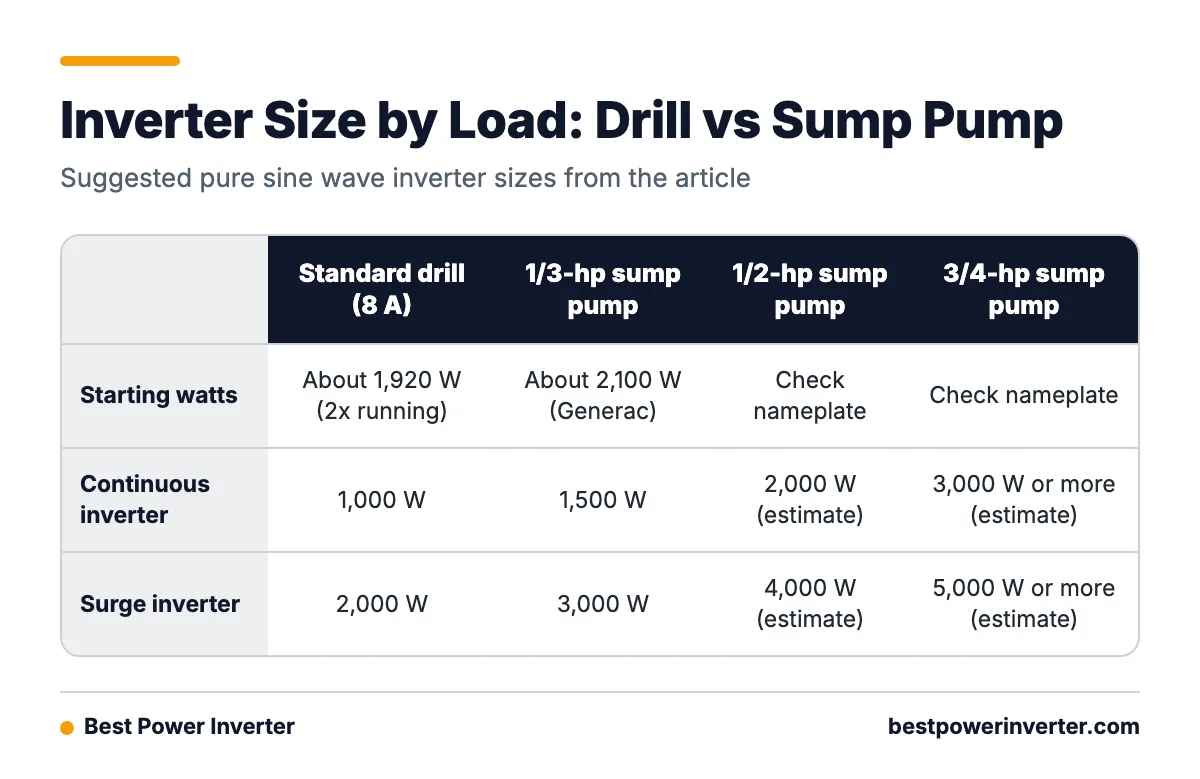
If starting watts are about twice running watts, as Generac says is typical, a 1/3-hp pump runs near 1,000 watts once it is spinning. The inverter must hold up through the 2,100-watt start every time the float switch kicks on. Leave a margin on top of that.
Only the 1/3-hp figure comes from the research above. The 1/2-hp and 3/4-hp rows below are planning estimates. Read your pump’s nameplate and size from that.
| Load | Starting watts | Suggested inverter (continuous / surge) |
|---|---|---|
| Standard drill (8 A) | About 1,920 W (2x running) | 1,000 W / 2,000 W |
| 1/3-hp sump pump | About 2,100 W (Generac) | 1,500 W / 3,000 W |
| 1/2-hp sump pump | Check nameplate | 2,000 W / 4,000 W (estimate) |
| 3/4-hp sump pump | Check nameplate | 3,000 W / 5,000 W or more (estimate) |
Test the pump restart before you rely on it in a storm. Fill the pit with water, let the pump cycle several times on the inverter, and watch for shutdown alarms.
Can a 12-volt battery run a drill or sump pump?
It can, but the current is huge. The formula is: DC amps = AC watts / (12 volts x inverter efficiency). A 1,000-watt AC load on a 12-volt battery draws more than 83 amps before losses. The table below assumes 85% efficiency, which is my assumption. Check your inverter’s spec sheet.
| AC load | Approx. DC amps at 12 V |
|---|---|
| 300 W | 29 A |
| 600 W | 59 A |
| 960 W (8 A drill) | 94 A |
| 1,500 W | 147 A |
| 2,100 W (pump start) | 206 A |
| 3,000 W | 294 A |
Those numbers explain why cable and fuse choices matter. Use the short, thick cables and the fuse size listed in your inverter manual, and mount the fuse close to the battery. Thin cables get hot and drop voltage, which can trigger low-voltage shutdown. Give the inverter airflow, since it makes heat under load. Keep it off carpet and away from battery vents.
For pumps above 1,000 watts, a 24-volt or 48-volt system cuts current in half or more. A 12-volt setup at 2,000+ watts is hard on batteries and wiring.

How long will a battery run a drill through an inverter?
Use this formula: runtime (hours) = battery watt-hours x usable fraction x inverter efficiency / load watts. A 12-volt, 100 Ah battery holds about 1,200 watt-hours.
Lead-acid batteries should usually be discharged only about half, leaving roughly 600 usable watt-hours. A lithium iron phosphate (LiFePO4) battery of the same rating can often use 80 to 90 percent. These are common rules of thumb. Follow your battery maker’s limits.
Example, 960-watt drill at 85% efficiency:
- Lead-acid, 600 Wh usable: 600 x 0.85 / 960 = about 32 minutes of continuous run time.
- LiFePO4, about 1,000 Wh usable: 1,000 x 0.85 / 960 = about 53 minutes.
Drills run in short bursts, so real working time is longer. A sump pump of about 1,050 running watts on the same lead-acid battery gives roughly 29 minutes of motor time. It adds up fast in a long outage.
What about cordless drills?
A cordless drill does not need an inverter to run. Its battery powers it directly. Cordless tools are rated by battery voltage, such as DEWALT’s 20V MAX drill/driver. Power figures like DEWALT’s 543 unit watts out describe the tool’s mechanical output, not the AC watts an inverter must supply. For charging, check the charger label for input watts. Chargers are small loads compared to a corded drill.
Can the inverter run the drill and sump pump at the same time?
Only with a much larger inverter. Generac recommends adding the running watts of all devices to the single highest starting-watt requirement. For an 8-amp drill and a 1/3-hp pump, that is 960 W + 2,100 W = 3,060 W. Add a margin and you need a 3,500-watt-class inverter or larger.
That is too much for most single 12-volt batteries. The safer approach is to run the pump alone. Use the drill only when the pump is idle, or move to a generator if you need both at once.
If you only need a drill for short jobs, then use a 1,000 to 1,500 W pure sine wave inverter.
If you need a pump for hours of outage, then use a larger inverter with a bigger battery bank, or a generator.
If you need both together, then a generator is usually more suitable.
Pre-purchase checklist
- Nameplate: write down volts and amps for every tool or pump.
- Waveform: pure sine wave output.
- Surge rating and duration: at least twice running watts, held long enough to start a motor.
- Battery type and size: lead-acid or lithium, with enough usable watt-hours.
- Cable gauge and fuse rating: match the inverter manual exactly.
- Protections: low-voltage shutdown, overload, and over-temperature.
- Pump restart test: cycle the pump several times before storm season.
Frequently Asked Questions
How big power inverter to run drill?
For a standard corded drill, use a pure sine wave inverter with at least 1,000 continuous watts and about 2,000 surge watts. For an exact number, multiply the drill’s nameplate amps by 120 volts, then allow about double that for surge.
How big power inverter to run sump pump?
A typical 1/3-hp sump pump may need about 2,100 starting watts, according to Generac’s worksheet. Choose an inverter with at least 2,500 to 3,000 surge watts and enough continuous output for the running load, which may be around 1,000 watts.
How many watts does a typical drill use?
Most corded drills use about 360 to 1,560 watts while running, depending on the 3 to 13 amp rating. A common 8-amp drill uses 960 watts.
How many starting watts does a 1/3-hp sump pump need?
Generac’s generator worksheet lists a sump pump at approximately 2,100 starting watts. Check your own pump’s nameplate or manual, since models vary.
Can a 12-volt battery run a drill or sump pump?
Yes, with the right gear. Expect about 94 DC amps for a 960-watt drill and over 200 DC amps during a pump start. Use thick cables, a proper fuse, and a battery that can deliver that current.
Sources