
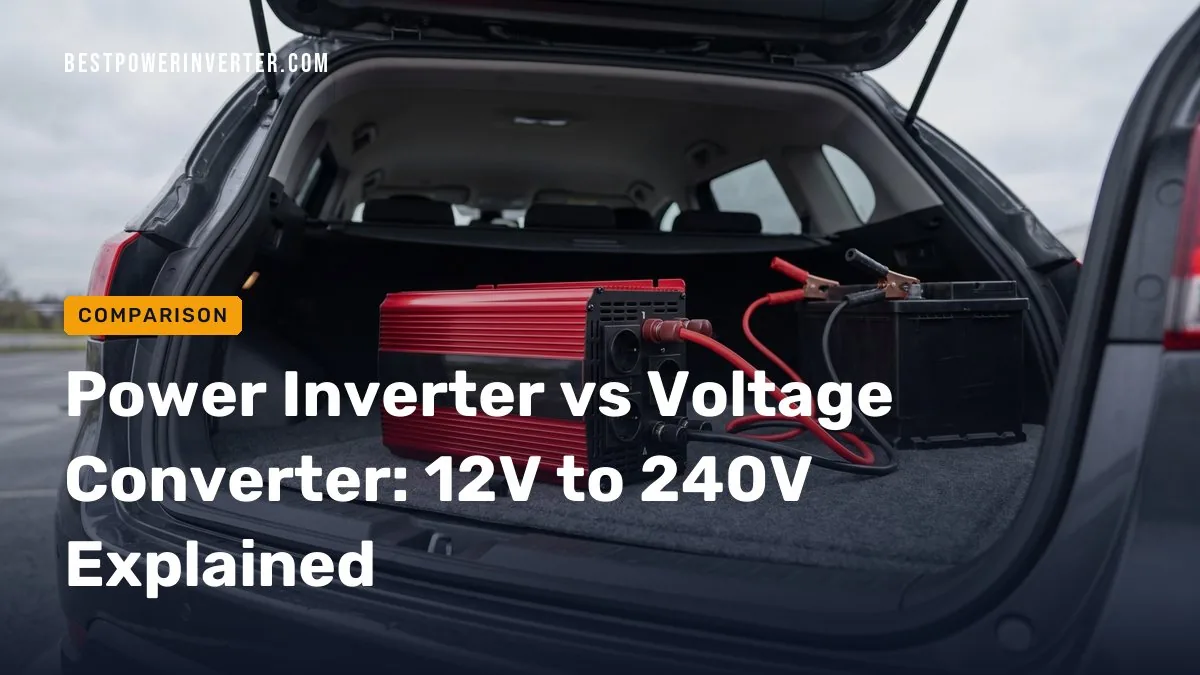
Never swap an inverter for a voltage converter: mixing them up can ruin a battery system or an appliance. An inverter turns low-voltage DC, such as 12V battery power, into 230V or 240V household AC. Its battery current equals AC watts divided by battery voltage, efficiency, and power factor, so size the inverter, cables, and fuse for that current and for startup surges.
Quick answer
Use an inverter when your power source is a battery (DC) and your appliance needs mains AC. Use a transformer or plug-in voltage converter only when you already have AC at the wrong voltage. Size the inverter 30% above your load, and fuse the battery cable.
- Best for laptops and phones: a small inverter, pure sine wave preferred
- Best for fridges, pumps, CPAP: pure sine wave with high surge rating
- Best for kettles and heaters: avoid on 12V; the current is too high
- An inverter changes DC to AC. A transformer or AC voltage converter only changes AC voltage.
- A 500W load on 12V draws about 46A. A 1,000W load draws about 93A.
- Motors and compressors can demand far more than their running watts for a moment at startup.
- Pure sine wave is best for motors, medical gear, and sensitive electronics. Simple heaters and chargers often do fine on modified sine wave.
- Short, thick cables and a fuse near the battery are not optional.
- What Is the Difference Between a Power Inverter and a Voltage Converter?
- How Does an Inverter Increase Voltage?
- How Much Power Does a 12V to 240V Inverter Use?
- How Do I Choose the Correct Inverter Wattage and Surge Rating?
- What Can an Inverter Power, and What Needs Pure Sine Wave?
- What Battery, Cable, Fuse, and Ventilation Does a 12V Inverter Need?
- Worked Sizing Example
- Why Might an Inverter Shut Down When an Appliance Starts?
- How Do I Use a Voltage Converter With a 12V Battery?
- Is It Safe to Use an Inverter in a Car, Van, Boat, or Off-Grid System?
- What Do Owners Say?
- Frequently Asked Questions
What Is the Difference Between a Power Inverter and a Voltage Converter?
An inverter takes DC from a battery and makes AC. A voltage converter, in the everyday sense, takes AC at one voltage and changes it to another. The words get mixed up in shops and search results, but the jobs are different.
Before you buy, work out what you have and what you need. A 12V battery gives DC. A wall socket gives AC. A 12V-to-240V product must be an inverter.
| Device | Input | Output | Typical use |
|---|---|---|---|
| Power inverter | 12V DC (battery) | 230/240V AC | Vans, boats, cars, off-grid power |
| Transformer | AC at one voltage | AC at another voltage | Running 110V gear from 240V mains, or the reverse |
| DC step-up converter | Low-voltage DC | Higher-voltage DC | Boosting 12V to 19V for a laptop, for example |
| Battery charger | AC mains | DC at battery voltage | Refilling the battery |
How Does an Inverter Increase Voltage?
An inverter raises voltage by switching DC on and off very fast with electronics, then passing it through a transformer or a transformer-like stage. Switching turns steady DC into pulses. Pulses can be stepped up, which a steady DC flow cannot.
Most modern units work in two steps. First, a high-frequency stage boosts 12V up to a high DC voltage. Second, an output stage switches that voltage back and forth, about 50 times per second in 230/240V regions, to build AC. The shape of that AC is the waveform. It can be a smooth sine wave or a stepped imitation.
Energy is not created. Raising the voltage lowers the current on the AC side, and the battery side pays for it. That is why a small appliance on 240V can pull a big current from a 12V battery.
How Much Power Does a 12V to 240V Inverter Use?
An inverter uses the power of your appliance plus its own losses. Battery current is roughly AC watts ÷ (battery volts × efficiency), then adjusted for power factor if the load is not a simple resistive one.
Here is the math, using a typical 90% efficiency:
- 500W load: 500 ÷ (12 × 0.90) = about 46A
- 1,000W load: 1,000 ÷ (12 × 0.90) = about 93A
Those figures are before power-factor effects. Doubling the watts doubles the amps. Technical guides such as the 12V DC to 240V AC inverter data sheet from TLC Direct also note that if you only know current, you can estimate power by multiplying amps by the mains voltage in use.
Idle consumption
Many pages skip this. An inverter that is switched on with nothing plugged in still draws current. Check the idle figure on the spec sheet. As an example, a unit idling at 6W pulls 0.5A from 12V, which is 12Ah over 24 hours. That is enough to flatten a small battery over a few days.
Power factor and VA
Some loads, such as motors and some power supplies, draw more apparent power (VA) than real power (W). That raises the current the inverter and battery must supply. If a label lists VA, use that number for sizing.
How Do I Choose the Correct Inverter Wattage and Surge Rating?
Add up the running watts of everything you will use at the same time, then add about 30% for fluctuating loads and startup demand. That buffer is suggested in the 12V to 240V inverter buying guide from The Van Conversion. Then check the inverter’s surge rating against your biggest motor.
Two numbers matter:
- Continuous watts: what the inverter can supply for hours.
- Peak (surge) watts: what it can supply for a second or so. Motors, compressors, and pumps can demand much more than their running wattage as they start.
Advertised watts are only part of the story. A 2,000W inverter on 12V can try to pull well over 150A. Your cable, fuse, and battery must handle that, or the label means nothing.
Sizing checklist
- Continuous watts of all loads used together, plus 30%
- Startup watts of the largest motor load
- Battery amp-hours and its maximum discharge rating
- Cable length, kept as short as possible
- Fuse rating matched to the cable and inverter
- Waveform: pure sine or modified
- Ventilation space around the unit
- Grounding as the manufacturer instructs

What Can an Inverter Power, and What Needs Pure Sine Wave?
An inverter can power laptops, phone chargers, lights, TVs, small fridges, pumps, and power tools, as long as the load fits its rating. Pure sine wave output closely matches utility power. It is generally preferred for sensitive electronics, medical devices, audio gear, motors, and variable-speed appliances. Modified sine wave is a stepped approximation that is cheaper but can cause buzzing, heat, or flicker in some gear.
| Appliance | Approx. running watts | Surge risk | Recommended waveform |
|---|---|---|---|
| Phone and laptop chargers | 10-100W | Low | Pure sine preferred |
| Space heater, kettle | 1,000-2,000W+ | Low surge, very high draw | Not practical on 12V |
| Refrigerator | 100-200W | High (compressor start) | Pure sine |
| Microwave | Often 1,000W+ input | Medium, large current | Pure sine; needs a large inverter |
| Water pump | 200-800W | High | Pure sine |
| CPAP machine | 30-90W | Low | Pure sine (check maker advice) |
| Power tools | 300-1,500W | High | Pure sine for motors and speed control |
These are approximate ranges. Always read the label on your own appliance. Heaters and kettles are the classic trap. They are simple loads, but 2,000W at 12V means roughly 185A, which is beyond most small systems.
What Battery, Cable, Fuse, and Ventilation Does a 12V Inverter Need?
A 12V inverter needs a battery that can deliver the full current, thick cable kept as short as possible, a fuse close to the battery, and clear space for airflow. Follow the inverter maker’s cable and fuse chart rather than guessing.
- Battery: It must support the discharge current. Lead-acid batteries are usually not discharged below about 50% to protect their life. Lithium iron phosphate batteries can typically use much more of their capacity. Check your battery’s maker data.
- Cable: At 93A, even small resistance wastes power as heat and drops voltage. A voltage drop can push the inverter into low-voltage shutdown. That is why short, thick cables matter.
- Fuse: Put a properly rated fuse or breaker on the positive cable, close to the battery terminal. It protects the cable, which is the part that can start a fire.
- Ventilation: Inverters make heat, and fans need airflow. Do not bury one in bedding or a sealed locker.
- Grounding: Follow the manual for earthing and chassis connection. Rules differ between vehicles, boats, and fixed systems.
From the Shop
A pattern buyers often report: a budget inverter ships with thin cables that look fine until the load rises. The inverter then shuts down, or the cable ends get warm. Buyers who swap to thicker, shorter cables and add a fuse usually solve the problem. Thin cables are a common weak point, so check the cable gauge against the manual before you rely on the supplied set.
Worked Sizing Example
Say you run a laptop (65W), LED lights (20W), a small TV (60W), and a fridge (150W running). That is 295W running.
- Add the buffer: 295W × 1.3 = about 384W. A 500W pure sine inverter with a fridge-friendly surge rating fits.
- Find the battery current: 295 ÷ (12 × 0.90) = about 27A, if everything runs at once.
- Estimate the energy: 27A × 4 hours = about 108Ah.
- Allow for usable capacity: with a lead-acid battery used to about 50%, you need roughly 216Ah of battery. A lithium battery that gives more usable capacity needs less.
Real fridges cycle on and off, so actual use is often lower. But sizing for the worst case keeps you out of trouble.

Why Might an Inverter Shut Down When an Appliance Starts?
The most common reason is a voltage dip. When a fridge compressor or pump starts, it pulls a large surge. If the battery, cables, or fuse cannot supply it, the voltage at the inverter input falls and low-voltage protection trips. Other causes include:
- An inverter surge rating below the appliance start-up demand
- A weak or partly discharged battery
- Thin, long, or loose cables and poor terminal contact
- Overheating from blocked airflow or heavy continuous load
- Overload protection, because the combined load is above the rating
If it trips only at startup: check surge rating, then cable gauge and length.
If it trips after a while: check temperature and ventilation.
If it trips with a low battery: recharge, and consider more battery capacity.
How Do I Use a Voltage Converter With a 12V Battery?
A plain AC voltage converter or transformer will not run from a 12V battery. For a 12V battery and a 240V appliance, you need an inverter. Here is the order to follow:
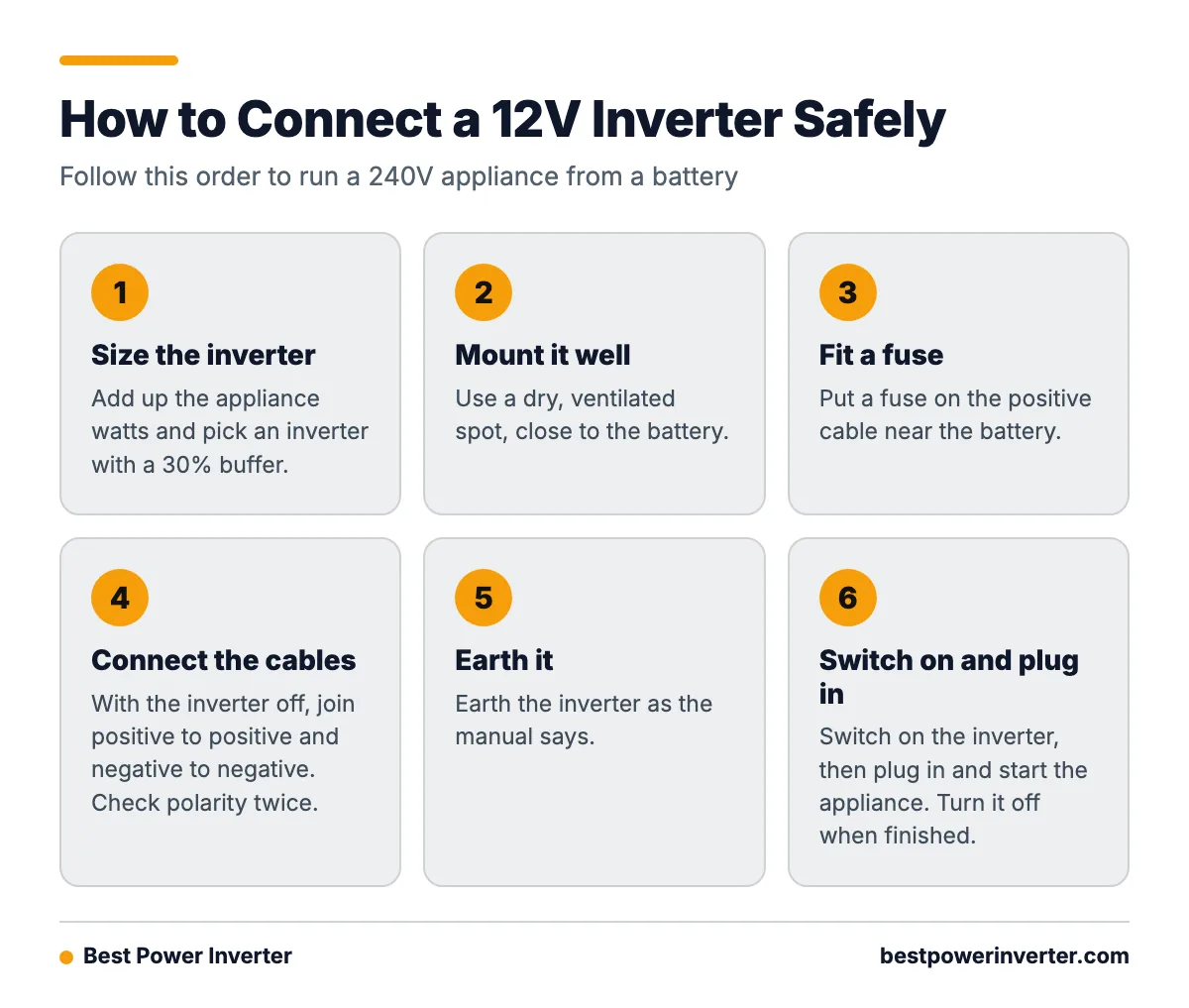
- Add up the appliance watts and pick an inverter with a 30% buffer.
- Mount the inverter in a dry, ventilated spot, close to the battery.
- Fit a fuse on the positive cable near the battery.
- With the inverter off, connect positive to positive and negative to negative. Check polarity twice.
- Earth it as the manual says.
- Switch on the inverter, then plug in and start the appliance.
- Turn the inverter off when finished.
Is It Safe to Use an Inverter in a Car, Van, Boat, or Off-Grid System?
Yes, if the system is wired and sized correctly. Most problems come from thin cables, missing fuses, poor ventilation, and overloaded sockets.
A vehicle’s cigarette-lighter socket is usually protected by a small fuse, often in the range of 10 to 20A. That limits you to a low-wattage inverter, enough for a laptop or phone charger. Larger inverters must connect straight to the battery. Never run a high-power inverter through a lighter socket.
Safety checklist
- Keep the inverter dry. Do not use it where water can splash on it.
- Use a fuse or breaker on the battery cable.
- Keep cables short, thick, and tightly connected.
- Never cover the vents.
- Do not leave the inverter running with the engine off if it can drain the starter battery.
- Treat the AC output as mains. It can shock you.
- Use a certified electrician for fixed boat or home installations.
What do owners say?
Owners like
- Pure sine wave models run laptops, CPAP machines, chargers, and audio gear quietly and without interference.
- Reliable low-voltage protection shuts the inverter down before the battery is over-discharged.
- Good units sustain their advertised continuous wattage under normal loads.
Common complaints
- Cooling fans can be loud, especially under heavy or sustained loads.
- Included battery cables are sometimes too thin for the inverter’s maximum current.
- Some units dip or shut down when a fridge or other motor starts.
- Budget models may run hot, with uncertain durability under continuous high power.
- Non-pure-sine models can cause flicker, buzzing, or poor compatibility with sensitive equipment.
Summarised from owner reviews and long-term user reports; individual experiences vary.
Frequently Asked Questions
What is a power inverter voltage converter?
The term usually means an inverter: a device that converts 12V DC battery power into 230/240V AC. A true AC voltage converter or transformer only changes one AC voltage to another and cannot run from a battery.
How much power does a 12V to 240V inverter use?
It uses the appliance’s watts plus conversion losses and idle draw. At 90% efficiency, a 500W load needs about 46A from a 12V battery and a 1,000W load needs about 93A, before power-factor effects.
How does an inverter increase voltage?
It switches DC rapidly using electronics, then steps the voltage up through a transformer or transformer-like stage and shapes the result into AC. Higher output voltage means lower AC current but higher battery current.
What can an inverter power?
Chargers, laptops, lights, TVs, small fridges, pumps, and power tools can all run, if the inverter’s continuous and surge ratings cover them. High-heat appliances such as kettles and heaters usually draw too much for a 12V system.
How to use a voltage converter?
For a battery, use an inverter. Size it with a 30% buffer, mount it in a ventilated spot, add a fuse near the battery, connect with short thick cables, ground as instructed, then switch on before plugging in your appliance.
Is it safe to use a voltage converter?
It is safe when the unit is the right type, correctly rated, fused, ventilated, and kept dry. Unsafe setups usually involve thin cables, no fuse, overloaded sockets, or using a transformer where an inverter is needed.