
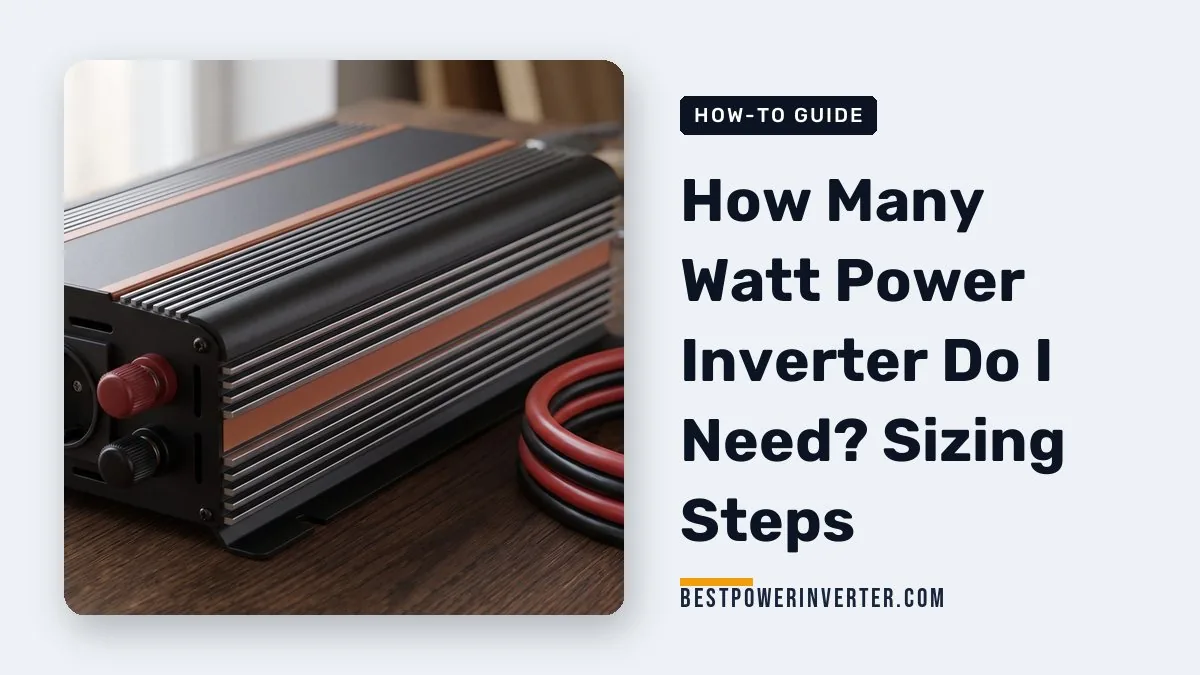
Most people size an inverter by looking at one appliance label and buying the number they see. That is how you end up with a unit that shuts off the moment a fridge compressor kicks in. Add up the running watts of everything you will use at the same time, add the biggest single startup surge, then add a 20-25% safety margin.
Quick answer
Total your simultaneous running watts, add the largest startup surge, and add 25%. Pick an inverter whose continuous rating covers that number and whose surge rating covers the peak.
- Best for car charging: 150-300W
- Best for camping: 300-1,000W
- Best for RV or home backup: 2,000-3,000W
- Size for what runs at the same time, not for everything you own.
- Motor loads like fridges and pumps can need 2-3x their running watts at startup, sometimes up to 6-7x.
- Add 20-25% headroom and round up to a standard size.
- Inverters lose about 5-15% to heat, so the battery supplies more power than the appliance uses.
- At 2,000W and above, 24V or 48V systems are generally recommended.
- Running watts vs surge watts
- How do I calculate the total wattage I need?
- How do I find the wattage if the label shows only amps or volts?
- What size inverter do I need for common appliances?
- Worked example
- What size inverter do I need for a car, RV, or home backup?
- Does pure sine versus modified sine change the size?
- What battery, cable, and fuse do I need?
- Too small or too big: common mistakes
- What do owners say?
- Frequently Asked Questions
What is the difference between continuous (rated) watts and surge (peak) watts?
Continuous watts are what the inverter can deliver all day. Surge watts are a short burst, usually a second or two, that it can deliver to start a motor.
A fridge might run at 150W but need 450W or more for a moment when the compressor starts. Motor-driven appliances such as refrigerators, pumps, and air compressors can need roughly 2-3x their running watts at startup, and sometimes up to 6-7x. Resistive loads like kettles and heaters have almost no surge. They just draw their full rating.
How do I calculate the total wattage I need step by step?
Follow five steps. Each one is simple.
- List every device you will run at the same time.
- Write down the running watts of each one.
- Add the running watts together.
- Find the largest single startup surge and add the extra it needs above its running watts.
- Add 20-25% as a safety margin, then round up to a standard inverter size.
Why the margin? An inverter that runs near its limit gets hot, and its fan runs hard. Owners report that extra headroom keeps the unit cooler and the fan quiet.
How do I find the wattage of an appliance if the label shows only amps or volts?
Multiply volts by amps. Watts = volts x amps. A 120V appliance drawing 10A uses about 1,200W.
If the label shows only amps, use 120V for standard US appliances. If it shows only watts, you are done. Look for the data plate on the back or bottom. For motor loads, the label often shows running amps only, so plan for the startup surge on top.
What size inverter do I need for a fridge, microwave, coffee maker, or power tools?
Use the table below. Figures are typical estimates. Check your own label, because models vary.
| Appliance | Typical running watts | Estimated surge watts | Minimum inverter size |
|---|---|---|---|
| Phone or laptop charger | 20-90W | None | 150W |
| LED lights (set of several) | 10-60W | None | 150W |
| TV (flat screen) | 60-150W | Low | 300W |
| Full-size refrigerator | 150-200W | 450-1,200W | 1,500W |
| Coffee maker | 800-1,200W | None | 1,500W |
| Microwave (1,000W cooking) | 1,200-1,500W input | Low | 2,000W |
| Circular saw | 1,200-1,500W | 2,400-4,500W | 3,000W |
| Well or sump pump (1/2 hp) | 600-1,000W | 1,800-3,000W | 3,000W |
| Air compressor (small) | 800-1,500W | Up to 6-7x running | 3,000W or more |
A microwave is labeled by cooking power, but it draws more from the wall. Check the input rating on the back.
Worked example: how many watts for a weekend cabin outage?
Say you want to run a fridge, a coffee maker, a TV, and a few lights at once.
| Load | Running watts |
|---|---|
| Refrigerator | 180W |
| Coffee maker | 1,000W |
| TV | 100W |
| Lights | 40W |
| Total running | 1,320W |
The fridge is the only big surge. If it needs about 540W to start (3x), the extra above its running watts is 360W. Add that: 1,320 + 360 = 1,680W. Add 25%: 1,680 x 1.25 = 2,100W. Round up to a standard size: a 2,500W or 3,000W inverter.
You could also skip the coffee maker while the fridge starts. That drops the need to about 1,000W after margin, and a 1,500W unit might do. Managing what runs together is cheaper than buying bigger.
From the Shop
The most common sizing error in this field is adding up only the running watts and forgetting the fridge. The inverter works fine until the compressor cycles on, then the overload alarm sounds. Always add the startup extra for the largest motor.

What size inverter do I need for an RV, car, or home backup?
Match the size to the job. Use this chart as a starting point.
| Use case | Typical loads | Inverter size range | System voltage |
|---|---|---|---|
| Car charging | Phone, laptop, camera | 150-300W | 12V |
| Camping | Lights, laptop, small fan, cooler | 300-1,000W | 12V |
| Van or boat | Fridge, induction cooktop, small appliances | 1,000-2,000W | 12V or 24V |
| RV | Microwave, coffee maker, TV, fridge | 2,000-3,000W | 24V or 48V preferred |
| Home backup (essentials) | Fridge, lights, router, sump pump | 3,000W and up | 24V or 48V |
A car cigarette-lighter socket is usually fused at about 10-15A, which limits usable power to roughly 120-180W. For anything bigger, connect the inverter directly to the battery with proper cables.
For home use, a standard US outlet is 120V, 15A. That gives a practical limit of about 1,800W, or 1,440W continuous under the 80% rule. A single inverter output can only feed what the circuit can carry.
Does a pure sine wave versus modified sine wave inverter change the size I need?
Not directly. The wattage math is the same. But the type affects what you can run and how well.
Pure sine wave units run sensitive electronics, motors, and appliances quietly, without buzzing or extra heat. Modified sine wave units are cheaper and handle simple loads like basic lights and chargers. Motors on a modified sine wave often run hotter and may draw more. If you run a fridge, pump, or medical gear, choose pure sine.
What battery size and cable/fuse do I need for the inverter I choose?
Work out the DC current first. Divide inverter watts by battery voltage, then by efficiency. DC amps = watts / volts / efficiency.
Inverter efficiency is typically around 85-95%, so the battery has to supply more than the appliance uses. A 1,000W load at 90% efficiency on 12V draws roughly 92A.
| Load | System | Approx. DC amps (90% efficiency) |
|---|---|---|
| 300W | 12V | 28A |
| 1,000W | 12V | 92A |
| 2,000W | 12V | 185A |
| 2,000W | 24V | 93A |
| 3,000W | 48V | 69A |
That is why higher-wattage inverters, about 2,000W and above, are generally recommended on 24V or 48V systems. Lower current means thinner, cheaper cable and less heat. Check the inverter manual for the exact cable gauge and fuse size, and size the fuse to protect the cable.
Runtime comes next. Multiply battery volts by amp-hours to get watt-hours. A 12V 100Ah battery holds about 1,200Wh. Divide by the load plus losses. Running 300W at 90% efficiency pulls about 333W from the battery, so you get roughly 3.6 hours at full discharge. Lithium batteries can use most of that. Lead-acid batteries should not be drained much below half, which cuts the real figure in half.
Do not forget idle draw. Many inverters use several watts just by being switched on, and that drains a battery overnight. Turn it off when you are not using it.
For extra calculators, see this battery size calculator for inverters.

What happens if my inverter is too small, and is a bigger one wasteful?
If it is too small, it trips on overload and shuts off, often when a motor starts. Repeated overloads stress the unit. A bigger inverter is not wasteful by itself. Owners say extra headroom keeps it cooler. But a much larger unit has a higher idle draw and costs more, so do not oversize by a lot.
If you only charge phones and laptops, then 150-300W is plenty.
If you run a fridge or pump, then size for the surge and choose pure sine.
If your total is over 2,000W, then plan on a 24V or 48V system.
If you are close to a size, then go up one step.
Common mistakes to avoid:
- Forgetting the startup surge on motor loads.
- Ignoring efficiency losses when sizing the battery.
- Using thin cables, which cause low-voltage alarms.
- Plugging a large inverter into a cigarette-lighter socket.
- Leaving the inverter on with nothing connected.
For more on sizing formulas, see this inverter sizing and selection reference.
What do owners say?
Owners like
- Pure sine wave inverters run sensitive electronics and appliances quietly without buzzing or heat issues.
- Headroom above the load keeps the inverter cooler, so the fan rarely kicks in.
- Built-in protections for overload, low voltage, and over-temperature give confidence.
- Remote on/off switches and displays make monitoring easy.
Common complaints
- Undersized units shut off when a fridge, microwave, or tool starts.
- Fans can be loud under load.
- Thin cables or small batteries cause low-voltage alarms or shutdowns.
- Stated wattage, especially surge, seems optimistic on cheap units.
- Idle power draw drains the battery when left switched on.
Summarised from owner reviews and long-term user reports; individual experiences vary.
Frequently Asked Questions
How many watt power inverter do I need?
Add the running watts of every device you will use at the same time. Add the largest startup surge, then add 20-25%. Round up to the next standard size. For a phone and laptop, 150-300W is enough. For a fridge and a few small appliances, expect 2,000W or more.
What size power inverter do I need?
It depends on the loads. Car charging needs about 150-300W, camping 300-1,000W, and an RV or home backup 2,000-3,000W or more. Match the size to your own total, not to a general category, and check surge needs for motors.
How many watt inverter do I need?
Use the worked method above. If your simultaneous running total is 1,320W and your biggest surge adds 360W, your base is 1,680W. With a 25% margin, that is about 2,100W, so a 2,500W or 3,000W unit fits. For other tools, try this inverter size calculator.
Sources