
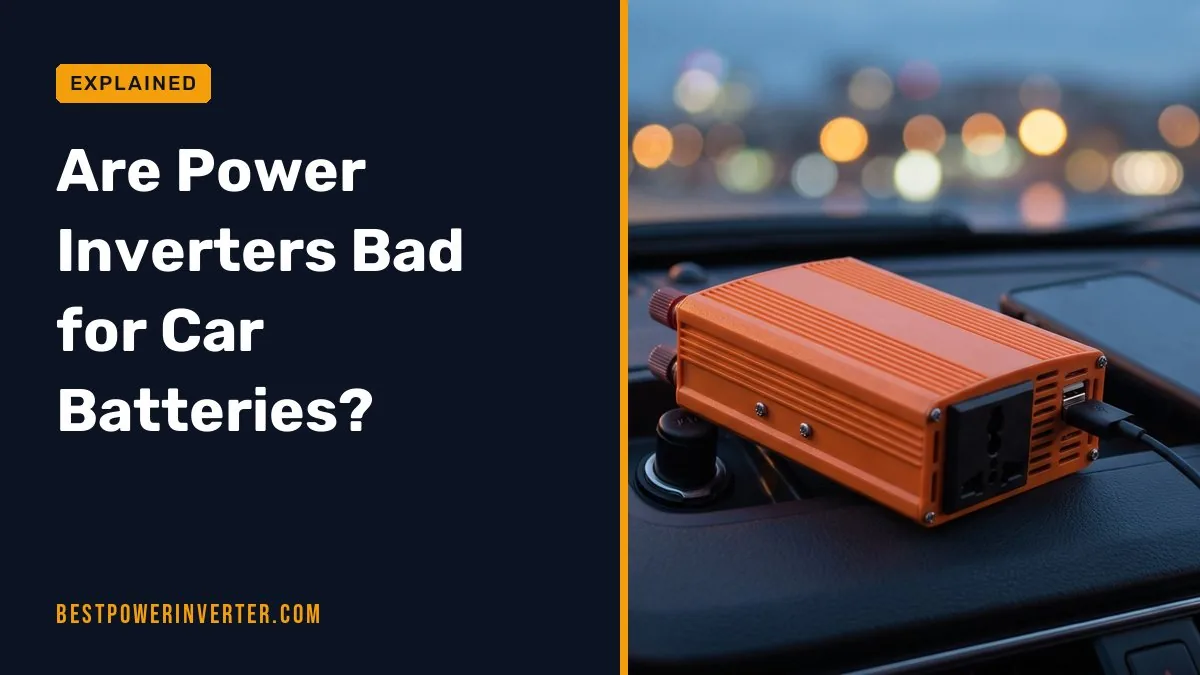
Power inverters are not bad for car batteries when you use them briefly, within their rating, and ideally with the engine running. The harm comes from long engine-off use, overloads, and repeated deep drains, which can wear out a starter battery early.
Quick answer
An inverter does not damage a battery by itself. It drains the battery, and repeated deep drains shorten a starter battery’s life. Keep loads small, run the engine for anything long, and use low-voltage protection.
- Best for phones and laptops: a small inverter in the 12-volt socket
- Best for long or heavy loads: a separate deep-cycle or lithium battery
- A drained battery is not always a damaged battery. Repeated deep discharge is what causes lasting wear.
- A starter battery is built for short, strong bursts, not long, slow drains.
- Runtime is shorter than the label math suggests once you count losses, idle draw, age, and cold.
- Socket inverters suit small loads. Anything bigger needs fused cables at the battery.
- Never run an engine in a closed garage. Carbon monoxide is the biggest safety risk.
- Are power inverters bad for car batteries?
- Do inverters damage car batteries or just drain them?
- Can a car battery power an inverter?
- How long will a car battery power an inverter?
- Should the engine be running?
- Can I run an inverter from a 12-volt car socket?
- What size inverter can a car battery handle?
- How can I stop an inverter from killing my battery?
- Is a deep-cycle battery better for inverter use?
- Which setup fits your use?
- Safety risks to know
- What do owners say?
- Frequently Asked Questions
Are power inverters bad for car batteries?
Not on their own. An inverter changes 12-volt DC power into 120-volt AC power. It only takes energy from the battery that your device needs, plus a little extra to run itself.
The trouble starts with how long and how hard you pull. A car battery has one main job: start the engine. That takes a big burst of current for a few seconds. Then the alternator refills the battery. An inverter asks for the opposite, a long steady pull with no refill.
Do inverters damage car batteries or just drain them?
Most of the time they only drain them. A battery that is drained once and then recharged is usually fine. Damage comes from repeating deep drains, or from leaving the battery flat for days.
Here is the difference:
- Temporary drain: You charge a laptop for an hour with the engine off. The battery dips a little. A drive recharges it.
- Accelerated wear: You run a heater or a TV for hours, repeatedly. A lead-acid starter battery loses capacity each time it is pulled low, and a battery left discharged can sulfate.
Starter batteries use many thin plates to deliver high starting current. Thin plates do not handle deep cycling well. That is why a battery that seemed fine can suddenly fail to start the car after a few bad nights.
Can a car battery power an inverter?
Yes. Any healthy 12-volt car battery can power an inverter, and that is how most vehicle inverters work. The real questions are how much power you pull and for how long.
An inverter draws more from the battery than the device label shows. Conversion losses and the inverter’s own idle use are added on top. For a 60-watt load and a 90% efficient inverter, the battery-side demand is about 66.7 watts before idle draw is counted. That gap grows as the load grows.

How long will a car battery power an inverter?
Plan on minutes to a few hours, depending on the load. The runtime formula is simple:
Runtime (hours) ≈ (battery volts × amp-hours × usable discharge × inverter efficiency) ÷ load watts
A nominal 12-volt, 100 Ah battery holds about 1,200 watt-hours (Wh) before any limits. In theory, that runs a 100-watt load for about 12 hours. Real life is shorter, and for a starter battery it is much shorter.
Worked example: a typical 60 Ah starter battery
- Energy: 12 V × 60 Ah = 720 Wh.
- Usable share: I use 50% as a ceiling for illustration. That leaves 360 Wh. Going lower risks hard starts.
- Efficiency: 360 × 0.90 = 324 Wh reaching your device.
- Runtime for a 100-watt load: 324 ÷ 100 ≈ 3.2 hours, before idle draw.
Compare that with a published LiFePO4 example. A 100 Ah, 12-volt lithium battery is treated as 1,280 Wh nominal and about 922 Wh after an 80% usable factor and 90% system efficiency, according to Epoch Batteries. Lithium can be used deeper. A starter battery cannot, so do not copy deep-cycle numbers to your car.
Why a starter battery gives less
- It should not be drained deeply, so the usable share is small.
- High current lowers the capacity you can pull out. Lead-acid does worse under heavy loads.
- Age, cold weather, and weak cells all cut capacity.
- You must keep enough charge to start the engine.
Estimated draw and runtime by load
These figures use the same 60 Ah battery, 50% usable, and 90% efficiency. They are rough ceilings. Real runtime is often shorter.
| Load | Battery draw (approx.) | Runtime ceiling | Recommended use |
|---|---|---|---|
| 100 W | about 9 A | about 3 hours | Laptop, camera charger; engine off for short spans |
| 300 W | about 28 A | about 1 hour | Small appliance; run the engine |
| 500 W | about 46 A | about 40 minutes | Power tool or blender; engine running, cables at battery |
| 1,000 W | about 93 A | about 20 minutes | Heavy tools; separate battery bank and fused cables |
The 1,000-watt row shows why big loads surprise people. About 93 amps leaves a starter battery fast, and the voltage sags under that pull. You can try your own numbers with the Samlex inverter run-time calculator.
Should the engine be running when using a power inverter?
For anything beyond a short, small load, yes. With the engine running, the alternator supplies current, so the battery is not carrying the whole load. This is the safest way to avoid a flat battery.
There are limits, though:
- At idle, an alternator makes less current than when driving. A big load can still pull the battery down.
- Your car’s own electrical needs come first. Lights, fans, and heated seats share the same supply.
- Check the alternator’s amp rating in your manual. Keep inverter draw well under what is left over.
Driving is better than idling. The engine spins faster and charges more. Idling in a parked car for hours wastes fuel, so for long jobs a separate battery makes more sense. And never idle in an enclosed space. See the safety section below.
Can I run an inverter from a 12-volt car socket?
Yes, but only for small loads. Accessory sockets are fused, commonly at around 10 to 20 amps, and the wiring behind them is thin. At 12 volts, a 15-amp circuit tops out near 180 watts, and it is wise to stay well under that. Look up the exact fuse rating in your owner’s manual.
Pushing a socket to its limit can melt plugs, heat the wires, or blow the fuse. Owners report all three.
If your load is under about 100 to 150 W: a socket inverter is fine.
If your load is 300 W or more: skip the socket. Use clamps or ring terminals straight to the battery, with a fuse.
If you need more than 1,000 W for long periods: use a separate battery bank and a charging system built for it.
What size inverter can a car battery handle?
The battery can supply more than the socket can. A healthy starter battery can feed a 300 to 1,000 watt inverter for a short time. But that only works with the right cables and a fuse.
Keep these points in mind:
- Continuous vs. surge rating: Motors and compressors pull extra power for a moment at startup. The inverter must handle that surge. Buyers often mistake the peak number for the running number.
- Cable size: Follow the inverter’s manual for gauge and length. Thin or long cables drop voltage and trigger early shutdowns.
- Fuse: Place it on the positive cable close to the battery. It protects the wire, not just the inverter.
- Ventilation: Inverters make heat. Keep the fan clear and do not cover the unit with bags or blankets.
- Right size: Pick an inverter a bit above your biggest load. An oversized unit wastes idle power. An undersized one trips.

How can I stop an inverter from killing my car battery?
Will an inverter kill my car battery? It can, if you let it run until the engine will not crank. These habits prevent it:
- Use low-voltage shutdown. Many inverters warn near 10.5 V and cut off near 10 V, but check your model. Some cut off too late to protect a starter battery.
- Watch the voltage. A rested, fully charged lead-acid battery reads about 12.6 V or more. Around 12.0 V it is roughly half charged. Stop there.
- Run the engine for long or heavy loads.
- Unplug the inverter when you leave the car, even if nothing is plugged in.
- Recharge soon. Drive for a good stretch or use a battery charger after a deep drain.
- Test the battery every year. An old battery has less to give.
Is a deep-cycle battery better than a car battery for inverter use?
Yes, for long or repeated loads. Deep-cycle batteries are made for slow, deep discharges. Starter batteries are not.
| Battery type | Handles deep discharge? | Best for |
|---|---|---|
| Starter (flooded lead-acid) | Poor | Starting the engine, short small loads |
| Deep-cycle AGM | Good | Camping, vans, steady medium loads |
| LiFePO4 (lithium) | Very good, deeper usable range | Frequent use, heavy loads, weight savings |
The best setup is a second battery that is separate from the starter battery. Then a drained inverter battery cannot leave you stranded. Use a proper isolator or DC-to-DC charger so the alternator can charge it without pulling the starter battery down. The Kazuki Battery runtime guide shows how lead-acid runtime is figured.
Which setup fits your use?
| Use case | Typical load | What to use |
|---|---|---|
| Phone or laptop charging | 10 to 100 W | Car battery is fine. Short engine-off use is OK; run the engine for longer. |
| Small appliance | 150 to 500 W | Run the engine and wire to the battery. Keep sessions short. |
| High-wattage tools or heaters | 800 W and up | Separate battery bank with a large inverter, or a generator. |
Decision checklist
- Is the engine running, or is the run short?
- Is the battery healthy, and is it a starter or deep-cycle type?
- Is the inverter’s continuous rating above your load, and its surge rating above startup?
- Is the socket rated for the load? If not, wire to the battery.
- Does the inverter have low-voltage cutoff?
- Is there a fuse near the battery, and are the cables the right gauge?
- Is the unit ventilated, and is the car outdoors or in open air?
Safety risks to know
- Carbon monoxide: Never run the engine in a garage, even with the door partly open, or in any closed space. CO is invisible and deadly. Park outside with clear airflow.
- Heat: Blocked fans and hot cables are fire risks. Feel plugs and cords during use. If they are hot, unplug.
- Sparks: Batteries can give off hydrogen gas. Connect the inverter with it switched off, and keep flames away.
- Reversed polarity: Red goes to positive, black to negative. Backward hookup can ruin the inverter fast.
- Loose connections: They create heat and voltage drop. Tighten them well.
What do owners say?
Owners like
- It is a handy way to charge laptops, phones, cameras, and other small electronics while traveling.
- It works as backup power on road trips, camping, and short outages.
- Pure-sine-wave models are valued for quieter operation and better compatibility with sensitive electronics.
- Automatic low-voltage shutdown is appreciated because it lowers the chance of flattening the vehicle battery.
Common complaints
- Inverters can shut down sooner than expected on thin accessory-socket wiring.
- The cooling fan is often noisy, especially under heavier loads.
- Advertised maximum wattage is misunderstood, and appliances that exceed continuous or surge limits cause shutdowns.
- High-power appliances drain the vehicle battery much faster than expected.
- Some users report melted plugs, hot cables, or blown accessory fuses near the socket’s limit.
Summarised from owner reviews and long-term user reports; individual experiences vary.
Frequently Asked Questions
Are power inverters bad for car batteries?
No, not when used wisely. The inverter is just a converter. The risk is deep or repeated discharge of a starter battery, which shortens its life. Short, small loads or engine-running use are low risk.
Do inverters damage car batteries?
They usually drain them rather than damage them. Damage builds up when a battery is drained deep again and again or left flat. One drain followed by a full recharge is rarely a problem for a healthy battery.
How long will a car battery power an inverter?
It depends on the load and the battery. As a rough ceiling, a 60 Ah starter battery can run a 100-watt load for about three hours, and a 1,000-watt load for about 20 minutes. Idle draw, cold, and age make real times shorter.
Can a car battery power an inverter?
Yes. A 12-volt car battery can run an inverter. Match the inverter to the wiring: small units can use the 12-volt socket, while larger units need fused cables to the battery.
Will an inverter kill my car battery?
It can leave you with a car that will not start if you run it engine-off for too long. A one-time flat battery can often be recharged. Repeated deep drains cause lasting wear, so use low-voltage cutoff and run the engine for long loads.
Sources