
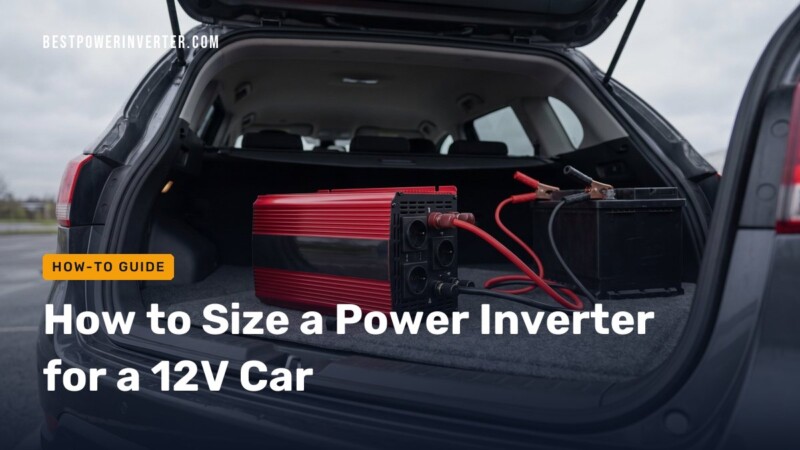
This guide is for drivers who want AC power in the car for phones, a laptop, or a small appliance and do not want to blow a fuse or drain the battery. Add up the running watts of everything you will use at the same time, then add 20% to 30% for startup surge. Phones and small electronics fit a 100W to 150W inverter, laptops and drones usually need 150W to 300W, and anything bigger needs 500W or more wired straight to the battery.
- Formula: total running watts x 1.2 to 1.3 = minimum inverter size.
- Plug-in (cigarette-lighter) inverters suit small loads. Many sources suggest staying well under the 450W maximum.
- Over about 300W to 400W, wire the inverter directly to the battery with a fuse.
- For continuous loads, many experts suggest staying around 600W or less on a standard car battery.
- Run the engine for anything heavy. The battery alone drains fast.
What a 12V Car Inverter Does
Your car runs on 12V DC power. Your laptop charger, fan, or drill expects 120V AC. An inverter converts one to the other. The catch is that the conversion is not free. Some power is lost as heat, so the inverter pulls a bit more from the car than the devices use.
How to Calculate Inverter Size
Use this simple method:
- List every device you will run at the same time. Not one device. All of them.
- Find the watts on each device label or power brick. If you only see amps, multiply amps by 120 to get watts.
- Add the watts together. This is your running load.
- Multiply by 1.2 to 1.3. This adds the 20% to 30% margin for startup surge and unexpected draw.
- Round up to the next common inverter size.
Formula: total running watts + 20% to 30% = minimum inverter size.
Continuous vs. Surge Watts
Continuous watts is what the inverter can deliver all day. Surge (or peak) watts is a short burst, often for a second or less. Motors and compressors, like those in fridges and power tools, pull extra when they start. Size by continuous rating first. Then check that the surge rating covers the startup kick of your biggest motor. A 300W inverter with a 600W surge rating is still a 300W inverter for steady use.
Common Devices and Inverter Sizes
These are typical ranges. Always check the label on your own gear.
| Device | Typical running watts | Suggested inverter | Connection |
|---|---|---|---|
| Phone charger | 5W to 20W | 100W to 150W | Cigarette lighter |
| Laptop | 45W to 100W | 150W to 300W | Cigarette lighter |
| Drone battery charger | 50W to 100W | 150W to 300W | Cigarette lighter |
| CPAP machine | Varies, check label | 150W to 300W (more if heated humidifier) | Lighter or battery |
| Mini-fridge | 50W to 100W, with higher startup | 300W to 500W | Battery preferred |
| Corded power tool | 300W to 800W | 500W to 1000W+ | Direct to battery |
For a CPAP, the machine label and the humidifier setting matter. A heated humidifier can add a lot of load, so read the power spec for your model.

Worked Examples
Example 1: Phone, laptop, and small fan
- Phone charger: 20W
- Laptop: 65W
- Small fan: 25W
- Total: 110W
- With 30% margin: 110 x 1.3 = 143W
A 150W inverter works, and a 200W to 300W model gives more room. This setup is fine on a plug-in unit, if the outlet fuse can handle it (see below).
Example 2: Mini-fridge or a power tool
Say a mini-fridge is rated 80W running. Compressors can pull several times that for a moment at startup. Add margin, and a 300W to 500W inverter with a good surge rating makes sense. Now take a corded drill rated 500W. 500 x 1.3 = 650W, so a 1000W inverter is the safe pick. At 650W you are past the practical limit of the lighter socket. Wire it to the battery.
Cigarette Lighter vs. Direct to Battery
Cigarette-lighter outlets are typically limited to about 450W or less, and many sources recommend lower practical loads. The reason is simple math. Amps = watts / 12. A 300W load pulls about 25A, and a bit more after conversion losses. Many car accessory circuits are fused at 10A to 20A, and a 15A fuse only supports about 180W. The thin wiring behind the socket was not built for more.
Direct battery wiring uses thick cable and its own fuse near the battery, so the high current never touches the small socket wiring.
- Under about 150W total: Plug into the cigarette lighter.
- 150W to 300W: Lighter may work. Check the fuse rating in your owner’s manual first.
- Over 300W to 400W: Wire directly to the battery with a fuse.
- Over 600W continuous: Think twice. Many experts suggest keeping a standard car battery near 600W or less for system protection.
Can I use a 1000W or 2000W inverter in a 12V car?
You can install one, but only with direct battery wiring, heavy-gauge cable, and a correctly sized fuse. A 2000W inverter at full load would try to pull well over 160A from a 12V system. A standard car alternator and battery are not built for that. Buy the large size only if you truly need it, and run it lightly. A bigger inverter does not force more power through. It only allows it.
Alternator, Battery, and Engine Use
Standard passenger car alternators are commonly described as roughly 40 to 120 amps, or about 480 to 1,440 watts at 12V. That is the total supply. Headlights, the engine computer, the blower fan, and other systems use part of it first. What is left over is your real inverter budget.
- Engine on: The alternator supplies the load and keeps the battery charged.
- Engine off: The battery alone supplies everything. Small loads for a short time are fine. Heavy loads can leave you unable to start the car.
For anything above phone or laptop charging, keep the engine running.
What happens if the inverter is too big?
The inverter itself is not the problem. Oversizing alone does little harm, though larger units can waste a bit more power at idle. The trouble comes from the loads you attach. Overload the lighter socket and you blow a fuse or overheat the wiring. Overload the alternator and the battery drains while you drive. Read more on the risks in this explainer on whether power inverters are bad for your car.

Safety Features to Look For
- Overload protection: Shuts the unit off when the load is too high.
- Over-temperature protection: Prevents overheating.
- Low-voltage shutoff: Stops the inverter before it drains the battery too far.
- Short-circuit protection.
- Inline fuse: Required for direct battery installs, placed close to the battery.
- Safety certification: Look for a recognized listing mark on the unit.
- Pure sine wave: Better for sensitive gear like CPAP machines and some laptops. Modified sine wave is cheaper and fine for simple loads.
Mistakes to Avoid
- Sizing for one device when several will run together.
- Confusing surge watts with continuous watts.
- Running a big inverter off the lighter socket.
- Using heavy loads with the engine off.
- Skipping the fuse on a battery connection.
- Using thin or long cables, which cause voltage drop and heat.
Frequently Asked Questions
How big of power inverter for 12v car?
Add up the running watts of every device you will use together, then add 20% to 30%. For phones and small electronics, 100W to 150W is enough. For laptops, 150W to 300W. For fridges and tools, plan on 500W or more with direct battery wiring.
What size inverter can I safely plug into a 12V car cigarette lighter?
Lighter sockets are typically limited to about 450W or less, and many sources suggest lower practical loads. Because many circuits are fused at 10A to 15A, 100W to 180W is often the safe range. Check your owner’s manual for the fuse rating.
How much extra wattage should I add for startup surge?
Add 20% to 30% to your total running watts. For motors and compressors, also check that the inverter’s surge rating covers the startup draw of the biggest device.
Do I need to connect a larger inverter directly to the battery?
Yes, for loads above about 300W to 400W. Direct wiring with a fuse and thick cable keeps heavy current off the thin socket wiring.
How do the engine running, alternator, and battery affect inverter size?
The alternator, often about 480 to 1,440 watts total, must also power the car itself. Only the leftover is available to your inverter. With the engine off, the battery alone supplies the load and drains quickly.
