

A power inverter with a remote outlet lets you switch the inverter on and off from a separate control point, which helps when the unit is mounted under a seat, in a cabinet, or in a battery bay. It does not store power. It converts 12V DC from a battery into 120V AC, so the right size depends on the wattage of the devices you plan to run. Based on the specifications and buyer feedback, the LANDERPOW 1500W pure sine wave inverter is the best overall pick for most drivers, RV owners, and campers.
Note on terms: on these products, the remote is a control panel or controller, not a separate AC outlet. You still plug devices into the outlets on the inverter body.
Our Winner: LANDERPOW 1500 Watt Pure Sine Wave Inverter
It combines 1500W continuous and 3000W surge output, pure sine wave power, three AC outlets, and a 15 ft wired remote with an LED screen. The listing also states a 3-year coverage plan, longer than the 12-month warranty listed for the Cantonape model.
How We Compared These Models
We compared four criteria: continuous and surge watts, waveform type (pure or modified sine), remote-control method and cable length, and the safety protections listed. These matter most because they decide what you can run, how safely you can run it, and how easily you can reach the controls. This analysis draws on listing specifications and patterns in Amazon buyer feedback, not on firsthand use.
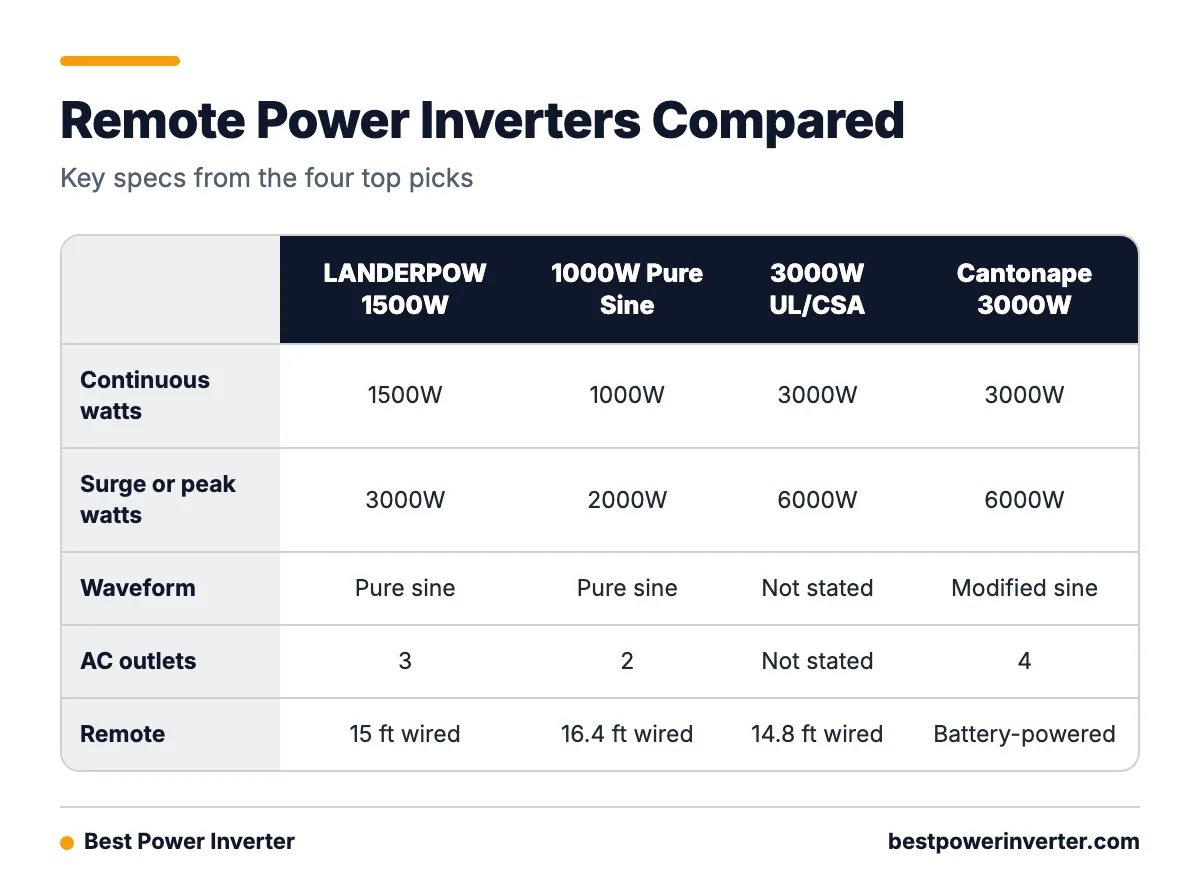
| Product | Key Specs | Our Choice | Action |
|---|---|---|---|
| LANDERPOW 1500W Pure Sine Wave | 1500W continuous, 3000W surge, 3 AC outlets, USB and 30W PD, 15 ft wired remote | Best Overall | |
| 1000W Pure Sine Wave Inverter | 1000W continuous, 2000W peak, 2 AC outlets, USB-A 18W, USB-C PD 30W, 16.4 ft wired remote | Best Budget | |
| 3000W Inverter, 6000W Peak (UL/CSA) | 3000W continuous, 6000W peak, 14.8 ft wired remote, LCD, dual cooling fans | Best High Capacity | |
| Cantonape 3000W Modified Sine Wave | 3000W continuous, 6000W surge, 4 AC outlets, 4 USB ports, battery-powered remote | Most Outlets |
How a Power Inverter Works
Does a power inverter store power?
No. An inverter does not store power. It converts DC from a battery into AC, and it stops delivering power when the battery is drained or the unit is switched off.
What is the difference between inverter power and battery storage?
Inverter wattage is how fast power can be delivered. Battery capacity is how much energy is available in total. A 1500W inverter on a small battery will run flat quickly under heavy load.
What does continuous watts vs surge watts mean?
Continuous watts is what the inverter can supply for as long as the battery and temperature allow. Surge (peak) watts is a brief burst for motor startup, such as a compressor or power tool.
Remote Outlet and Wired Remote Control Features
How does a remote outlet or wired remote control work?
Manufacturers state that a remote port lets you turn the inverter on and off from a distance. On the wired models here, a cable plugs into the inverter and runs to a small control panel. Listed cable lengths are 14.8 ft, 15 ft, and 16.4 ft. Victron manuals note that its inverter can be turned off completely by removing the remote connector, so check how any model behaves when the remote is unplugged.
Limits to know: the remote switches the inverter itself, not individual outlets. Long remote cables do not extend the battery cables. Keep the inverter close to the battery, with short, thick DC cables, and run only the thin remote cable to your control point.
Sizing, Pure Sine Wave, and What a 120W Inverter Can Run
Do I need pure sine wave or modified sine wave power?
Pure sine wave output is closer to household power and is the safer choice for CPAP machines, laptops, audio gear, and anything with a sensitive motor or electronics. Modified sine wave units are usually cheaper and work for simple loads like lights and basic chargers, but some devices hum, run hotter, or refuse to work. The Samlex 120 watt pure sine wave inverter page shows how compact units are described.
What can a 120 watt inverter power?
A 120W inverter commonly provides 120W continuous and may offer around 240W surge on some models. A worked example:
- Laptop charger (65W) plus phone charger (18W) = 83W. This fits.
- Add a 30W LED light = 113W. This is close to the limit.
- A 1,000W microwave, 1,500W kettle, or hair dryer will not run at all.
None of the four products reviewed here are 120W units. They suit larger loads, while a small 120W unit is better for charging a laptop or camera in a car.
How do I choose the strongest power inverter for my needs?
Add up the running watts of everything you will use at once, then add a margin of about 20 percent. For the strongest power inverter in this group, the two 3000W units lead on output, but they also need the biggest battery and cables. Rough battery current is watts divided by 12, plus losses: 1000W is about 83A or more, 1500W about 125A or more, and 3000W about 250A or more.
Safety and Installation
Is power inverter safe to use in a car, RV, or boat?
Yes, when installed correctly. Manufacturer manuals, including this battery power inverter manual, give the main rules in plain terms:
- Use the inverter in a ventilated area, away from water, rain, snow, and flammables.
- Do not connect the inverter’s AC output to another AC source, such as a household outlet or generator.
- Some models are not approved for ignition-protected areas, so avoid engine bays and fuel compartments unless the manual allows it.
- Match cable gauge and fuse size to the manual. Check polarity before connecting.
What should I check before installing an inverter remotely?
- Battery size and type (the listings cover AGM, GEL, lead-acid, and in one case LiFePO4).
- Surge watts needed by motor loads.
- Clear airflow around the cooling fan.
- Short DC cable runs, with the remote cable reaching your control point.
In-Depth Reviews

1. LANDERPOW 1500 Watt Pure Sine Wave Inverter – Best Overall
Our Verdict: The best balance of output, waveform quality, remote convenience, and coverage for most 12V users.
Based on the listing, this model delivers 1500W continuous and 3000W surge with efficiency above 91 percent. Pure sine wave output makes it suitable for CPAPs, laptops, and home theater gear. It includes three AC outlets, a 5V/3.1A USB port, and a 30W PD port.
The 15 ft wired remote has an LED screen showing battery level, output, and errors. Two 4AWG cables of 2 ft each are included, and the metal shell is described as heat-dissipating. The listing states 3-year coverage.
Why We Like It
- Pure sine wave output for sensitive electronics
- Remote with a live status screen
- Cables included and 3-year coverage listed
Pros & Cons
Pros
- Three AC outlets plus fast USB and PD charging
- 3000W surge handles many motor startups
- Priced at $139.99 on the listing
Cons
- 1500W still cannot run large heaters or kettles at full draw alongside other loads
- 2 ft battery cables mean it must sit close to the battery

2. 1000 Watt Pure Sine Wave Inverter – Best Budget
Our Verdict: A lower-wattage pure sine wave option with a long remote cable, suited to vans, cabins, and light RV use.
This unit offers 1000W continuous and 2000W peak. The listing highlights dual LCD screens and a 16.4 ft wired remote, the longest cable in this group. Outputs include two AC outlets, USB-A at up to 18W, and USB-C PD at up to 30W.
The kit includes battery cables, the remote, and replacement fuses. Listed protections cover over voltage, under voltage, overload, overheating, short circuit, and reverse polarity, with isolated input and output and an aluminum housing. It carries a 4.9/5 rating, though the listing data does not show how many reviews that rests on.
Why We Like It
- Pure sine wave at a lower capacity tier
- 16.4 ft remote for hard-to-reach mounting
- Spare fuses included
Pros & Cons
Pros
- Good fit for CPAPs, laptops, and TVs
- USB-C PD charging at up to 30W
- Smaller battery bank needed than 3000W units
Cons
- Only two AC outlets
- 1000W limit rules out most heating appliances

3. 3000W Power Inverter, 6000W Peak – Best High Capacity
Our Verdict: The pick for heavy loads, with a wired remote and UL/CSA certification listed.
This inverter lists 3000W continuous and 6000W peak with efficiency above 90 percent. The wired remote is 14.8 ft and works with the LCD display for voltage, battery level, and protection status. Dual smart cooling fans activate when internal temperature exceeds 113°F or the load reaches about 40 percent.
Two 5AWG battery cables of 2.6 ft are included. The listing says it works with LiFePO4, AGM, GEL, and lead-acid batteries. At full load, expect a current draw near 250A, so the battery bank and cabling must be sized accordingly.
Why We Like It
- UL and CSA certification listed
- Handles power tools and small appliances
- Works with several battery chemistries
Pros & Cons
Pros
- 6000W peak for demanding startups
- Remote and LCD for monitoring
- Suited to RV, truck, and solar systems
Cons
- Needs a large battery bank and heavy cabling
- Overkill if you only charge small devices

4. Cantonape 3000W Power Inverter – Most Outlets
Our Verdict: The most outlets and ports here, best for basic loads that do not need pure sine wave power.
The Cantonape provides 3000W continuous and 6000W surge of modified sine wave power, with four AC outlets and four USB ports. The LCD shows input and output voltage, battery capacity, load, and frequency, and displays error codes such as low voltage protection.
The included remote controller switches the inverter on and off, and the listing says it needs a 12V 23A battery that is not included. Six protections are listed, along with an aluminum body, a temperature-controlled fan, and a 12-month warranty.
Why We Like It
- Four AC outlets and four USB ports
- Clear LCD with fault codes
- Strong output for the listed price tier
Pros & Cons
Pros
- Most connection options in this group
- 6000W surge rating
- Six protection features
Cons
- Modified sine wave may not suit CPAPs or sensitive audio gear
- Remote battery is not included
Common Buying Mistakes
- Buying by peak watts instead of continuous watts.
- Choosing modified sine wave for medical or audio equipment.
- Ignoring battery capacity and cable gauge.
- Mounting the inverter in a closed, hot compartment.
- Assuming the remote adds outlets or extends the DC cable.
Frequently Asked Questions
What is a power inverter remote outlet?
The phrase power inverter remote outlet usually means an inverter with a remote port and control panel. It switches the inverter on and off from a distance. Devices still plug into the outlets on the inverter body.
Does an inverter store power?
No. An inverter only converts battery DC into AC. Runtime depends on your battery capacity and your load.
What can a 120 watt inverter power?
It can run a laptop charger, phone chargers, and small LED lights, as long as the total stays under 120W. It cannot run microwaves, kettles, or hair dryers.
Is a power inverter safe?
It is safe when used with proper ventilation, correct fuses and cables, and no contact with water or flammables. Never tie the AC output to another AC source. See the Victron inverter manual for an example of manufacturer guidance.
What is the strongest power inverter here?
The Cantonape and the 3000W unit with 6000W peak are the strongest on paper. The 3000W unit lists UL/CSA certification, while the Cantonape offers more outlets.
Conclusion
For most buyers, the LANDERPOW 1500W is the best power inverter with a remote outlet, thanks to pure sine wave output, a 15 ft remote, and listed 3-year coverage. Choose the 1000W pure sine wave unit for lighter loads and a lower battery demand. Choose the 3000W UL/CSA model for heavy loads, and the Cantonape if you need more outlets for basic devices. Whatever you buy, size the inverter and battery to your actual wattage, and install it with ventilation and short DC cables.
Affiliate Disclosure: As an Amazon Associate, we may earn commissions from qualifying purchases from Amazon.com. This comes at no extra cost to you and helps support our research.