
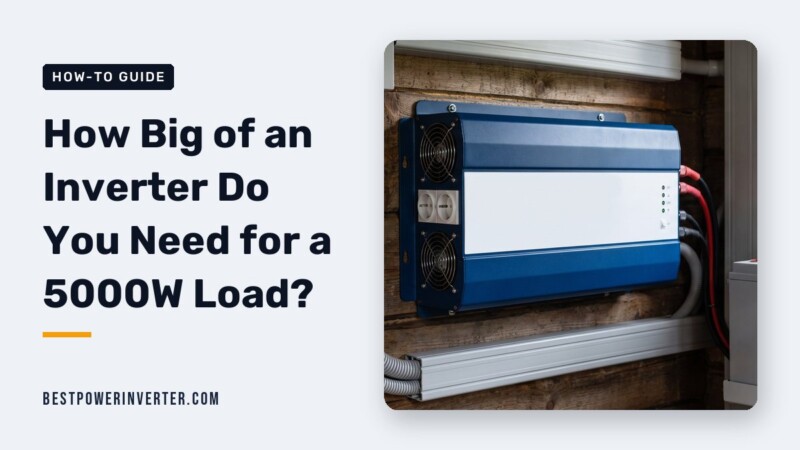
For a true 5000W continuous load, a 5000W inverter is the minimum, but a 6000W unit is the safer buy once you add headroom and motor startup surge. This guide is for DIY solar, RV, off-grid, and backup-power buyers running about 5,000 watts from a battery bank. Below is how to size it, what your batteries must deliver, and what to check before you pay.
- 5000W continuous load + 20% headroom = 6000W inverter. The 1.25 multiplier gives 6250W.
- Check the surge rating separately. Motors can pull 2-3 times their running watts at startup.
- A 5000W load pulls about 417A at 12V, 208A at 24V, and 104A at 48V, before losses.
- Choose 24V or, better, 48V for this size. 12V needs extreme cable and battery capability.
- Inverter size is set in watts. VA matters only when the maker lists VA instead.
What 5000W Actually Means
People mix up two numbers. Watts (W) measure how fast power is used. Watt-hours (Wh) measure how much energy a battery stores. A 5000W load is a speed. A battery’s capacity is a tank.
The inverter only cares about the speed. It must supply every watt your appliances pull at the same moment. The battery bank decides how long that lasts. A 48V 100Ah lithium bank holds about 4,800Wh, so a steady 5000W would drain it in under an hour once losses are counted.
How to Calculate Minimum Inverter Size
Add up the running watts of everything that may run at once. Then add headroom. A common rule is about 20% above the calculated load. Some guides suggest 20-30% to cover heat, aging, and extra loads added later. The Off Grid Benchmark inverter sizing guide covers the same approach.
- 5000W x 1.20 = 6000W
- 5000W x 1.25 = 6250W (the multiplier used for continuous loads)
- 5000W x 1.30 = 6500W
So a 5000W load points to a 6000W inverter as a practical minimum. If you buy 5000W, you run at 100% all the time. That means more heat, louder fans, and shutdowns on hot days.

Why Surge Rating Matters More Than the Nameplate
Continuous watts are what the inverter supports all day. Surge watts are a short burst for startup. Refrigerators, well pumps, and compressors may need about 2-3 times their running watts for a moment. Many inverters hold their surge rating for only a few seconds, and the time varies by model.
- Only resistive loads (heaters, kettles, ovens): size at 6000W.
- One large motor (pump, compressor): add its extra startup watts to your peak and check the surge spec.
- Several motors that may start together: move up to 8000W or stagger the startups.
Battery Voltage and Current Draw
Power equals volts times amps. Lower voltage means much higher current for the same watts. That current runs through your battery, fuse, and cable.
| Battery voltage | Amps at 5000W (ideal) | Amps at about 90% efficiency |
|---|---|---|
| 12V | ~417A | ~463A |
| 24V | ~208A | ~231A |
| 48V | ~104A | ~116A |
Inverters lose some power as heat, so the battery supplies more than 5000W. The 90% figure is an example. Check your model’s rated efficiency. At 12V, you need very thick cable, a large fuse, and batteries rated for that discharge. For a 5000W-class system, 48V is the usual choice. It keeps cable size and heat manageable. The inverter basics and selection guide from Solar Electric Supply explains voltage matching further.
Worked Example: Resistive and Motor Loads
Say you plan this backup load:
| Appliance | Running watts | Startup watts |
|---|---|---|
| Refrigerator | 200 | ~600 |
| Well pump | 1,100 | ~3,300 |
| Microwave | 1,200 | 1,200 |
| Space heater | 1,500 | 1,500 |
| Lights and electronics | 1,000 | 1,000 |
| Total | 5,000 |
Step 1, continuous: 5000W x 1.20 = 6000W.
Step 2, surge: If the pump starts while everything else runs, add its extra 2,200W. Peak is about 7,200W. Add the fridge starting too, and it is about 7,600W.
Step 3, check the spec: Pick a 6000W inverter whose surge rating covers at least 7,600W. Many list around twice their continuous rating, but confirm it and the duration.
5000W vs 6000W vs 8000W
| Inverter size | Best for | Watch out for |
|---|---|---|
| 5000W | Real loads under about 4,000W | No headroom for a true 5000W load |
| 6000W | 5000W continuous load with margin | Confirm surge rating for motors |
| 8000W | Multiple motors or planned growth | Higher idle draw, cost, and cable size |
Common Sizing Mistakes to Avoid
- Sizing to running watts only and ignoring startup surge.
- Treating battery amp-hours as if they set inverter size.
- Choosing 12V for a 5000W system without checking cable and battery limits.
- Forgetting efficiency losses on the battery side.
- Oversizing too far. A much larger inverter wastes money and has a higher idle draw.

Watts vs VA
Size by watts. VA is volts times amps, and watts equal VA times power factor. Resistive loads have a power factor near 1, so VA and watts match. Motors and electronics can be lower. A 5000W load at 0.8 power factor needs 6,250VA. If an inverter is rated only in VA, check its watt rating too.
Quick Buyer Checklist
- Total continuous watts of everything that runs together.
- Add 20-25% headroom.
- Largest motor startup surge, and the inverter’s surge rating and duration.
- Battery voltage: 24V or 48V preferred at this size.
- Battery bank maximum continuous discharge in amps.
- Inverter efficiency, and cable and fuse size for the current.
Frequently Asked Questions
How big of a power inverter do I need for a 5000W battery?
Think of it as a 5000W load. A 5000W inverter is the minimum, and a 6000W inverter is the safer pick with headroom. Then confirm the surge rating and that your battery bank can deliver the current.
Do I need a 5000W inverter for a 5000W load?
You need at least that, but it leaves no margin. Running at full rating all day adds heat and can trigger overload shutdowns. A 6000W unit is the practical choice.
How much headroom should I add when choosing an inverter?
Add about 20% as a common rule. Some guides use 20-30% for heat, aging, and future additions. For 5000W, that means 6000-6500W.
Is inverter size based on watts, VA, or both?
Size by watts. VA matters when a maker lists only VA or when loads have a low power factor. Convert using watts = VA x power factor.
What happens if my inverter is too small?
It may shut down on overload, trip on startup surge, run hot, or wear out early. Motor loads like pumps are the usual trigger.
