

The best 24V pure sine wave inverter is the one whose continuous watts cover your running load and whose surge rating covers your biggest motor start, with 20% to 30% headroom. Your battery bank, fuse and cables must also be able to carry the DC current it will draw. The Victron Phoenix 24V 2000VA Smart suits feature-rich installations, and 600W to 1000W units suit lighter loads, but the right size depends on your appliances and battery capacity. A pure sine wave inverter turns the battery’s DC power into clean AC, so household devices and sensitive electronics run properly from an RV, boat, van or off-grid cabin.
As an Amazon Associate, we earn from qualifying purchases. This doesn’t change the price you pay.
Quick answer
Add up running watts, add the largest startup surge, then add 20% to 30% headroom. Pick a continuous rating above that, and confirm your battery, fuse and cable can supply the DC current.
- Best for heavy loads: 4000 Watt JARXIOKE (Top Pick)
- Best for mid-size RV/truck: 3000W models
- Best for light loads: 1000W X XU YUAN
What is a 24-volt pure sine wave inverter, and who needs one?
It converts 24V DC from a battery bank into smooth AC, similar to a household outlet. Anyone with a 24V system in an RV, boat, truck, van, off-grid cabin or solar backup setup needs one to run laptops, TVs, chargers and medical equipment without noise or glitches. Larger battery systems commonly use 24V because the same power needs half the current of a 12V system.
Why choose pure sine wave output instead of modified sine wave?
Pure sine wave output is stable and smooth, so motors, battery chargers, medical devices and electronics run as designed. Modified sine wave output is a stepped approximation that can cause humming, extra heat or malfunction in some of these devices. For anything with a motor, a charger or a medical purpose, pure sine wave is the safer choice.
Which 24V pure sine wave inverter is best for RV, van, solar, marine or home backup?
Match the rating to the load: 1000W for lights, laptops and small appliances, 2000W to 3000W for a fridge plus kitchen items, and 4000W only for large loads with a battery bank and cabling to match. The seven picks below are compared first, with the listed specifications.
Listed specifications side by side
| Model | Continuous / surge | Output | Outlets and extras | Best use |
|---|---|---|---|---|
| JARXIOKE 4000W | 4000W / surge not stated | 110V/120V | 4 AC, dual USB, Type-C, LCD, remote | Large RV or off-grid loads |
| OLTEANP 3000W | 3000W / surge not stated | 110V/120V | 4 AC, USB, Type-C, LCD, remote | Trucks, outages |
| JARXIOKE 2000W | 2000W / surge not stated | 110-120V | 2 AC, USB, LCD, remote | Home, RV, solar |
| JARXIOKE 3000W | 3000W / surge not stated | 110V/120V | 3 AC, dual USB, LCD, remote | Home, RV, solar |
| InsensVert 3000W | 3000W / 6000W surge | 120V | Dual AC, 20A socket, USB 18W+30W, PD60W, remote | Motor-heavy RV or truck loads |
| X XU YUAN 1000W | 1000W / 2000W peak | 50Hz/60Hz switchable, 12V/24V auto-detect | LCD, Type-C, overload and overheat protection | Light loads, mixed regions |
| SUNWHEEL 3000W | 3000W / surge not stated | 110V/120V | 4 AC, LCD | RV, truck, off-grid |
Efficiency, idle draw and temperature derating are not stated in these listings, so check the manual before you buy. Six of the seven list 110V/120V output; only the X XU YUAN lists a switchable 50Hz/60Hz frequency.

1. 4000 Watt Pure Sine Wave Power Inverter 24V DC to 110V 120V Converter
- Brand: JARXIOKE
- Manufacturer: JR-1
- Color: Orange
- Dimensions: Height: 6.02 inches Width: 8.07 inches Length: 11.02 inches
This unit converts 24V DC to 110V/120V AC for family RV trips, off-grid solar systems and car use. It has four AC outlets, dual USB ports, Type-C ports, an LCD display for power status and a remote control.
Based on the specifications, 4000W at 24V and 90% efficiency means roughly 185A from the battery at full load (4000 / 24 / 0.9). That needs a large battery bank, a high-rated fuse and heavy short cables. It makes sense only if you really run loads of 2500W or more.

2. New Upgraded 24V 3000 Watts Pure Sine Wave Inverter, 24V DC to 110V/120V AC Power Inverter
- Brand: OLTEANP
- Manufacturer: OLTEANP
- Weight: about 11 pounds
This 24V 3000W inverter offers four AC outlets, a USB port and a Type-C port, with a remote control and LCD screen. The listing positions it for trucks, vehicles and power outages. It delivers clean output for sensitive electronics, and its weight is modest for the class, which helps in a vehicle install.

3. JARXIOKE 2000 Watt Pure Sine Wave Power Inverter
- Brand: JARXIOKE
- Manufacturer: JARXIOKE
The JARXIOKE 2000 Watt Pure Sine Wave Inverter converts 24V DC to 110-120V AC for homes, RVs and off-grid solar setups. It has two AC outlets, a USB port, an LCD showing real-time status and a remote control.
At 2000W and 90% efficiency the draw is about 92.6A from a 24V battery, so a 100A-class battery management system (BMS) is the minimum to check. This is a good fit for a fridge, a laptop and small kitchen items, though a motor with a large startup surge needs separate checking.

4. 3000 Watt Pure Sine Wave Power Inverter 24V DC to 110V 120V Converter for Home
- Brand: JARXIOKE
- Manufacturer: JARXIOKE
This 3000 Watt Pure Sine Wave Power Inverter converts 24V DC to 110V/120V AC for home, RV and off-grid solar systems. It has three AC outlets, dual USB ports, an LCD with real-time information and a remote control. At full load it draws about 139A from the battery at 90% efficiency.

5. 3000W Pure Sine Wave Inverter, Car Power Inverter 24V to 120V AC Converter for RV, Truck, Solar
- Brand: InsensVert
- Manufacturer: InsensVert
- Dimensions: Height: 14.84 Inches Width: 3.19 Inches Length: 6.42 Inches Weight: 9.37 pounds
This 3000W inverter converts 24V DC to 120V AC for RVs, trucks, solar setups and outdoor use. It has dual AC outlets, a 20A socket, USB ports including PD60W and a remote control. The listing states a 6000W surge, the highest surge ratio among the seven picks, which is the figure to check for fridge or pump starts. Its tall, narrow shape (14.84 inches high, 3.19 wide) suits upright wall mounting more than a shelf.

6. 1000W Pure Sine Wave Inverter (2000W Peak), 12V/24V Auto-Detect
- Brand: X XU YUAN
- Manufacturer: X XU YUAN
- Color: black
- Dimensions: Height: 2.95 inches Width: 4.13 inches Length: 10.83 inches
This 1000W inverter has a 2000W peak and auto-detects 12V or 24V input, with switchable 50Hz or 60Hz frequency. It has an LCD display, Type-C fast charging, a silent design per the listing, and built-in overload and overheat protection.
At 1000W and 90% efficiency it draws about 46A at 24V, so thinner cables and a smaller fuse are enough. The switchable frequency is the useful point for buyers outside 60Hz regions.
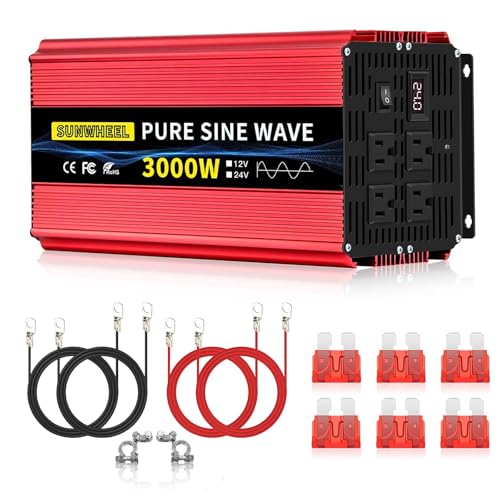
7. SUNWHEEL 3000W 24V Pure Sine Wave Inverter, 24V DC to 110V/120V AC Power Inverter
- Brand: SUNWHEEL
- Manufacturer: SUNWHEEL
- Dimensions: Height: 5.91 inches Width: 7.09 inches Length: 11.8 inches
The SUNWHEEL 3000W inverter converts 24V DC to 110V/120V AC for RVs, trucks, off-grid living and power outages. It has four AC outlets and an LCD showing real-time power information, in a compact body for tight spaces.
What size 24V inverter do I need for my appliances?
Size it to the running watts of everything that will run together, plus the largest startup surge, plus 20% to 30% headroom, a commonly used rule described in this inverter sizing guide. Work through these steps:
- List each appliance and its running watts from the nameplate.
- Add the running watts of everything that can be on at the same time.
- Add the extra startup watts of the single largest motor load (surge minus running watts).
- Multiply the total by 1.2 to 1.3 for headroom.
- Choose an inverter whose continuous rating meets that number, and whose surge rating covers the start.
- Check that the battery BMS, fuse and cable ratings cover the DC current in the next section.
Hypothetical example: a 150W fridge needing about 600W to start, plus 200W of lights and a laptop, gives 350W running + 450W extra startup = 800W, and 800W x 1.3 = about 1040W. A 1000W unit is marginal, so 2000W is the comfortable choice.
How much startup surge capacity is needed for refrigerators, pumps, compressors and power tools?
Motor loads draw several times their running watts for a moment at start, so the surge rating must exceed the start figure on the appliance label, not its running watts. Check the nameplate or manual for locked-rotor or starting watts. The Victron Phoenix 24V 2000VA Smart, for example, lists 4000VA peak, and the Green Cell 24V 2000W lists 4000W instantaneous peak, so a 2:1 surge ratio is typical for 2000W units. Surge duration varies by model, so confirm how many seconds the peak is held.
How do continuous power, surge power and temperature derating differ?
Continuous power is what the inverter can hold for hours, surge is a brief burst, and derating is the continuous power lost as the unit heats up. The manufacturer rates the Victron Phoenix 24V 2000VA Smart at 1600W continuous at 25°C, 1450W at 40°C and 1000W at 65°C, so an engine bay or sealed locker can cost you a third of the capacity. Details are on the Victron Phoenix 24V 2000VA Smart listing. Where a listing only quotes one wattage, treat it as the best case.
| Reference model | Continuous | Peak | Efficiency | No-load draw | Input / other |
|---|---|---|---|---|---|
| Victron Phoenix 24V 2000VA Smart | 1600W at 25°C | 4000VA | 94% maximum (stated) | 9W; 1.3W in ECO mode | Approx. 18.6V to 34V DC |
| Green Cell 24V 2000W | 2000W | 4000W | Not stated here | Not stated here | 24V input |
| RS PRO 24V 600W (230V) | 600W | Not stated here | Not stated here | Not stated here | Maximum input current 50A, per the RS PRO listing |
How many amps does a 24V inverter draw from the battery?
Battery current is appliance watts divided by battery voltage and inverter efficiency, so 2000W at 24V and 90% efficiency is about 92.6A. Using the same formula (90% efficiency assumed):
| AC load | Battery current at 24V |
|---|---|
| 600W | about 27.8A |
| 1000W | about 46.3A |
| 2000W | about 92.6A |
| 3000W | about 138.9A |
| 4000W | about 185.2A |
What battery capacity and cable size are needed for a 24V inverter?
The battery bank, BMS and cables must all handle the full DC current in the table, with the fuse rated above it and the cable rated above the fuse. Take the exact cable gauge and fuse value from the inverter manual, and keep cable runs as short as possible. A battery BMS limited to 100A cannot safely feed a 3000W inverter at full load, however good the inverter is.
For runtime, use usable energy rather than nominal. A 24V 200Ah battery holds 4800Wh nominal. The depth-of-discharge figures below are illustrative assumptions, so check your battery’s data sheet:
| Step | Lithium (assume 80% usable) | Lead-acid (assume 50% usable) |
|---|---|---|
| Nominal energy | 4800Wh | 4800Wh |
| Usable DC energy | 3840Wh | 2400Wh |
| After 90% inverter efficiency | about 3456Wh AC | about 2160Wh AC |
| Runtime at 1000W | about 3.5 hours | about 2.2 hours |
For comparison, a 2400W load for three hours needs 7200Wh of AC energy, or about 8000Wh from the DC system at 90% efficiency, before depth of discharge. That is far beyond this single 200Ah battery.
What efficiency, idle consumption and voltage range should buyers compare?
Compare peak efficiency, no-load draw, ECO or standby mode and the DC input window. The Victron lists 94% maximum efficiency, 9W no-load consumption and 1.3W default zero-load consumption in ECO mode. Nine watts around the clock is about 216Wh a day, which matters on a small battery. The Victron input range of about 18.6V to 34V DC also tolerates voltage sag and charging peaks. Also confirm the output voltage and frequency: the six 110V/120V picks suit 60Hz regions, while a 230V/50Hz installation needs a model like the RS PRO 600W or the switchable X XU YUAN.
Which safety features matter?
Look for low-voltage shutdown, overload, short-circuit, over-temperature and reverse-polarity protection, since these cover the common ways an inverter or battery gets damaged. Low-voltage shutdown protects the battery from deep discharge. Reverse-polarity protection guards against a wiring mistake, but still fit a fuse close to the battery. Of the seven picks, only the X XU YUAN listing names overload and overheat protection explicitly, so confirm the rest in the manual.
Can the inverter run continuously, and how should it be installed?
It can run continuously at or below its continuous rating, provided heat can escape. Use this checklist:
- Ventilation: leave clear space around the fan and vents, and avoid sealed lockers.
- Fuse and disconnect: fit a DC fuse near the battery positive and a disconnect switch.
- Cables: short, correctly sized and tight at the terminals.
- Grounding: follow the manual for chassis or hull bonding.
- Hardwiring or transfer switch: for home backup, use a transfer switch so the inverter never feeds the grid.
- Battery: fully charged and sized per the earlier sections before first use.
When is a 24V system better than 12V?
24V is better when loads are large, because the same wattage draws half the current of 12V, which allows thinner cabling and less voltage drop. A 2000W load needs about 93A at 24V and about 185A at 12V (90% efficiency). Under about 1000W, 12V is usually simpler.
Frequently Asked Questions
What Is A 24 Volt Pure Sine Wave Power Inverter?
It converts 24V DC power from batteries into clean AC power for sensitive devices.
Why Choose Pure Sine Wave Over Modified Sine Wave?
Pure sine wave inverters provide stable, smooth power, protecting electronics from damage and suiting motors, chargers and medical devices.
Can A 24v Inverter Run Household Appliances?
Yes, it can power many household devices like TVs, laptops and small refrigerators, as long as continuous and surge ratings cover the load and the battery can supply the current.
How Do I Connect A 24 Volt Power Inverter Safely?
Use correctly sized cables, fit a fuse near the battery, ensure good battery charge, and follow the inverter’s manual carefully.
Will a 24V inverter drain my battery when nothing is plugged in?
Yes, idle draw continues. The Victron lists 9W no-load, or 1.3W in ECO mode, so check this figure for any model you consider.
Can I use a 120V/60Hz inverter on a 230V/50Hz appliance?
No. Match the output voltage and frequency to the appliance, using a 230V model such as the RS PRO 600W or a frequency-switchable unit where applicable.
Conclusion
Choose by load, not by headline wattage: total the running watts, add the biggest startup surge and 20% to 30% headroom, then verify the battery current, BMS, fuse and cable. Use a 1000W unit for light loads, a 2000W to 3000W unit for a fridge and kitchen items, and the 4000W only with a bank that can supply about 185A. Always check output voltage and frequency for your region, and the temperature derating where the unit will live.
Sources