
Off-grid campers and RV owners planning basic power systems need to know exactly which household devices their battery bank can support. A 1000-watt inverter comfortably runs electronics requiring up to 800 continuous watts, such as laptops, LED TVs, CPAP machines, and small blenders. It will fail to power high-draw heating or cooling appliances, completely ruling out microwaves, space heaters, standard coffee makers, and full-sized air conditioners.
Quick answer
A 1000W inverter handles basic household electronics, small charging blocks, and medical devices like CPAP machines perfectly. It will instantly overload if connected to devices with heating elements or large compressor motors.
- Always keep continuous loads under 800 watts to prevent overheating.
- A 1000W inverter has a temporary 2000W surge capacity to start small motors.
- Run time depends entirely on your battery bank size, not the inverter.
- Heating appliances (like toasters and coffee makers) draw 1000W to 1500W and will trip the overload protection.
- What can a 1000 watt power inverter run?
- Understanding Continuous vs. Surge Power (The 80% Rule)
- Wattage Cheat Sheet for Common Devices
- Can a 1000 watt inverter run a fridge and freezer?
- How long will a 1000 watt inverter run?
- What can a 1000 watt inverter generator run?
- Do I need a 1000 watt or a 2000 watt inverter?
- What do owners say?
- Frequently Asked Questions
What can a 1000 watt power inverter run?
A 1000W inverter provides enough alternating current (AC) to run small household electronics, camp lighting, and basic entertainment systems. The rule for success is simple. Look at the data tag on your appliance. If the listed wattage is under 800W, a 1000W inverter will run it.
To make planning easier, here is a rapid-fire checklist for the top 10 questionable appliances owners frequently ask about.
- CPAP Machine: Yes. (Draws 30-60 watts)
- Laptop Charger: Yes. (Draws 50-100 watts)
- Starlink Dish: Yes. (Draws 50-75 watts)
- LED Television: Yes. (Draws 60-150 watts)
- Standard Box Fan: Yes. (Draws 50-100 watts)
- Small Blender: Yes. (Draws 300-600 watts)
- Standard Drip Coffee Maker: No. (Draws 1000-1200 watts)
- Microwave: No. (Draws 1000-1500 watts)
- Space Heater: No. (Draws 1500 watts)
- Hair Dryer: No. (Draws 1500-1800 watts)

Understanding Continuous vs. Surge Power (The 80% Rule)
To understand what an inverter can run safely, you need to know the difference between continuous load and surge capacity. A standard 1000W inverter typically features a peak surge capacity of 2000W. This surge lasts for just a few milliseconds. It exists purely to start electric motors, which demand a massive burst of power to begin spinning.
However, you should never pull exactly 1000 watts of continuous power through a 1000-watt inverter. Continuous load should optimally be kept at or below 80 percent of the rated capacity. This leaves you with an 800-watt safe working limit.
Wattage Cheat Sheet for Common Devices
Different devices have vastly different power requirements. Heating elements consume massive amounts of energy. Electronics consume very little. The table below outlines starting watts versus running watts for common items.
| Device | Running Watts | Starting Surge Watts | 1000W Inverter Safe? |
|---|---|---|---|
| Smartphone Charger | 5W – 20W | None | Yes |
| Standard Laptop | 50W – 100W | None | Yes |
| Mini Fridge | 100W – 200W | 400W – 600W | Yes |
| Desktop Computer | 200W – 400W | None | Yes |
| Toaster | 900W – 1200W | None | No |
| Electric Kettle | 1200W – 1500W | None | No |
Can a 1000 watt inverter run a fridge and freezer?
It depends entirely on the size and type of the refrigerator. A 1000-watt inverter cannot run a full-size residential refrigerator and freezer combination. A full-size refrigerator usually requires 300 to 800 running watts. That falls within the limit. However, the compressor has a massive starting surge of 1200 to 1600 watts.
This high surge requirement often causes a 1000W inverter to instantly trigger its overload protection circuit. It shuts down before the compressor can turn over.
You can run small dorm-style mini-fridges, which have much smaller compressors. Alternatively, many campers use dedicated 12V portable fridges. These wire directly to the battery bank and bypass the inverter completely, saving energy.
From the Shop
Common failure points include trying to start older kitchen appliances on modified sine wave inverters. From what we’ve seen on the bench, users complain that their mid-sized fridge “clicks” but won’t cool. The inverter’s surge limit simply cannot push past the locked rotor amps of older fridge compressors, leading to blown internal fuses on the inverter.
How long will a 1000 watt inverter run?
Inverters do not store power. They only convert it. Explaining how long an inverter will run requires looking at your battery bank capacity (measured in Amp-hours or Ah). The wattage of the inverter itself does not dictate run time.
A standard 12V 100Ah lead-acid battery provides roughly 600 usable watt-hours, assuming a safe 50 percent depth of discharge. To figure out your run time, divide the usable watt-hours by the load of the device you plug in.
- Small load: Plugging in a 50W laptop? 600 usable watt-hours divided by 50W equals 12 hours of run time.
- Heavy load: Plugging in an 800W load? 600 usable watt-hours divided by 800W equals just 45 minutes of run time.
For more detailed mathematics on matching loads to battery capacity, check standard runtime math calculations. An inverter is merely the bridge between the battery and the device. A bigger inverter will not give you longer run times.
What can a 1000 watt inverter generator run?
A 1000 watt inverter generator runs the exact same appliances as a 1000 watt battery inverter. The load limits remain identical. You can still power electronics, lights, and small fans. You still cannot power microwaves or space heaters.
The difference lies in the power source. A battery inverter pulls silent power from a battery bank. An inverter generator burns gasoline to produce the electricity, using an internal inverter module to clean the AC power output so it is safe for sensitive electronics. The generator will run as long as you keep fuel in the gas tank, whereas the battery inverter stops when the battery goes flat.

Do I need a 1000 watt or a 2000 watt inverter?
Choosing the correct size prevents equipment failure and wasted money. A typical heavy-duty unit like standard commercial 1000W inverters handles basic needs, but you must upgrade if your lifestyle involves cooking or heating.
If you only need to charge laptops, watch TV, run a CPAP, and run internet routers: Buy a 1000-watt pure sine wave inverter. It is cheaper, physically smaller, and draws less idle power from your battery.
If you want to use a microwave, a hair dryer, a coffee maker, or small power tools: Upgrade to a 2000-watt inverter. These heating elements easily pull 1500 watts, making a 1000-watt model useless.
What do owners say?
Owners like
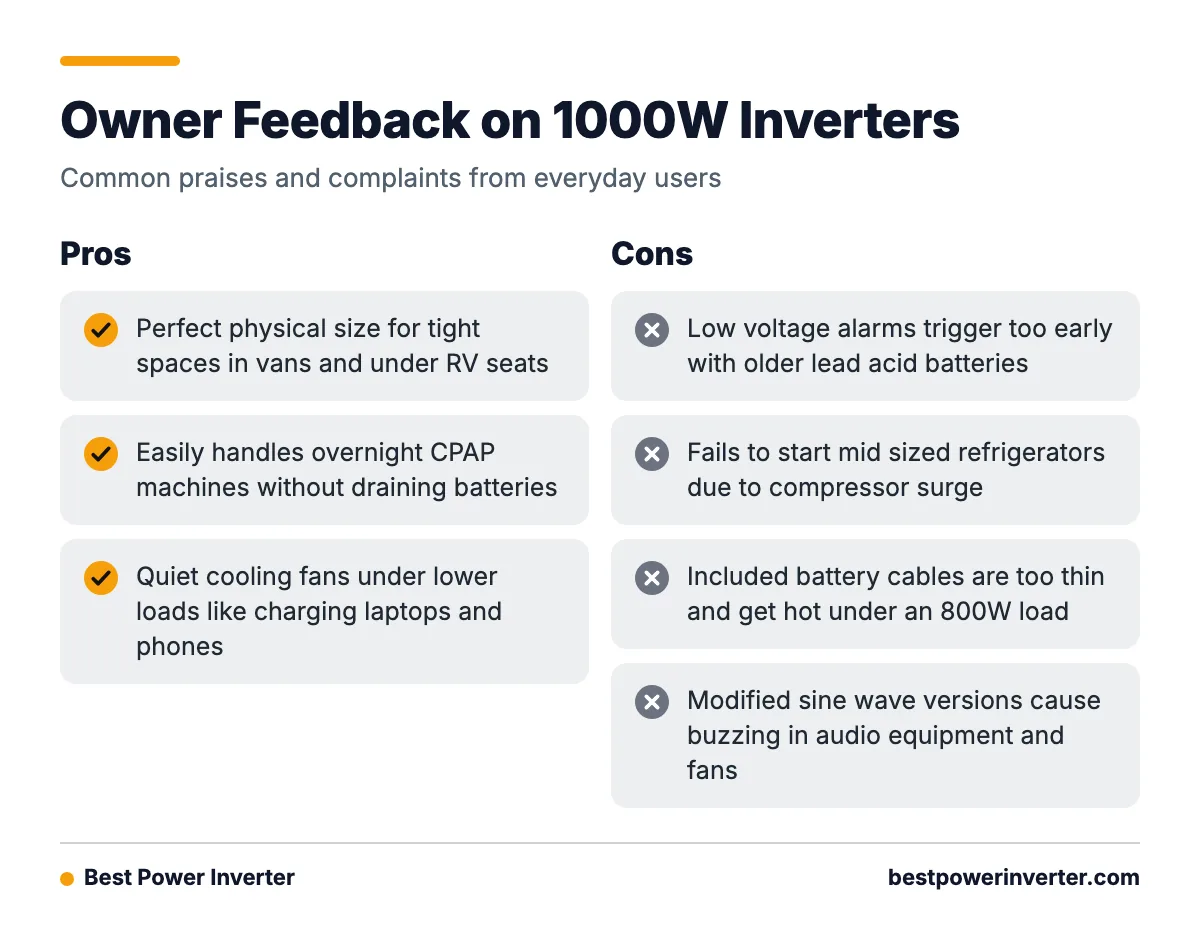
- Perfect physical size for tight spaces in vans and under RV seats
- Easily handles overnight CPAP machines without draining batteries too quickly
- Quiet cooling fans under lower loads like charging laptops and phones
Common complaints
- Low-voltage alarms trigger too early when used with older lead-acid batteries
- Fails to start mid-sized refrigerators due to compressor surge tripping the overload protection
- Included battery cables are often too thin and get hot under an 800W+ load
- Modified sine wave versions cause annoying buzzing in audio equipment and fans
Summarised from owner reviews and long-term user reports; individual experiences vary.
Frequently Asked Questions
what can 1000 watt inverter run?
It can comfortably run electronics drawing up to 800 continuous watts. This covers laptops, televisions, CPAP machines, gaming consoles, fans, and small blenders. It cannot run heating appliances.
what can 1000w inverter run?
A 1000W inverter runs sensitive electronics and low-draw motorized devices. Internet routers, device chargers, and small fans operate perfectly. High-draw devices like air conditioners will not start.
how long will 1000 watt inverter run?
The inverter will run until the connected battery bank is depleted. A 100Ah 12V lead-acid battery powering a 50W laptop through a 1000W inverter will last about 12 hours. The exact time depends on the battery size and the connected load.
what can a 1000 watt inverter generator run?
It can run the same items as a standard 1000-watt inverter. It will power lights, small televisions, computers, and medical devices. The only difference is that a generator uses fuel to generate the power continuously.
can a 1000 watt inverter run a fridge and freezer?
No. A standard full-size residential fridge requires a massive surge of power to start the compressor, frequently exceeding 1200 watts. This surge will trigger the overload protection on a 1000-watt inverter. However, you can run small dorm-style mini-fridges.
what can 2000 watt inverter run?
A 2000-watt inverter provides headroom to run heating and cooking appliances. It will successfully power microwaves, standard drip coffee makers, hair dryers, and small portable space heaters.
what will a 1000 watt power inverter run?
It will safely run any device that requires under 800 watts of continuous power. Laptops, portable monitors, drone battery chargers, and CPAP machines are ideal loads.
Sources