
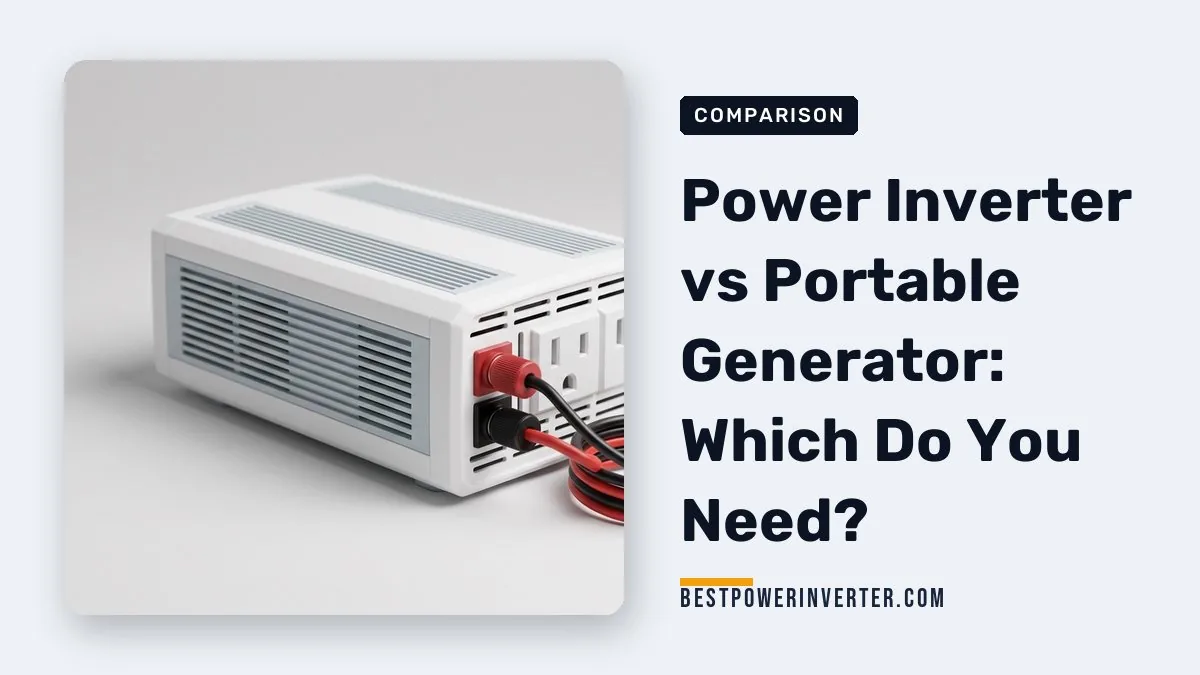
Homeowners, renters, and campers shopping for backup power often meet four products with similar names. A power inverter converts battery power into household AC for small loads. A portable generator burns fuel to make electricity and can run far larger loads, including a whole house when it is sized and connected correctly.
Quick answer
Use a power inverter for phones, laptops, and lights from a car or battery. Use a portable generator for a fridge, sump pump, or house circuits during an outage. Choose an inverter generator if you want quieter, cleaner power.
- Best for whole-home backup: portable generator with a transfer switch
- Best for electronics: inverter generator or power station
- Best for indoor use: portable power station
- A power inverter does not make power. It only converts DC from a battery to AC.
- A portable generator makes power from fuel. An inverter generator is a cleaner, quieter type of portable generator.
- A portable power station is a battery with outlets. It is not a generator.
- Size a generator by starting watts and running watts, not running watts alone.
- Never run any fuel-burning generator indoors, in a garage, or near windows.
- What is the difference between a power inverter and a portable generator?
- How does an inverter generator work?
- Is a portable power station the same as an inverter generator?
- Side-by-side comparison
- Can an inverter generator power a house?
- How to size a generator: a worked example
- Which option is best for fridges, Wi-Fi, medical devices, or power tools?
- What does a 200W power inverter actually run?
- What safety rules matter for home backup?
- How to choose
- What do owners say?
- Frequently Asked Questions
What is the difference between a power inverter and a portable generator?
A power inverter changes stored DC power into AC power. A portable generator creates new electricity by burning fuel. That one difference shapes everything else: runtime, cost, noise, and how much you can plug in.
A plug-in inverter sits between a battery and your device. It might draw from a car battery, a deep-cycle battery bank, or a solar setup. It never runs out of fuel, but it drains the battery behind it. Most small units are limited by the socket or cable they connect to.
A portable generator has an engine and an alternator. As long as you keep adding fuel, it keeps making power. Larger models offer 120/240V output, which Honda says is intended for home backup use on its backup generators. The tradeoff is exhaust, noise, and maintenance.
Here is a clean way to remember it:
- Power inverter: a converter. Needs a battery.
- Portable generator: a power maker. Needs fuel.
- Inverter generator: a power maker with an electronic output stage.
- Portable power station: a battery with a built-in inverter and outlets.
How does an inverter generator work?
An inverter generator makes AC power, converts it to DC, then converts it back to clean AC. Honda explains this process, and Generac describes the same idea: electronic circuits convert the current back and forth to lower total harmonic distortion. You can read more in Honda’s explanation of inverter generators.
What powers an inverter generator?
Fuel powers it. Most run on gasoline, and some also run on propane or both. The engine spins the alternator. The inverter stage then cleans up the output. EcoFlow notes that inverter generators can keep running as long as fuel is available.
Clean output matters for laptops, TVs, routers, and other electronics with sensitive circuits. Many inverter generators can also slow the engine at light loads, which usually cuts noise and fuel use. That is a design trait of the category, so check the manufacturer’s specs for each model.
Is a portable power station the same as an inverter generator?
No. A portable power station is a rechargeable lithium-ion battery unit with outlets, not a fuel-burning generator. It has an inverter inside, but its energy comes from stored capacity. You recharge it from a wall outlet, a car, or solar panels.
That changes two big things. First, runtime is limited by battery size. EcoFlow notes that power stations are limited by stored capacity and recharging. Second, power stations can generally be used indoors, while inverter generators must run outdoors because of exhaust risk. The EcoFlow power station vs inverter generator comparison covers this in more detail.

Side-by-side comparison
| Type | Energy source | Runtime | Indoor use | Typical loads |
|---|---|---|---|---|
| Power inverter | External battery (car, deep-cycle) | Depends on the battery | Yes, but the battery must be safe and vented | Phone and laptop chargers, small lights |
| Portable generator | Gasoline, propane, or both | As long as fuel lasts | Never | Fridge, sump pump, power tools, house circuits |
| Inverter generator | Gasoline, propane, or both | As long as fuel lasts | Never | Electronics, camping gear, essentials |
| Portable power station | Built-in lithium battery | Limited by capacity, then recharge | Generally yes | Routers, laptops, small appliances |
Can an inverter generator power a house?
It can power parts of a house, and a large one can power more. Fuel-powered portable generators can supply enough power for an entire home when properly sized, while lightweight power stations are typically best for small appliances and electronics. The key words are “properly sized.”
Can I power my house with a portable generator?
Yes, with a safe connection. A licensed electrician should install a transfer switch or an approved interlock. This keeps your house from sending power back into the utility lines, which can hurt line workers. Honda lists 120/240V portable models for this purpose on its home backup generator page.
What portable generator can power a house?
It depends on your loads, not the house size. Add up what you must run. A few essentials may fit a mid-size unit. Central air, electric ranges, and electric dryers need much more. Most small inverter generators cannot run central air or full-house loads unless they are oversized or paired up.
Pick your path:
- Fridge only: a small inverter generator or a large power station can do it. Check the fridge’s starting watts first.
- Essentials only (fridge, sump pump, lights, router, furnace fan): a mid-size portable generator with a transfer switch.
- Whole-home: a large 120/240V generator, a transfer switch, and load management. Or consider a standby unit.
How to size a generator: a worked example
Motors need a burst of power to start. That burst is called starting watts (or surge watts). Once started, the motor falls back to running watts. Add up the running watts of everything, then add the single biggest starting surge on top.
Example loads (typical figures; check your own nameplates):
| Appliance | Running watts | Starting watts |
|---|---|---|
| Refrigerator | about 700 | about 2,200 |
| Sump pump (1/3 hp) | about 800 | about 1,300 |
| Wi-Fi router | about 15 | about 15 |
- Total running watts: 700 + 800 + 15 = about 1,515W.
- Worst-case start: the fridge surges while the pump and router already run. 2,200 + 800 + 15 = about 3,015W.
So you need a generator rated near 3,500 starting watts, with at least 1,600 to 2,000 running watts. That leaves some margin. Stagger the starts when possible, and never run at the very top of the rating for hours.
Whole-house readiness checklist
- List essential circuits: fridge, sump pump, furnace blower, lights, router, medical gear.
- Add up running watts and the largest starting surge.
- Have a licensed electrician install a transfer switch or interlock.
- Store fuel in approved containers, away from living space, and rotate it.
- Place a battery-powered or plug-in CO alarm on each floor.
- Run the generator briefly each season to confirm it starts.

Which option is best for fridges, Wi-Fi, medical devices, or power tools?
- Fridges: a portable or inverter generator sized for the starting surge. A large power station works for short outages.
- Wi-Fi: a power station is the easiest. Routers draw very little.
- Medical devices: a power station is often best for indoor use and clean power. Confirm the device’s wattage and runtime with its maker or your clinician. Do not rely on one backup source for life-support gear.
- Power tools: a portable generator for heavy motors, such as saws and compressors. An inverter generator suits lighter tools with electronics.
What does a 200W power inverter actually run?
A 200W car inverter runs small electronics. It does not run anything with a heating element or a big motor. Check the label on your exact model, since ratings and fuse limits vary.
| Can run | Cannot run |
|---|---|
| Phone and tablet chargers | Microwave |
| Laptop charger (about 45 to 90W) | Coffee maker or kettle |
| Camera and drone battery chargers | Hair dryer or space heater |
| Small LED lights, router | Refrigerator or freezer |
| Small fan | Power tools or air compressor |
Two limits catch buyers. First, a 12V cigarette lighter socket is usually fused, often around 10 to 15 amps. At 12 volts, that is about 120 to 180 watts, so you may never reach 200W through that socket. Second, running it with the engine off drains the car battery. Run the engine when drawing more than a small load, or clip the inverter directly to a separate battery.
What safety rules matter when using a generator for home backup?
The biggest rule is simple: run fuel-burning generators outdoors only. Exhaust contains carbon monoxide, which you cannot see or smell. EcoFlow states inverter generators must be operated outdoors because of exhaust risk.
- Keep the unit well away from doors, windows, and vents. Many safety agencies advise about 20 feet.
- Never run it in a garage, even with the door open.
- Use a transfer switch or interlock. Never plug a generator into a wall outlet.
- Use outdoor-rated, heavy-gauge extension cords sized for the load.
- Follow the manual for grounding. Keep the generator dry, under a vented cover.
- Let the engine cool before refueling. Store fuel away from ignition sources.
- Manage the load. Turn on big loads one at a time.
From the Shop
Based on patterns in buyer reviews, the most common regret is not size but placement. People buy a quiet unit, then find the cord is too short to reach a safe spot. Measure the distance from your outlet or inlet to the safe outdoor location before you buy.
How to choose between lowest cost, quiet operation, and longer runtime
- Lowest cost per watt: a conventional portable generator. It is louder and its output is less clean.
- Quietest and cleanest: an inverter generator costs more per watt, but suits electronics and campsites. A power station is silent.
- Longest runtime: a fuel generator wins, because you can refuel. Power stations need recharging.
- Apartment or indoor use: a power station only. A plug-in inverter works in a vehicle.
What do owners say?
Owners like
- Quiet operation compared with conventional generators
- Cleaner power for sensitive electronics
- Easy portability for camping and short outages
- Simple start-up and quick connection for essentials
Common complaints
- Limited runtime without refueling or recharging
- Not enough output for central air or full-house loads unless oversized
- Noise and fumes make outdoor placement mandatory
- Confusion over wattage ratings and what appliances actually work
Summarised from owner reviews and long-term user reports; individual experiences vary.
Frequently Asked Questions
What is a power inverter portable generator?
Usually it means one of two things. It may be an inverter generator, which burns fuel and cleans the output electronically. Or it may be a power inverter paired with a battery. Check for a fuel tank or a battery to know which one you are looking at.
What powers an inverter generator?
An engine powers it, usually on gasoline, propane, or both. The engine spins an alternator, and the inverter stage then smooths the output into clean AC.
How does a power inverter generator work?
It makes AC, converts it to DC, and converts it back to steady AC. Generac says this lowers total harmonic distortion, which is helpful for electronics.
What portable generator can power a house?
One with enough running and starting watts for the circuits you pick, plus 120/240V output and a transfer switch. Add up your essentials first, then size up for margin.
Can I power my house with a portable generator?
Yes, if it is sized for your chosen loads and connected through a transfer switch or interlock installed by a licensed electrician. Run it outdoors, away from the home.
Inverter generator vs portable power station: which is better?
Choose the generator for long outages, since you can refuel it. Choose the power station for quiet, indoor-safe backup of small loads. Power stations are limited by stored capacity and recharging.
What does a BESTEK 200W portable power inverter run?
It runs phone chargers, laptop chargers, camera battery chargers, and small lights. It will not run a microwave, a hair dryer, a fridge, or power tools. Also check the vehicle socket’s fuse limit, which may cap output below 200W.
Sources
