
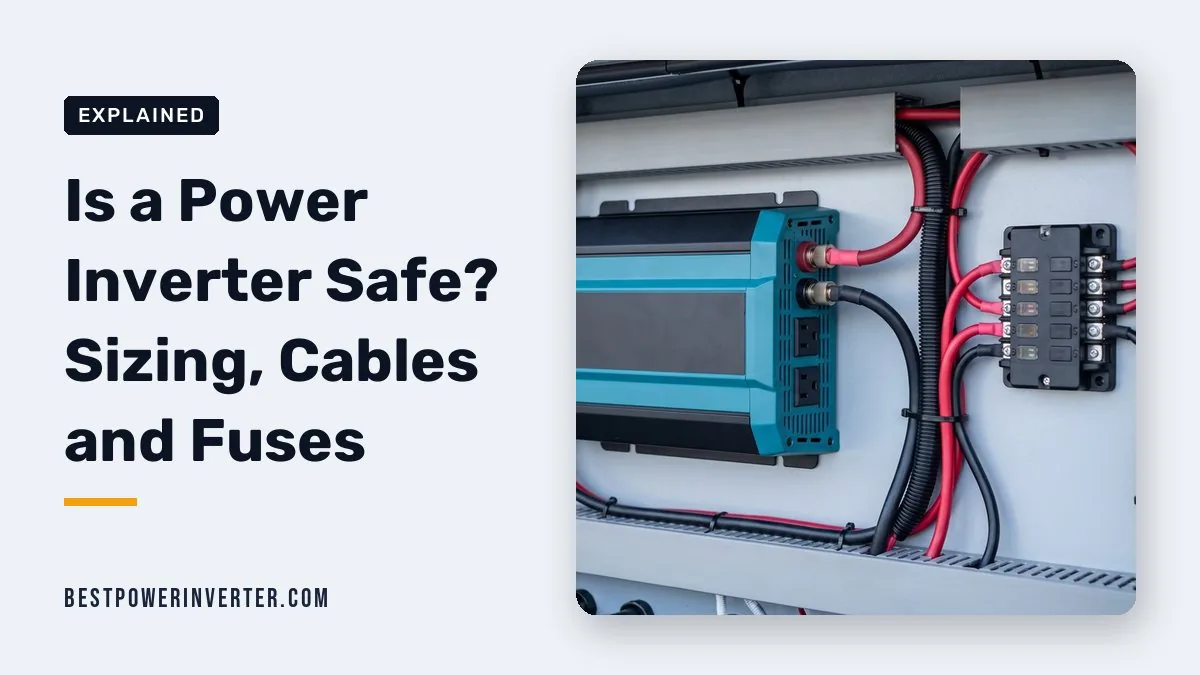
Drivers, RV owners and van builders who want household power from a 12V battery can relax: a power inverter is safe when it is sized for the load, wired with correctly rated cable and fuses, kept ventilated, and paired with a battery that can supply the current. Most real problems are not the inverter itself. They come from overloaded lighter sockets, thin cables, hot enclosed spaces and flat starter batteries.
Quick answer
Inverters are safe when you match size to the load, fuse the positive cable near the battery, and give the unit airflow. Use the lighter socket only for about 150W or less. Anything bigger goes straight to the battery.
- Best for phones, laptops, a small TV: a 150-300W unit in the socket
- Best for drills, fridges, pumps: a pure sine unit wired to the battery
- Vehicle sockets are usually fused at 10-15A, so they handle only about 120-180W.
- A 1000W load pulls roughly 95-100A from a 12V battery. That needs thick cable and a fuse.
- Even with nothing plugged in, an inverter can pull 0.2-1.5A and flatten a battery in days.
- Motors need 2-3 times their running watts to start. Size for the surge.
- Pure sine wave is the safer choice for motors and electronics.
- Higher system voltage (24V or 48V) cuts current and heat for the same power.
- Is a power inverter safe to use in my car?
- Do inverters use power when they are not in use?
- What size inverter do I need?
- How big of a power inverter can my truck handle?
- What cables and fuses does an inverter need?
- Pure sine wave or modified sine wave?
- How long can I run an inverter with the engine off?
- Is a 48V power inverter different?
- Plug in, clamp on or hardwire?
- Pre-use safety checklist
- Troubleshooting alarms, buzzing and shutdowns
- What do owners say?
- Frequently Asked Questions
Is a power inverter safe to use in my car?
Yes, if you respect its limits. An inverter turns 12V DC into 120V AC, and 120V AC can shock you. The unit also moves a lot of current on the DC side, and that is where fires start.
Here are the real risks, in order of how often they cause trouble:
- Overheated wiring. Thin or loose cables heat up under high current. A cable that is too small for the load is a fire risk.
- Overloaded sockets. A lighter socket fuse blows, or worse, someone swaps in a bigger fuse and melts the socket wiring.
- Dead battery. Running a load with the engine off can leave you unable to start the vehicle.
- Poor ventilation. Inverters make heat. Covered by a blanket or jammed in a bag, they overheat and shut down.
- Shock. The AC output can hurt you. Keep units dry and use a GFCI-protected outlet or cord where moisture is possible.
- Carbon monoxide. An inverter makes no exhaust. A generator does, and so does your engine. Never idle a vehicle in a closed garage to keep an inverter charged.
That last point matters. People switch from a generator to an inverter to avoid fumes, then run the engine in a shut garage anyway. Run the engine outdoors only.
Do inverters use power when they are not in use?
Yes. An inverter that is switched on with nothing plugged in still draws power to keep its electronics running. This is called idle or no-load draw. For small and mid-size units it is roughly 0.2-1.5A at 12V, or about 3-20W. Large units draw more.
It sounds small. It is not, over a full day.
How big of a power drain is an inverter on my battery?
With a load, the drain is big. Efficiency is typically about 85-95%, so the battery must supply more than the appliance uses. The formula is simple: DC watts = AC watts ÷ efficiency. A 1000W load needs about 1000 ÷ 12 ÷ 0.9, which is roughly 95-100A from a 12V battery.
Idle draw is slower but steady. Here is a worked example on a 100Ah lead-acid battery, where you should use only about 50Ah (50% depth of discharge):
| Idle draw | Used per 24 hours | Days to reach 50Ah used |
|---|---|---|
| 0.5A | 12Ah | about 4 days |
| 1.0A | 24Ah | about 2 days |
| 1.5A | 36Ah | about 1.4 days |
So an inverter left on in a parked car can flatten the battery in a couple of days. Switch it off when not in use. A remote switch makes this easy, and owners often praise it for that reason. See the Samlex America inverter FAQ for more on how inverters draw power.
From the Shop
A pattern that shows up again and again in buyer reviews: someone plugs an inverter in for a camping weekend, forgets the switch, and finds the car will not start on Monday. The fix costs nothing. Turn the unit off, or buy one with a low-voltage cutoff and a power-save mode.
What size inverter do I need?
Add up the running watts of everything you will use at the same time. Then check the surge watts for any motor. Choose an inverter whose continuous rating covers the running total and whose surge rating covers the startup peak. Leave about 20% spare room.
Watts, amps and watt-hours are different things. Watts are power right now. Amps are current. Watt-hours are energy over time. Mixing them up is the top sizing mistake.
Appliance sizing table
These are typical ranges. Always check the nameplate on your own device.
| Appliance | Running watts | Startup surge | Suggested inverter | 12V draw (running) |
|---|---|---|---|---|
| Laptop | 45-90W | None | 150-300W | about 4-8A |
| 32-inch TV | 30-60W | Low | 150-300W | about 3-6A |
| Inkjet printer | 20-50W | Low | 150-300W | about 2-5A |
| Power drill (corded) | 500-700W | 2-3x | 1500W | about 50-65A |
| Mini fridge | 80-120W | 3x or more | 600-1000W | about 8-11A |
| 1/2 hp sump pump | about 1000W | 2000W+ | 2000-3000W | about 95A |
A laser printer is different from an inkjet. Its fuser can pull several hundred watts while warming up, so size it like a small heater.
How big an inverter to power a 32 TV?
A 300W inverter is plenty for most 32-inch TVs, which usually use 30-60W. Add a streaming stick or game console and you may reach 150W. A 300W unit still covers it, but a 150W unit would be tight and could trip.
Why do motor loads need a much bigger inverter than their running watts?
A motor at rest has no spinning momentum, so it pulls a big burst of current to start. Compressors, drills and pumps can need 2-3 times their running watts, sometimes more. A 1/2 hp sump pump often needs about 1000W running and 2000W or more to start.
If the inverter’s surge rating is too low, it will shut down or fault each time the motor kicks on. Repeated hard starts also stress the unit. For a sump pump, a 2000-3000W pure sine inverter is the usual choice, and a 12V system at that size means close to 200A, which is a good reason to consider 24V or 48V.
How big of a power inverter can my truck handle?
It depends on how you connect it, and on your battery and alternator. Three limits apply.
- The socket. Most vehicle 12V sockets are fused at 10-15A. That limits them to about 120-180W. Anything larger must connect directly to the battery.
- The wiring and fuse. Direct connection is only as strong as the cable and fuse you install. See the chart below.
- The alternator. Check your alternator rating. Many are in the 90-200A range, and the vehicle itself uses a share of that. A 1000W load takes about 95A, which can use up most of a small alternator. With the engine running, keep inverter draw well below your spare alternator capacity.

Engine off, the battery is the only source. A starter battery is built for short, high bursts, not long drains. For regular use, add a second deep-cycle or lithium battery with an isolator or DC-DC charger. That keeps your starting battery safe.
What cables and fuses does an inverter need?
Use thick, short cables and a fuse on the positive line within about 7 inches (18 cm) of the battery, as is common practice. Rate the fuse to protect the cable, not to match the inverter’s surge. Currents below include a 90% efficiency estimate.
| Inverter | System | Approx. input current | Typical cable (short run, under about 6 ft) | Typical fuse |
|---|---|---|---|---|
| 300W | 12V | about 28A | 10 AWG | 40A |
| 300W | 24V / 48V | 14A / 7A | 14 AWG | 20A / 10A |
| 1000W | 12V | about 93A | 2 AWG | 125-150A |
| 1000W | 24V / 48V | 46A / 23A | 6 AWG / 10 AWG | 60A / 30A |
| 2000W | 12V | about 185A | 2/0 AWG | 250A |
| 2000W | 24V / 48V | 93A / 46A | 2 AWG / 6 AWG | 125A / 60A |
| 3000W | 12V | about 280A | 4/0 AWG | 400A |
| 3000W | 24V / 48V | 139A / 69A | 1/0 AWG / 4 AWG | 200A / 100A |
| 4000W | 12V | about 370A | Paired 2/0 or 4/0, or larger | 500A |
| 4000W | 24V / 48V | 185A / 93A | 2/0 AWG / 2 AWG | 250A / 125A |
These are typical planning figures, not a code. Your inverter’s manual sets the exact cable size and fuse for your model, and longer runs need thicker cable to limit voltage drop. Follow the manual first.
Can I plug a 4000W inverter into a car?
Not into a socket, and rarely into a normal car at all. A 4000W inverter on 12V pulls roughly 370A at full load. That needs very heavy cable, a large fuse or breaker, and a big battery bank. A normal starter battery and a stock alternator are not built for that. In vans and RVs, 4000W units usually sit on a lithium bank, ideally at 24V or 48V.
Pure sine wave or modified sine wave?
Pure sine wave is safer for motors and electronics. It matches the smooth power from a wall outlet. Modified sine wave is a rough, stepped approximation that costs less.
Modified sine wave can cause extra heat, noise or failure in motors, some chargers and sensitive electronics. You may hear a hum or buzz from a fridge or fan, or see a motor run hot. It works fine for simple resistive loads like a basic heater or an old incandescent lamp.
- Choose pure sine for: fridges, pumps, drills, laptops, medical gear, TVs, battery chargers and anything with a motor or a digital controller.
- Modified sine may be fine for: simple lights and basic tools, if the maker allows it.
For a sump pump or fridge, buy pure sine. The extra cost is less than a burned-out motor.
How long can I run an inverter with the engine off?
Use this formula: runtime in hours = battery Wh × usable depth of discharge × efficiency ÷ load watts. Lead-acid batteries should generally not be discharged below about 50%. LiFePO4 allows around 80-100%.
A worked example with a 1000W load and a 100Ah, 12V battery (1200Wh):
| Battery type | Usable share | Calculation | Runtime |
|---|---|---|---|
| Lead-acid | 50% | 1200 × 0.5 × 0.9 ÷ 1000 | about 32 minutes |
| LiFePO4 | 80% | 1200 × 0.8 × 0.9 ÷ 1000 | about 52 minutes |
Real runtime is often shorter. High current makes batteries sag in voltage, and the inverter’s low-voltage alarm can trip the unit early. Owners often report that the low-voltage shutdown arrives sooner than they expected.
Now a small load. A 50W TV at 12V is about 4.6A. On the same lead-acid battery with 50Ah usable, that is roughly 10 hours, minus idle draw and losses. Small loads are where inverters work best.
How do I size an inverter for a 5000Wh (5 kWh) battery?
First, learn what the label means. Watts (W) measure power. Watt-hours (Wh) measure stored energy. A “5000W battery” usually means either 5000Wh of storage or a 5000W maximum output, and sellers mix the two. Check both numbers.
Then size for your loads, not the battery. A 5 kWh battery can feed a 5000W load for about an hour at best, less after losses. If your biggest load is 2000W, a 3000W inverter is enough, and the battery would run it for roughly two hours at that load. Also check the battery’s continuous discharge limit. A 48V battery with a 100A limit supports about 4800W. A 12V 5 kWh battery is about 417Ah, and 5000W from it would mean around 460A, which is why such banks are usually 48V.
Is a 48V power inverter different?
The AC output is the same, but the DC side is much easier on cables. Higher voltage means lower current for the same power. A 4000W load is roughly 370A at 12V but about 90A at 48V. Lower current allows thinner cable, less heat and smaller voltage drop.
A 48V inverter makes sense for home backup, large van or RV builds, and any setup above about 2000-3000W. It also suits big lithium banks and solar systems. For a small car setup under 1000W, 12V is simpler. You cannot mix voltages. The inverter must match the battery bank’s voltage.
Plug in, clamp on or hardwire?
If your load is under about 150W (phone, laptop, small TV), plug a small inverter into the socket.
If your load is 150W to about 400W and short-term, use battery clamps with the fuse in line, engine running.
If your load is over 400W, or runs often, hardwire it with correct cable, a fuse near the battery, and a disconnect switch.
If your load has a motor over 1000W, hardwire to a deep-cycle bank, and consider 24V or 48V.
Pre-use safety checklist
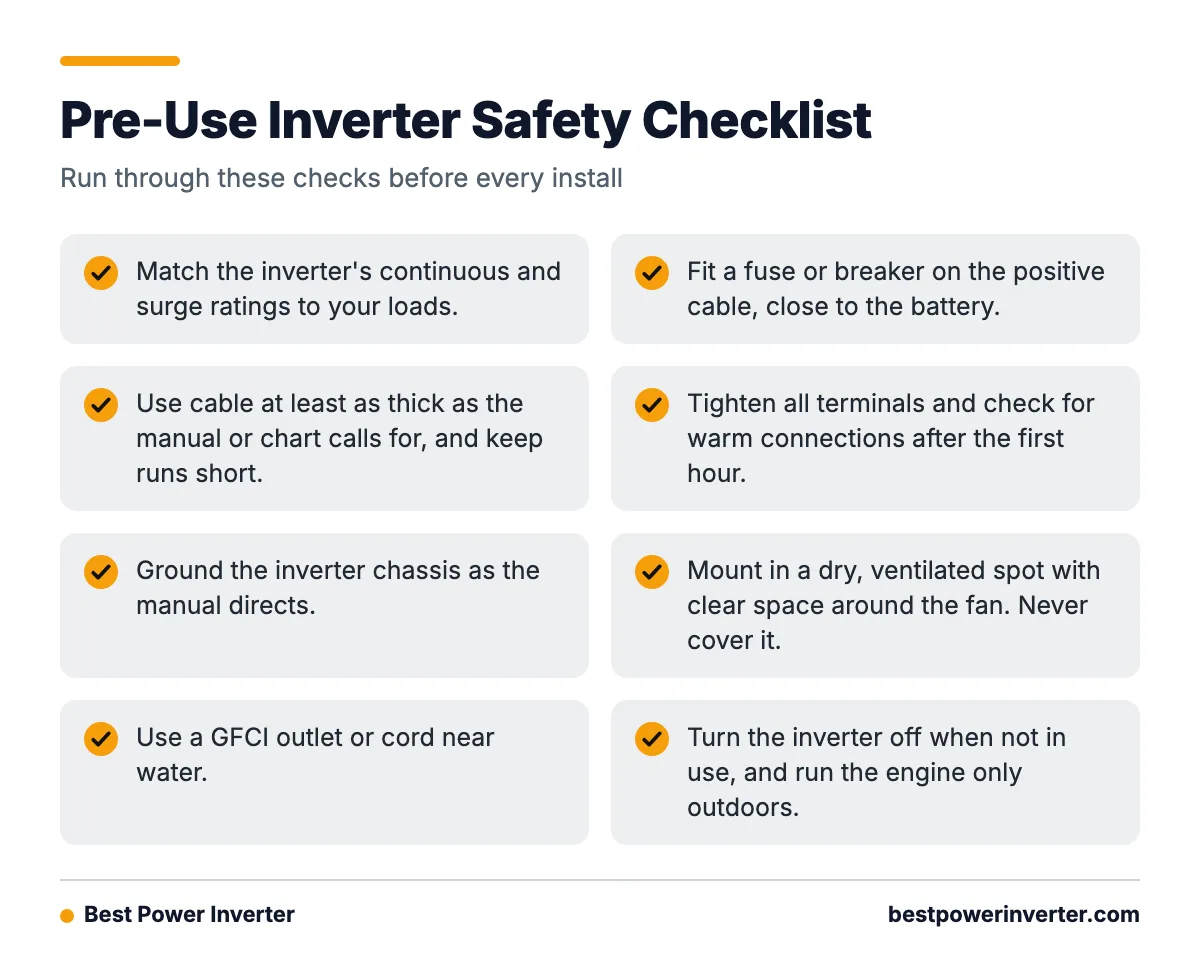

- Match the inverter’s continuous and surge ratings to your loads.
- Fit a fuse or breaker on the positive cable, close to the battery.
- Use cable at least as thick as the manual or chart calls for, and keep runs short.
- Tighten all terminals. Check for warm connections after the first hour of use.
- Ground the inverter chassis as the manual directs.
- Mount in a dry, ventilated spot with clear space around the fan. Never cover it.
- Keep it away from fuel, batteries venting gas, and anything flammable.
- Use a GFCI outlet or cord near water. Use short, heavy-gauge extension cords.
- Turn the inverter off when not in use.
- Run the engine only outdoors.
Troubleshooting alarms, buzzing and shutdowns
| Symptom | Likely cause | Fix |
|---|---|---|
| Low-voltage alarm | Battery drained or cable voltage drop | Start the engine, shorten or thicken cables, reduce load |
| Overload shutdown | Load or motor surge too high | Remove loads, use a larger inverter |
| Overheating | Blocked airflow, hot space, long heavy load | Move to a cooler spot, clear the vents, cut load |
| Buzzing from audio or TV | Modified sine output | Switch to pure sine |
| Loud fan | Normal at mid and high load | Mount away from sleeping areas |
Owners also report that rated wattage is not always reached in practice for long periods. Many units derate when hot. If you plan a constant heavy load, choose an inverter rated well above it.
What do owners say?
Owners like
- Pure sine wave inverters run sensitive electronics and motors quietly.
- Built-in protections (overload, low-voltage, over-temperature shutoff) give peace of mind.
- Handy for camping, road trips and power outages for TVs, laptops and chargers.
- A remote switch or display makes monitoring and turning off idle draw easy.
Common complaints
- The cooling fan is loud on mid and large units.
- Included battery clamps and cables are too thin or too short for the rated output.
- Rated wattage is not reached in practice; units shut down early or overheat under sustained loads.
- The low-voltage alarm or shutdown trips the battery sooner than expected.
- Idle draw drains the battery if the unit is left switched on.
Summarised from owner reviews and long-term user reports; individual experiences vary.
Frequently Asked Questions
Is power inverter safe?
Yes, when it is sized for the load, fused on the positive cable, ventilated, and kept dry. The main dangers are overheated cables, shock from the AC side, and a drained battery.
Is power inverter safe for car?
It is, if you stay within the socket’s 10-15A limit (about 120-180W) or connect larger units directly to the battery with proper cable and a fuse. Switch it off when parked.
Do inverters use power when not in use?
Yes. Idle draw is roughly 0.2-1.5A at 12V on small to mid units. On a 100Ah lead-acid battery, 1A idle can use the safe 50Ah in about two days.
How big power inverter to run sump pump?
A 1/2 hp pump often needs about 1000W running and 2000W or more to start. Choose a 2000-3000W pure sine inverter, and check the pump’s nameplate. Use 24V or 48V if you can, to keep current manageable.
48 volt power inverter: when does it make sense?
Choose one for large loads, home backup or big lithium banks. A 4000W load is about 90A at 48V instead of 370A at 12V, so cables run cooler and thinner.
How big of a power drain is an inverter?
At idle, about 3-20W on small to mid units. Under load, add 10-15% for efficiency losses. A 1000W load pulls roughly 95-100A at 12V.
How big power inverter for 5000W battery?
Size it to your loads, not the battery label. Check whether 5000W means output or 5000Wh of storage, and check the battery’s continuous discharge limit. A 3000W inverter suits a 2000W peak load.
How big an inverter to power a 32 tv?
A 300W inverter is enough for most 32-inch TVs, which use roughly 30-60W. Add a streaming device or console and you still stay well under that.
How big of a power inverter can my truck handle?
Through the socket, about 150W. Connected to the battery, it depends on your cable, fuse, battery and alternator. Keep the draw well below your spare alternator capacity, and add a second battery for heavy use.
4000 watt power inverter: what does it need?
Very heavy cable, a 400-500A fuse at 12V, and a large battery bank. Most people run one at 24V or 48V, where input current is about 185A or 93A.