
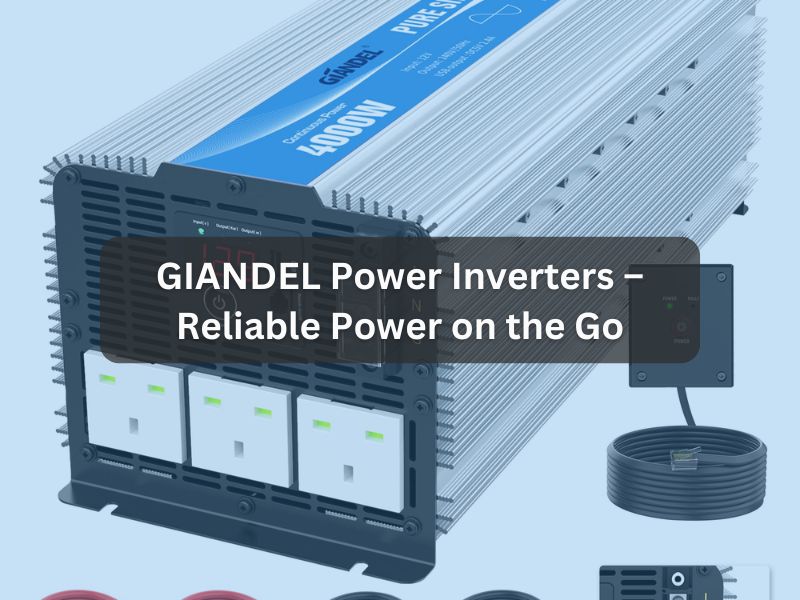
GIANDEL sells a wide range of 12V and 24V inverters, in pure sine wave and modified sine wave versions, with continuous ratings from 300W up to 5000W. Their published specs show efficiency above 91% on several pure sine models, but how reliable an inverter proves in your setup depends on matching waveform, voltage, surge capacity and wiring to the load. This guide is based on manufacturer specifications and listing data, not on our own bench testing.
GIANDEL Power Inverters provide a practical solution to convert DC power to AC power, making them ideal for off-grid adventures, emergencies, and mobile work setups.
Table of Contents
| Sr | Headings |
|---|---|
| 1 | What Are GIANDEL Power Inverters? |
| 2 | How Do GIANDEL Power Inverters Work? |
| 3 | Types of GIANDEL Power Inverters |
| 4 | Pure Sine Wave vs Modified Sine Wave: Which Loads Need What |
| 5 | GIANDEL Model Comparison: 1500W, 2000W and 5000W |
| 6 | Continuous Power, Surge Power and Overload Behavior |
| 7 | Input Voltage: 12V vs 24V |
| 8 | Efficiency, Standby Current and Idle Draw |
| 9 | Key Features of GIANDEL Power Inverters |
| 10 | Benefits of Using GIANDEL Power Inverters |
| 11 | Common Uses for GIANDEL Power Inverters |
| 12 | How to Choose the Right GIANDEL Inverter |
| 13 | Worked Sizing Example |
| 14 | Wiring, Fuses and Battery Capacity |
| 15 | Installation Tips for GIANDEL Inverters |
| 16 | Maintaining Your GIANDEL Power Inverter |
| 17 | FAQs About GIANDEL Power Inverters |
What Are GIANDEL Power Inverters?
GIANDEL Power Inverters are devices that transform DC (direct current) power from a battery into AC (alternating current) power used by household devices. They are especially useful when conventional power sources are unavailable, such as during camping trips, emergencies, or while working remotely.
The lineup includes 12V pure sine wave inverters from 300W to 5000W and 12V modified sine wave inverters from 300W to 5000W. Several 12V models list a nominal AC output of 120V AC ±10%, so they are aimed at North American 120V appliances. Model names such as GS-1500SCR, GS-2000SAR, PS-2000SDR, PS-5000GER and PM-5000QBR identify the series and wattage. The company describes itself on its company and support page.
How Do GIANDEL Power Inverters Work?
These inverters convert DC electricity from sources like car batteries into AC power. This process involves switching the DC input into high-frequency AC, then back into the required output.
Step-by-Step Process:
- DC Input: Comes from batteries or solar panels.
- Conversion Circuitry: Changes DC to AC.
- Output: Supplies energy for appliances like laptops or refrigerators
Types of GIANDEL Power Inverters
Pure Sine Wave Inverters
- Ideal for sensitive electronics like laptops and TVs.
- Provide smooth and stable power.
Modified Sine Wave Inverters
- Suitable for basic devices like power tools or lamps.
- More budget-friendly.
High-Power Inverters
- Designed for running multiple or heavy-duty appliances.
- Used in RVs or for off-grid living.
Pure Sine Wave vs Modified Sine Wave: Which Loads Need What
A pure sine wave output follows the smooth waveform of utility power. A modified sine wave is a stepped approximation that many simple loads accept but some handle poorly. Some GIANDEL pure sine models list total harmonic distortion of 3% or less, which is the figure to compare when a load is fussy about power quality.
Checklist: Choose Pure Sine If Any of These Apply
- You will charge laptops, camera batteries or tool batteries through their AC adapters.
- The load is medical equipment such as a CPAP machine. Check the device manual first.
- The appliance has a compressor or induction motor, such as a refrigerator, freezer or air conditioner.
- The device has a variable-speed motor, a dimmer, a timer or digital controls.
- You will run audio or video gear, where a modified waveform can add audible hum or interference.
- A microwave or any appliance that states “pure sine wave required” is in the plan.
Modified Sine Is Usually Acceptable For
- Incandescent lamps and simple resistive heating elements.
- Basic universal-motor corded tools used for short jobs.
- Simple chargers with no timers or digital displays.
When you are unsure, choose pure sine. The price difference is usually smaller than the cost of a damaged appliance or a buzzing, hot motor.
GIANDEL Model Comparison: 1500W, 2000W and 5000W
The table uses only figures from GIANDEL’s product listings. Where a value is marked “Check listing”, it was not part of the verified data used for this article, so confirm it on the product page before buying.
| Model | Waveform | Continuous | Surge | Input (nominal) | Efficiency | Standby / idle |
|---|---|---|---|---|---|---|
| GS-1500SCR | Pure sine | 1500W | 3100W | 12V DC | Greater than 91% | Check listing |
| GS-2000SAR | Pure sine | 2000W | 4100W for 2 seconds | 12V DC | Check listing | Check listing |
| PS-2000SDR | Pure sine | 2000W | 4000W | 12V DC | Greater than 91% | Check listing |
| PS-5000GER | Pure sine | 5000W | 7000W for 2 seconds | 12V DC | Greater than 92% | Check listing |
| PM-5000QBR | Modified sine | 5000W | Check listing | 12V DC | Check listing | Idle current up to 3.5A |
Several 12V GIANDEL models list a nominal input range of 9.8V to 16V DC. Some pure sine models list standby current around 2A. Not every model shares every figure, so read the listing for the exact unit.
Continuous Power, Surge Power and Overload Behavior
Continuous wattage is what the inverter can supply indefinitely, within its thermal limits. Surge wattage is a short burst for motor start-up, and the listings state it as brief. The GS-2000SAR, for example, lists 4100W for 2 seconds. Compressors, pumps and saws can draw several times their running wattage at start-up, so a surge rating helps only if the start-up lasts less than the stated window.
Overload protection is a separate matter. The PM-5000QBR lists overload protection beginning at 5001W to 5500W, so loading it just above 5000W is expected to trigger a shutdown rather than allow sustained operation. Plan to keep continuous loads at about 80% of the rating, for example 1600W on a 2000W unit. This reduces heat, fan noise and nuisance shutdowns.
Input Voltage: 12V vs 24V
The 12V models list a nominal input range of 9.8V to 16V DC. The lower limit matters under load. Voltage sags as a battery discharges and as high current flows through cables, so an inverter at the end of a long, thin cable can reach its low-voltage cutoff while the battery still has charge. Check the listing for the exact cutoff of your model.
- Choose 12V for cars, most RVs and small boats where the battery bank is already 12V.
- Consider 24V if your bank is 24V or your load is above about 3000W. Doubling the voltage halves the current, which allows thinner cable and smaller fuses.
- Never mix them. A 24V inverter on a 12V battery will not run, and a 12V inverter on a 24V bank can be destroyed.
Efficiency, Standby Current and Idle Draw
An efficiency figure of “greater than 91%” means roughly 9% or less of the battery energy is lost as heat while running. That is why the battery draws more than the AC wattage you see. At 1500W and 91%, the battery supplies about 1650W.
Idle draw is the hidden drain. A standby current of 2A at 12V is about 24W, or roughly 576Wh over 24 hours (48Ah). An idle draw of up to 3.5A, as listed for the PM-5000QBR, is about 42W, or around 1000Wh (84Ah) per day if left switched on. Switch large inverters off when nothing is plugged in, particularly in RVs and boats on a small battery bank.
Key Features of GIANDEL Power Inverters
GIANDEL Inverters stand out due to their robust features:
- Built-In Protection: Safeguards against overloads, overheating, and short circuits.
- Smart Cooling System: Ensures efficient performance.
- Compact Design: Easy to install and transport.
- Multiple Outlets: Power several devices simultaneously.
- High Efficiency: Reduces energy loss during conversion.
Some listings add extras such as USB-C ports (the GS-1500SCR listing mentions USB-C) or remote panels (the 5000W listings reference remotes). A remote is useful when the inverter sits near the battery bank but the switch needs to be inside the cabin. Confirm protections such as low-voltage and over-voltage shutdown on the specific model’s page, since this article does not list thresholds for each unit.
Benefits of Using GIANDEL Power Inverters
- Uninterrupted Power: Reliable during outages.
- Versatility: Powers a variety of devices.
- Portability: Convenient for travel or work on the go.
- Cost-Effectiveness: Saves fuel compared to generators.
Common Uses for GIANDEL Power Inverters
- Camping: Powering lights, fans, or small appliances.
- Emergency Backup: Keeping essentials like fridges or medical devices running.
- Worksite Support: Operating tools and equipment in remote areas.
- Off-Grid Living: Enabling sustainable energy setups.
| You May Like: How Does Power Inverter Handle Low-Voltage Situations?
Which Size Suits Which Use
| Use | Typical choice | Reason |
|---|---|---|
| Car or truck: laptops, chargers, small tools | 1500W pure sine | Enough for most single loads; the 12V current stays manageable. |
| RV: fridge, TV, coffee maker, not at the same time | 2000W pure sine | 4000W-class surge helps compressor start-ups. |
| Whole-RV or off-grid backup with several large loads | 5000W pure sine, ideally on a larger bank | 7000W surge for 2 seconds; needs heavy cable and a large battery bank. |
| Worksite with simple tools and lamps, budget priority | Modified sine, such as the 5000W PM-5000QBR | Acceptable only if no sensitive electronics are on the same inverter. |
How to Choose the Right GIANDEL Inverter
Consider These Factors:
- Power Requirements: Match the inverter’s wattage to your devices.
- Wave Type: Choose pure sine wave for sensitive electronics.
- Battery Compatibility: Ensure compatibility with your power source.
- Number of Outlets: Decide based on how many devices you’ll power.
Worked Sizing Example
The wattages below are example assumptions. Read the nameplate on your own equipment.
| Load | Running watts | Notes |
|---|---|---|
| Compact refrigerator | 150W | Start-up may be several times higher for a moment. |
| Laptop charger | 65W | Needs clean power; use pure sine. |
| Circular saw | 1100W | Heavy start-up current. |
| Total if all run together | 1315W |
- Add the running loads that can overlap: 150 + 65 + 1100 = 1315W.
- Add about 20% headroom: 1315 × 1.2 ≈ 1580W.
- Check the largest start-up. If the saw and fridge compressor start in the same second, you need surge above the sum of their start-up currents.
- Result: a 1500W unit is marginal, so a 2000W pure sine model is the safer choice. If the saw runs only when the fridge is idle, a 1500W model with 3100W surge can cope.
Wiring, Fuses and Battery Capacity
Current at the battery is watts divided by volts and efficiency. These are calculated estimates using listed efficiency figures and a 12.0V battery. Real current rises as the battery voltage sags.
| Inverter | Approx. battery current at full load | Battery energy per hour at full load | Amp-hours per hour at 12V |
|---|---|---|---|
| 1500W (91%) | about 137A | about 1650Wh | about 137Ah |
| 2000W (91%) | about 183A | about 2200Wh | about 183Ah |
| 5000W (92%) | about 453A | about 5435Wh | about 453Ah |
What This Means for Cables and Fuses
- Use the manual’s cable chart first. Typical industry charts call for heavy-gauge copper (roughly 1/0 AWG class for 1500W, 2/0 AWG class for 2000W) on very short runs. 5000W at 12V commonly needs multiple parallel large cables, and some installers use cables in the 4/0 AWG class.
- Keep the cable as short as possible, ideally under 3 to 6 feet. Voltage drop at these currents quickly pushes the input toward the low-voltage cutoff.
- Fuse on the positive cable, close to the battery. A common rule is to size the fuse at about 125% of full-load current: roughly 175-200A for 1500W, 250A for 2000W, and above 550A for 5000W, using a fuse rated for DC. Follow the manual if it specifies a value.
- Count the fuses and connections. At 5000W, installers often use a bus bar, a main disconnect and sometimes more than one fuse in parallel. Every added connection must be crimped and torqued correctly.
Battery Bank Guidance
- 1500W: a single 12V lithium battery of 100Ah (about 1200Wh) will run a full 1500W load for well under an hour. Match battery discharge limits to about 140A. Check the battery’s maximum continuous discharge rating.
- 2000W: plan for at least 200Ah of lithium capacity if you expect to run near full load for any meaningful time, or accept short bursts only.
- 5000W: at roughly 450A, a 12V system is demanding. Plan on a large bank with a high discharge rating, or consider a 24V design. Daily loads of 1000-2000W are far more realistic than continuous 5000W for most batteries.
Installation Tips for GIANDEL Inverters
Proper installation ensures safe and efficient use:
- Location: Mount in a ventilated, dry area.
- Connections: Use appropriate cables and secure them tightly.
- Testing: Check connections before using the inverter.
Also keep clear space around the cooling fan intake and outlet, ground the chassis as instructed, and connect with the inverter switched off. Test with a small load first, then step up, and check the cable ends for warmth after 10 minutes at moderate load.
Maintaining Your GIANDEL Power Inverter
- Regular Cleaning: Dust and debris can affect performance.
- Battery Monitoring: Ensure your power source is in good condition.
- Inspection: Check for loose wires or signs of wear.
FAQs About GIANDEL Power Inverters
1. Can I use a GIANDEL Power Inverter for solar systems?
Yes, they are compatible with solar setups and work efficiently with solar panels and batteries.
2. Are GIANDEL inverters safe for sensitive devices?
Pure sine wave models are safe for sensitive electronics like laptops and medical equipment.
3. How do I calculate the inverter size I need?
Add up the wattage of all devices you plan to use simultaneously and choose an inverter with slightly higher capacity.
4. Can I use GIANDEL inverters in vehicles?
Yes, they are great for car use, especially for road trips or as mobile power stations.
5. Do these inverters make noise?
They are designed with quiet cooling systems, so noise is minimal.
6. Are GIANDEL power inverters reliable?
Based on the published specifications, the pure sine models list efficiency above 91% and defined surge ratings, and the lineup includes listed protections. Real reliability depends on correct sizing, short heavy cables, proper fusing and adequate ventilation. Read the product page and manual for your exact model.
7. What is the difference between continuous and surge power?
Continuous power is the sustained output. Surge is a brief peak, listed as 2 seconds on models such as the GS-2000SAR and PS-5000GER, for starting motors.
8. Should I leave the inverter on all the time?
Not on a small battery. Standby current of about 2A, or idle current up to 3.5A on the PM-5000QBR, drains the battery over a day or two even with nothing connected.
9. Can a 5000W inverter run from a car battery?
At about 450A of battery current at full load, a starter battery and standard cables are not suitable. Use a purpose-built deep-cycle or lithium bank and the heavy cabling and fusing the manual specifies.