
RV owners and van builders choosing between 12V and 24V should start with the battery bank, not the wattage. A 12V inverter needs a compatible 12V battery system, a 24V inverter needs a compatible 24V system, and a mismatch can damage your equipment. For the same wattage, 24V draws about half the battery current, so it suits bigger loads and longer cable runs.
Quick answer
Match the inverter to your battery voltage. Choose 12V for loads up to about 2,000W on an existing 12V system. Choose 24V for new systems above that, because it draws half the current.
- Best for cars and small vans: 12V, since the vehicle already uses it.
- Best for RVs and boats under 2,000W: 12V with short, heavy cables.
- Best for cabins, solar, and 3,000W setups: 24V, for smaller cables and fuses.
- A 12V inverter on a 24V battery can be damaged. A 24V inverter on a 12V battery will usually not start.
- Battery current = load watts ÷ battery volts ÷ inverter efficiency.
- At 90% efficiency, a 2,000W load pulls about 185A from 12V and about 93A from 24V.
- Most cars should stay at 150W through the socket, or 300W to 500W wired to the battery.
- Size for running watts and startup surge, then confirm the battery, cable, and fuse can handle the current.
- What is the difference between a 12V and 24V power inverter?
- Can I run a 12V inverter on a 24V battery?
- How much battery current does a 1,000W, 2,000W, or 3,000W inverter draw?
- What can a 12 volt inverter power?
- How big of a power inverter can I use in a 12V car?
- How do running watts and startup surge affect size?
- What cable, fuse, battery, and surge requirements should be checked before installation?
- Do you need pure sine wave or modified sine wave?
- When is a 24V inverter better than a 12V inverter?
- What is the best 12V power inverter for a car, van, boat, or RV?
- Frequently Asked Questions
What is the difference between a 12V and 24V power inverter?
The difference is the battery voltage each one is built to accept. An inverter turns DC battery power into AC power, the type that comes from a wall outlet. Both types can produce the same AC output. What changes is how hard the battery side has to work.
Power equals volts times amps. Double the volts and you need half the amps for the same power. This comparison of 12V, 24V, and 48V battery systems shows the same result: with equal power and efficiency, 24V draws about half the current of 12V.
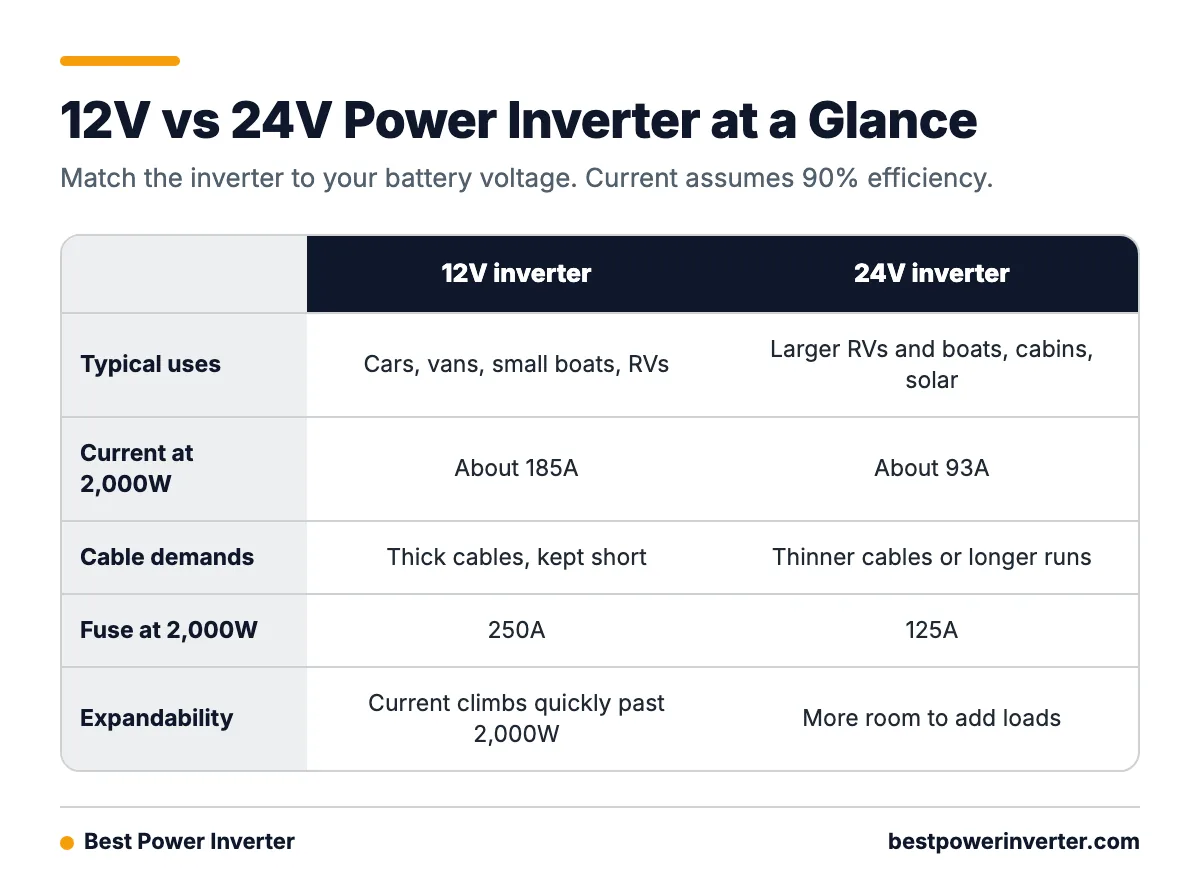
| Factor | 12V inverter | 24V inverter |
|---|---|---|
| Typical uses | Cars, vans, small boats, RVs, small backup loads | Larger RVs and boats, cabins, solar systems, 24V trucks |
| Current at 2,000W (90% efficiency) | About 185A | About 93A |
| Cable demands | Thick cables, kept short | Thinner cables or longer runs |
| Fuse rating | Higher | About half |
| Cost | Usually lowest if you already own a 12V battery | Needs a 24V bank and charger, but saves on cable and fuses at high power |
| Expandability | Current climbs quickly past 2,000W | More room to add loads |
| Compatibility | Works directly with 12V vehicle systems | 12V accessories need a 24V-to-12V DC converter |

Can I run a 12V inverter on a 24V battery?
Do not connect a 12V inverter directly to a 24V battery unless the manufacturer says that model accepts 24V. The input voltage is about double what its parts expect, so the inverter can be damaged. Some models have over-voltage protection that shuts them down. Never rely on that as a way of testing.
Can I use a 24V inverter on a 12V battery?
It will generally not work. A 12V battery cannot supply enough input voltage, so the inverter will usually refuse to start or will shut off with a low-voltage fault. This failure is less violent than the reverse mistake, but you still get no usable power.
Compatibility check
- 12V inverter with a 24V battery: NO. It risks damage unless the manufacturer explicitly approves it.
- 24V inverter with a 12V battery: NO. Input voltage is too low, so it will generally not run.
- Manufacturer-approved dual-voltage equipment: YES. Confirm that exact model lists both input ranges, and set any selector switch before connecting it.
Two matching 12V batteries wired in series make a 24V bank, and that can feed a 24V inverter. Use batteries of the same type, age, and capacity. If they are lithium, first confirm the manufacturer allows series wiring.
How much battery current does a 1,000W, 2,000W, or 3,000W inverter draw?
A 1,000W load draws about 93A from 12V, a 2,000W load about 185A, and a 3,000W load about 278A, assuming 90% efficiency. On 24V, each figure drops by half. Efficiency is the share of battery power that reaches your appliance. Check your inverter’s data sheet for its real figure.
| AC load | Current from 12V | Current from 24V |
|---|---|---|
| 1,000W | About 93A | About 46A |
| 2,000W | About 185A | About 93A |
| 3,000W | About 278A | About 139A |
Worked example
The formula is: current = load watts ÷ battery volts ÷ inverter efficiency.
For a 2,000W load at 90% efficiency on 12V: 2,000 ÷ 12 ÷ 0.90 = 185A.
The same load on 24V: 2,000 ÷ 24 ÷ 0.90 = 93A.
Swap in your own load and efficiency to get your figure.
Those numbers shape the whole build. This RV inverter sizing guide notes that a 3,000W inverter on 12V can need nearly 280A. That creates heavy demands on cables, fuses, batteries, and heat control.
What can a 12 volt inverter power?
A 12V inverter can power anything within its continuous rating and surge rating, provided the battery and cables can deliver the current. Continuous rating means the power it can supply for long periods. Surge rating means the short burst it can supply when a motor starts.
| Inverter size | Full-load current at 12V (90% efficiency) | Typical loads | Connection |
|---|---|---|---|
| 150W | About 14A | Phone and laptop chargers, camera batteries | Socket, if the fuse allows |
| 300W | About 28A | Laptop, small TV, fan | Direct to battery |
| 1,000W | About 93A | TV, small tools, small fridge if surge fits | Direct to battery with heavy cable |
| 2,000W | About 185A | Microwave or coffee maker, one at a time | Short, heavy cable and a large battery bank |
| 3,000W | About 278A | Several large loads together | Possible, but 24V is the better choice |
Read the appliance label, not the advertised output. A microwave sold by its cooking power takes more than that from the outlet, and the label shows the higher number.
How big of a power inverter can I use in a 12V car?
For most cars, use a 150W plug-in inverter or a hardwired 300W to 500W model. Going past about 1,000W usually means upgrading the battery, cables, and possibly the alternator, which is the engine-driven generator that recharges the battery.
Engine-off use is the trap. A 300W load draws about 28A, so a 60Ah starter battery would be half empty in about an hour. It may then struggle to start the car. For anything beyond short engine-off use, run the engine or add a separate deep-cycle battery.
Worked example
These inputs are examples, so replace them with figures from your vehicle.
Socket limit: with a 15A socket fuse, 15 × 12 × 0.90 = 162W. A 150W inverter fits. A 300W inverter does not belong in that socket at full load.
Alternator limit: a 120A alternator with 50A already used by the car leaves 70A spare. Then 70 × 12 × 0.90 = 756W of steady output with the engine running. Alternators often make less at idle, so the real number can be lower.
12V car sizing checklist
- Running watts: add up everything that will run at the same time.
- Startup surge: check the start-up demand of any motor or compressor.
- Socket rating: find the fuse size in your owner’s manual and do the sum above.
- Alternator output: find its rating and allow for what the car already uses.
- Battery condition: an old or weak battery will sag under load.
- Cable gauge: use the size the inverter manual lists for your cable length.
- Fuse placement: fit the fuse in the positive cable, as close to the battery as practical.
How do running watts and startup surge affect size?
The inverter must cover two separate numbers: the total running watts and the brief spike when a motor starts. Fridges, pumps, air compressors, and power tools all spike. Heaters, toasters, and kettles mostly do not.
Use this rule. Multiply total running watts by 1.25 for continuous capacity. Then add the largest startup demand to the running watts of everything else to find the surge you need. Motor surge varies widely, so get it from the appliance’s manual or the manufacturer.
What cable, fuse, battery, and surge requirements should be checked before installation?
Check continuous load, startup surge, battery voltage, battery discharge rating, cable size, fuse protection, and which appliances run together. This inverter battery sizing guide covers how the battery fits into that choice. Your inverter’s manual has the final word on cable and fuse sizes.
How does cable length affect voltage drop?
Longer cable and higher current both increase voltage drop, which is the voltage lost in the wire before it reaches the inverter. Too much drop can trigger low-voltage shutdowns. Lost voltage also becomes heat.
Worked example
Take a 2,000W load with the inverter 10 feet from the battery. That is 20 feet of 2/0 AWG copper cable, counting both directions. AWG is the American Wire Gauge sizing system. Standard AWG tables list 2/0 copper at about 0.078 ohms per 1,000 feet, so this run has about 0.00156 ohms.
| System | Current | Voltage drop (amps × ohms) | Heat in cable (amps² × ohms) |
|---|---|---|---|
| 12V | 185A | About 0.29V (2.4%) | About 53W |
| 24V | 93A | About 0.15V (0.6%) | About 13W |
Half the current means a quarter of the cable heat, using the very same wire.
How should you size and place the fuse?
The fuse protects the cable from overheating and fire, so it belongs on the positive wire near the battery. A common rule sizes it at 125% of continuous current. At 2,000W, that is about 231A on 12V, so a 250A fuse. On 24V it is about 116A, so a 125A fuse. Make sure the cable is rated above the fuse, and follow the manual if its figure differs.
Can the battery supply the current?
Check the battery’s maximum continuous discharge rating before anything else. Lithium batteries contain a battery management system, or BMS, that cuts power when the limit is passed. A 12V battery limited to 100A supports only 100 × 12 × 0.90 = 1,080W. A 2,000W inverter would trip it. A 24V battery with the same 100A limit supports 2,160W.
How long will the battery last?
Runtime in hours = amp-hours × volts × usable share × efficiency ÷ load watts. A 12V 100Ah lithium battery running a 300W load, with its full capacity used, lasts 100 × 12 × 1.0 × 0.90 ÷ 300 = 3.6 hours. A lead-acid battery limited to 50% use, a common limit for longer life, lasts 1.8 hours.
Higher voltage does not create more stored energy. Two 12V 100Ah batteries hold 2,400Wh whether they are wired for 12V 200Ah or 24V 100Ah. The 24V wiring simply delivers that energy at lower current.
Do you need pure sine wave or modified sine wave?
Most buyers should choose pure sine wave. Its output closely follows the smooth AC power from a wall outlet, so it suits fridges, pumps, medical devices, and sensitive electronics. Modified sine wave uses a rougher, stepped signal. It costs less and can run simple heating loads, but motors may run hotter and audio gear may buzz. Check the appliance maker’s guidance before using modified sine wave with a medical device or anything that has a compressor.
When is a 24V inverter better than a 12V inverter?
A 24V inverter is better when the load is above about 2,000W, the cable run is long, or you are building a new system with room to grow. As the current table shows, this is where 12V cables, fuses, and battery limits start to get expensive and difficult. The 2,000W cut-off is a practical rule based on those current figures, not a formal standard.

Choose by your situation
- If you have a standard car: stay with 12V and keep the load small.
- If you have a 12V van, RV, or boat and need up to 2,000W: stay with 12V, and keep the cables short.
- If you need more than 2,000W: move to 24V if you can change the battery bank.
- If you are building a cabin or solar system from scratch: start at 24V unless the loads will stay small.
- If your truck has a 24V electrical system: buy a 24V inverter. Confirm the voltage first.
- If most of your gear runs on 12V DC: stay on 12V, or budget for a 24V-to-12V converter.
A 24V system has real downsides. You need a 24V charger, matched batteries, and a converter for 12V lights and accessories. For a small load in an existing 12V vehicle, that extra work rarely pays off.
What is the best 12V power inverter for a car, van, boat, or RV?
The best 12V inverter for most people is a pure sine wave model sized to the real load, with continuous rating, surge rating, and efficiency clearly published. This article does not rank specific brands because it has no verified product data to support a pick. Use these specifications to narrow your search.
| Use | What to buy | Skip it if |
|---|---|---|
| Car | 150W plug-in, or 300W to 500W hardwired | Your load exceeds the socket fuse or spare alternator output |
| Van | 1,000W to 2,000W hardwired pure sine | The battery’s discharge rating is below the full-load current |
| Boat | Pure sine model meant for marine use, up to 2,000W on 12V | It would sit in a gasoline engine space and is not ignition protected |
| RV | 2,000W pure sine on 12V, with short cables | You plan to run several large loads together, which favors 24V |
Frequently Asked Questions
Power inverter 12V vs 24V: which is better?
Neither wins for every job. A 12V inverter is the better fit for cars and smaller loads on existing 12V systems. A 24V inverter is better for larger loads and longer cables because it draws about half the current. If your load is above about 2,000W and you can choose your battery voltage, pick 24V.
Can I use 12V inverter on 24V battery?
Not unless the manufacturer explicitly states that the model accepts 24V input. Connecting a standard 12V inverter to 24V can damage it. Buy a 24V inverter, or use dual-voltage equipment that the manufacturer has approved for both battery voltages.
Can you use a 24 volt inverter with a 12 volt battery?
Generally not, because a 12V battery does not provide enough input voltage. The inverter will usually fail to start or will shut down on a low-voltage fault. If you need 24V, wire two matching 12V batteries in series, as long as the batteries allow it.
How big of power inverter for 12V car?
Use up to about 150W through the accessory socket if the fuse allows it. For more power, connect a 300W to 500W inverter directly to the battery with a proper fuse. Check spare alternator output before going larger, and keep the engine running for sustained loads.
Sources