
Inverter generators usually run quieter and burn less fuel, but conventional generators deliver more watts for less money. That is the core trade-off. An inverter generator makes cleaner, more stable power and is easier to carry. A conventional generator is usually the better pick for big tools, large appliances, and tight budgets.
Quick answer
Choose an inverter generator for laptops, TVs, camping, RVs, and moderate home backup. Choose a conventional generator when you need high wattage, heavy motor loads, or the most power per dollar.
- Best for sensitive electronics: inverter generator, for stable output
- Best for job sites: conventional generator, for surge power
- Best for camping and RVs: inverter generator, for low noise
- An inverter generator converts engine AC to DC, then rebuilds it as clean AC.
- Most inverter models run from about 2,000 to 3,500 watts. Larger ones reach 4,000 watts or more.
- Conventional generators give higher output for similar size and usually cost less.
- Size any generator by adding running watts plus the single highest starting-watt need.
- Never backfeed a house through an outlet. Use a transfer switch.
- A battery power station is not a generator. It has no engine.
- What is a power inverter generator?
- How does an inverter generator work?
- Generator vs power inverter: are they the same?
- What is the difference between an inverter generator and a conventional generator?
- Why is an inverter generator better, and when is it not?
- How much power does a portable generator provide?
- How do I calculate the generator size I need?
- Can an inverter generator power a house?
- What powers an inverter generator?
- How do I safely connect a generator to a home?
- Can two inverter generators run in parallel?
- Which one should you buy?
- What do owners say?
- Frequently Asked Questions
What is a power inverter generator?
A power inverter generator is a portable engine-driven generator that uses electronics to produce stable AC power. It does what any generator does: it burns fuel to make electricity. The difference is how it cleans up that electricity before it reaches your devices.
People also ask what a power inverter generator does in daily use. It runs lights, phones, laptops, TVs, fridges, tools, and camp gear when the grid is down or you are off-grid. The inverter part simply makes the output smoother.
How does an inverter generator work?
An inverter generator works in three steps. The engine spins an alternator that makes raw AC. A rectifier converts that AC to DC. Then an inverter rebuilds the DC as fresh, steady AC at the right voltage and frequency.
This AC-to-DC-to-AC path is why the output is stable. The engine speed does not have to match the 60 Hz output, so it can slow down when the load is light. According to the research behind this guide, inverter generators can throttle engine speed at lighter loads, which cuts noise and fuel use. Conventional generators commonly run at a steadier, faster speed.

Generator vs power inverter: are they the same?
No. A generator makes electricity from fuel. A plain power inverter only changes DC power from a battery into AC power. It makes no energy of its own.
The names cause real confusion, so here are the three devices side by side.
- Power inverter: A box that plugs into a car socket or battery bank. It turns 12V DC into 120V AC. It runs only as long as the battery lasts.
- Inverter generator: An engine, an alternator, and inverter electronics in one unit. It makes power as long as it has fuel.
- Portable power station: A large battery with a built-in inverter. It has no engine and is silent, but it must be recharged from the wall, a car, or solar panels.
Many web pages blur these together. If a product has no engine and no fuel tank, it is not a generator. It stores power; it does not create it.
What is the difference between an inverter generator and a conventional generator?
The main difference is how the power is produced and delivered. A conventional generator ties engine speed directly to output frequency, so the engine must run fast all the time. An inverter generator decouples the two, which allows a variable engine speed and a cleaner waveform.
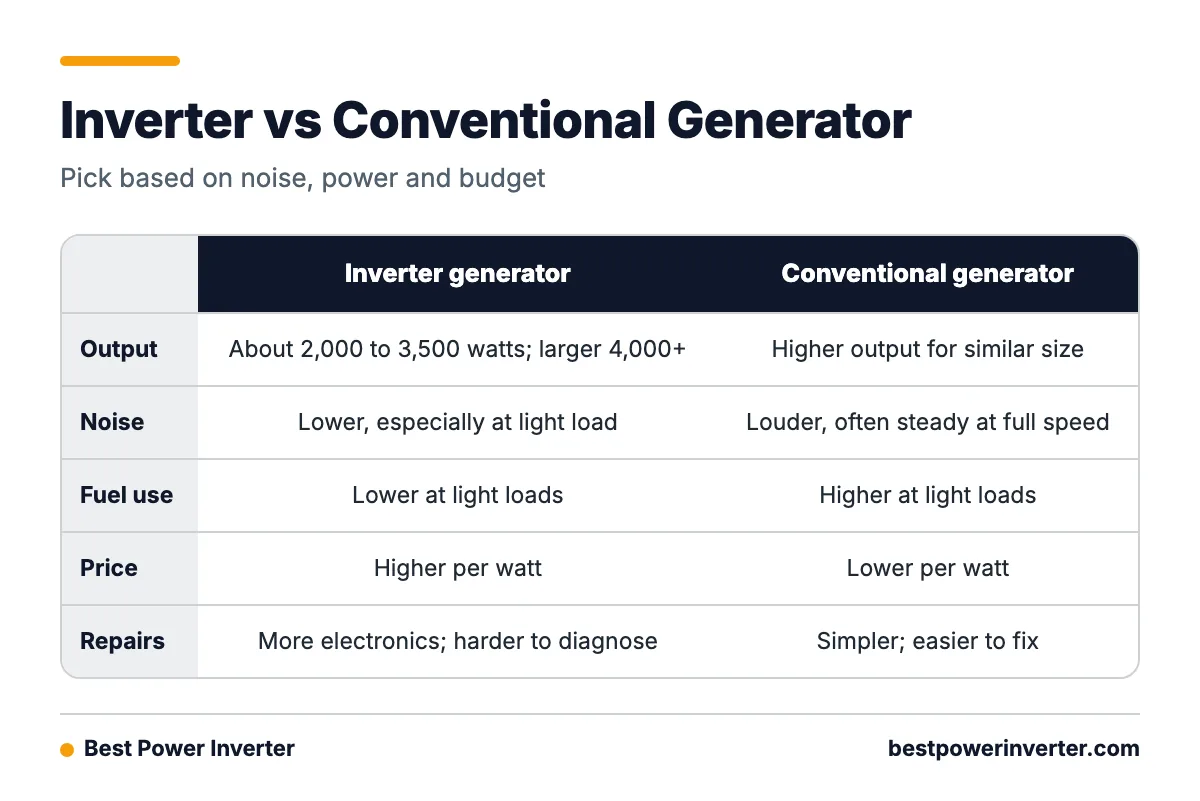
The table below compares them. Values are typical ranges based on manufacturer information and common buyer experience, so check the specific model you plan to buy.
| Feature | Inverter generator | Conventional generator |
|---|---|---|
| Output | Commonly about 2,000 to 3,500 watts; larger models 4,000+ watts | Higher output for similar size and weight |
| Waveform quality | Clean, stable sine wave | Less stable; voltage and frequency can drift |
| Noise | Lower, especially at light load | Louder, often steady at full engine speed |
| Fuel use | Lower at light loads thanks to throttling | Higher at light loads |
| Portability | Compact and lighter for the output | Larger, heavier frame, often with wheels |
| Price | Higher per watt | Lower per watt |
| Repair complexity | More electronics; harder to diagnose | Simpler; easier to fix |
| Best use | Electronics, camping, RVs, moderate backup | Job sites, heavy motors, big backup loads |
Why is an inverter generator better, and when is it not?
An inverter generator is better when quiet, fuel economy, and clean power matter more than raw wattage. It is not better when you need the most watts for the least money.
Where inverter generators win
- Sensitive electronics: Laptops, TVs, phone chargers, and medical-adjacent gadgets prefer stable voltage and frequency.
- Noise: The engine slows at light load. Compare the manufacturer’s dBA rating, and note the load it was measured at.
- Fuel use: Throttling saves fuel when you only run a few small items.
- Portability: Smaller frames are easier to lift into a truck or RV bay.
Where conventional generators win
- Maximum watts per dollar: You get more output for the money.
- High surge loads: Well pumps, air compressors, and large saws can ask for big starting power.
- Simple repairs: Fewer electronics mean fewer things that can fail.
Noise is reduced, not removed. Some owners expect near-silent operation and are surprised. Keep that in mind if neighbors sit close by.
How much power does a portable generator provide?
Portable generators range from small recreation units to large emergency backup machines. Output is rated in watts, and what you can run depends on both running watts and starting (surge) watts.
| Class | Typical output | Typical use |
|---|---|---|
| Recreation | About 2,000 to 3,500 watts | Camping, RVs, tailgating, small tools, essentials at home |
| Mid-size backup | About 5,000 to 6,000 watts | Several major appliances, window air conditioners |
| Large backup | 10,000 watts and up | Larger emergency loads on a transfer switch |
One source used for this guide notes that a typical home may need about 5,000 watts to run several major appliances and window air conditioners. Your real number depends on the loads you pick.
Are portable power generators and inverter generators the same thing? Not exactly. “Portable generator” is a broad label for any generator you can move. Inverter generators are one type of portable generator. Conventional open-frame models are the other common type.
How do I calculate the generator size I need?
Add the running watts of everything you want to power at once. Then add the single highest starting-watt requirement among those items. That is the basic method recommended in sizing guides, including the Lowe’s generator sizing buying guide.
Motors are the catch. A refrigerator compressor or sump pump may draw two to three times its running watts for a moment at startup. But motors rarely all start at the same instant, so you only add the largest surge, not every surge.
Worked example
The figures below are sample values for illustration. Real appliances vary, so check the nameplate or manual on your own equipment.
| Item | Running watts | Starting watts |
|---|---|---|
| Refrigerator | 700 | 2,100 |
| Sump pump | 800 | 2,400 |
| Furnace blower | 600 | 1,800 |
| Lights | 200 | – |
| Wi-Fi router and modem | 50 | – |
| Total running | 2,350 |
- Add running watts: 700 + 800 + 600 + 200 + 50 = 2,350 watts.
- Find the highest starting watts: the sump pump at 2,400.
- Add them: 2,350 + 2,400 = 4,750 watts.
This method is a little conservative, because the pump’s running watts are already in the total. That small cushion is useful. In this example, a 5,000-watt class unit would fit. Many 2,000 to 3,500 watt inverter generators would be too small for all five loads at once.
Can an inverter generator power a house?
Yes, with limits. A small inverter generator can power selected essentials. Larger inverter models above 5,000 watts may power an entire house when correctly sized, according to the sources behind this guide. Most homeowners, though, will run only chosen circuits.
Here are three common home-backup scenarios.
- 2,000 to 3,000 watts (essentials): A fridge, some lights, a router, phone and laptop charging, and maybe a small heater or fan. An inverter generator suits this well.
- 5,000 to 6,000 watts (several major appliances): Fridge, sump pump, furnace blower, and a window air conditioner, rotated by hand. Either an inverter or conventional unit works. The conventional one costs less.
- 10,000 watts and up (larger emergency loads): Bigger well pumps, central air, or electric ranges. This is often conventional or standby territory, and load management still matters.
Whole-house claims often skip three things: load management, a properly sized transfer switch, and professional installation. Do not skip them. The Generac home sizing article is a good place to see how loads add up.

What powers an inverter generator: gasoline, propane, or both?
Inverter generators run on gasoline, propane, or both. Models that accept both are called dual-fuel.
- Gasoline: Easy to find and energy-dense. It goes stale in storage, so use fresh fuel or a stabilizer.
- Propane: Stores well for years and burns cleaner. Output is usually a bit lower than on gasoline for the same engine.
- Dual-fuel: You can switch based on what you have. Owners like this flexibility during outages.
For how to power an inverter generator: add oil to the correct level, fill the tank with fuel (or connect propane), place the unit outdoors, start it, and let it settle before plugging in loads. Start the biggest load first, then add smaller ones. Follow your manual for the exact sequence.
Tank size matters in a long outage. Smaller tanks mean more frequent refueling, a common owner complaint. Always shut the engine off and let it cool before refueling.
How do I safely connect an inverter generator to home appliances or a transfer switch?
For a few items, run heavy-duty outdoor extension cords from the generator to the appliances. For wiring into your home, use a transfer switch installed by a licensed electrician.
Follow these basic safety rules, which also appear in the Lowe’s generator guide and in manufacturer manuals:
- Carbon monoxide: Run the generator outdoors only, well away from doors, windows, and vents. Use a battery-powered CO alarm inside.
- Never in a garage: Even with the door open, fumes can enter the home.
- Grounding: Follow the manual’s grounding instructions for your unit and your setup.
- Dry location: Keep the generator off wet ground and shielded from rain, but with open airflow.
- Cords: Use cords rated for the load and outdoor use.
Can two inverter generators run in parallel?
Yes, many inverter generators can be linked in parallel with a manufacturer cable or kit. Two smaller units then act like one larger source. This only works with models designed for it, and ideally two of the same model.
Parallel use is handy for carrying two light units instead of one heavy one. It also lets you run one unit at a time when the load is low. It will not fix a surge problem if your single biggest motor still exceeds what the pair can handle. Check the kit’s stated combined running and starting watts.
Which one should you buy?
Match the generator to your biggest need. Use this checklist and decision guide.
Choose an inverter generator if:
- You power laptops, TVs, chargers, or other sensitive electronics.
- Quiet operation matters at a campsite, RV park, or close to neighbors.
- You need moderate backup for essentials, around 2,000 to 3,500 watts or somewhat more.
- You want easy carrying and lower fuel use at light loads.
Choose a conventional generator if:
- You run construction tools or other high surge loads.
- You want the most watts per dollar.
- You need 5,000 watts or more on a limited budget.
- You prefer simpler repairs.
Choose a battery power station if: you need silent, fume-free power indoors for small loads and can recharge it.
The Lowe’s inverter generator buying guide is a useful next read before you shop.
What do owners say?
Owners like
- Quieter operation than conventional portable generators, especially at light loads
- Lower fuel consumption when the engine can throttle down
- Compact size and easier transport for camping, RV use, and emergency essentials
- Stable electrical output that users prefer for laptops, televisions, chargers, and other sensitive electronics
- Dual-fuel flexibility on models that support gasoline and propane
Common complaints
- Lower maximum output can prevent users from running several large appliances simultaneously
- Higher purchase price than similarly rated conventional generators
- Smaller fuel tanks can require frequent refueling during extended outages
- Noise is reduced but not eliminated, and some owners expect near-silent operation
- More electronic components can make diagnosis and repairs more complex or expensive
Summarised from owner reviews and long-term user reports; individual experiences vary.
Frequently Asked Questions
How to power inverter generator?
Check the oil, add fuel (gasoline, propane, or whichever the model accepts), and set the unit outdoors on level ground. Start it, let it run for a minute, then plug in your loads, largest first. Use a transfer switch if you want to feed home circuits.
How does a power inverter generator work?
The engine makes AC power, a rectifier converts it to DC, and an inverter turns that DC into clean, stable AC. Because output does not depend on engine speed, the engine can slow down at light loads to save fuel and reduce noise.
How much power portable generator provides?
It varies by class. Inverter generators commonly range from about 2,000 to 3,500 watts, with larger models at 4,000 watts or more. Conventional portable generators offer higher output at similar portability, and large units go to 10,000 watts and above.
What is power inverter generator?
It is a portable, engine-driven generator that uses inverter electronics to produce clean, stable AC power. It suits electronics, camping, RVs, and selected home backup loads.
What does a power inverter generator do?
It makes electricity from fuel and delivers it as steady, high-quality power. That lets you run phones, laptops, TVs, lights, fridges, and tools when you have no grid power.
Can inverter generator power a house?
Yes, if it is sized right. Smaller units can cover essential circuits. Larger inverter models above 5,000 watts may power an entire house, but you need load management, a properly sized transfer switch, and professional installation.
What is portable power generator?
It is any generator built to be moved, including inverter models and conventional open-frame models. It is not the same as a battery power station, which stores electricity and has no engine.
Why is an inverter generator better?
It is quieter, more fuel-efficient at light loads, easier to carry, and gives cleaner power for electronics. It is not better for raw wattage or price. Conventional generators win there.
Are Power Smart inverter generators good?
This guide has no verified testing or owner data on that brand, so no honest rating can be given. Judge any model by its rated running and starting watts, dBA rating, runtime at half load, warranty, and recent buyer reviews.
Are Power Smart inverter generators any good for home backup?
That depends on the specific model and your loads. Size the unit using your running watts plus the highest starting-watt need, then compare those numbers to the model’s rated output. If it falls short, choose a larger unit.
Sources