

Homeowners, renters, and balcony-solar shoppers who want a mini inverter for one to four panels should start with the panels, not the wattage. The right unit depends on panel voltage and current, your grid voltage, and local interconnection rules. Of the five listings below, only the Y&H 500W Grid Tie Micro Inverter is a true grid-tied microinverter. The other four are 12V battery-based inverters or off-grid kits.
Quick answer
For feeding a small solar setup into the grid, the Y&H 500W Grid Tie Micro Inverter is the only match in this group. The 12V units suit batteries, RVs, and cars, and cannot connect panels to the grid.
- Best for grid-tied panels: Y&H 500W Micro Inverter
- Best for off-grid starter power: 100W panel kit
- Best for RV battery banks: 3000W pure sine unit
Our Winner: Y&H 500W Grid Tie Micro Inverter Auto AC110V/220V Output, DC26-46V PV Input, MPPT Pure Sine Wave
Based on the listing, it is the only product here built to synchronize with the utility grid. It has MPPT, auto-sensing 110V/220V output, and a published input window for 36V-class panels. It also has the lowest listed price of the five. Its 3.6/5 rating and missing certification details mean you should verify local rules before buying.
How We Compared These Models
Based on the listing information and buyer ratings, we weighed four criteria: whether the unit can connect panels to the grid, how well its stated voltage window matches common panel specs, the clarity of its output ratings, and the star rating from verified buyers. Safety certification, warranty, and monitoring also matter, but none of the listings state them in the data we reviewed. Treat those as items to confirm on the Amazon page.
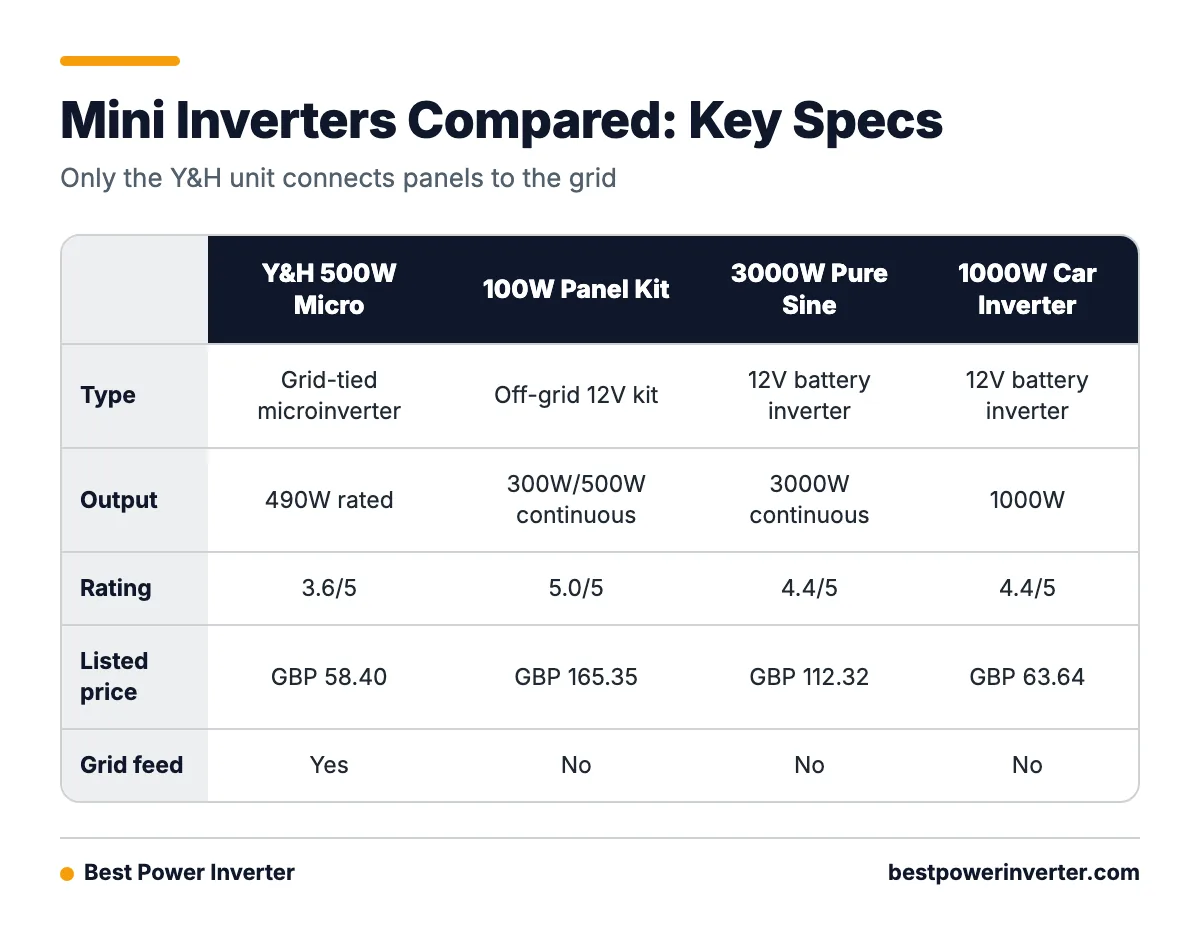
Prices in the listing data appear in GBP. Check the live price in your own currency before ordering.
| Product | Key Specs | Our Choice | Action |
|---|---|---|---|
| Y&H 500W Grid Tie Micro Inverter | Grid-tied, MPPT 24-40V, DC 26-46V input, 490W rated output, 110V/220V auto, no battery use. Listed at GBP 58.40, 3.6/5 | Editor’s Choice | |
| Complete Solar Inverter Kit with 100W Panel and 50A Charge Controller | Off-grid 12V kit, 100W panel, PWM controller, 300W/500W continuous output. Listed at GBP 165.35, 5.0/5 | Best Complete Kit | |
| 3000W Pure Sine Wave Inverter 12V DC to 120V AC | Battery inverter, 3000W continuous, 6000W peak, pure sine. Listed at GBP 112.32, 4.4/5 | Best for RV Power | |
| 1000 Watt Car Power Inverter, Pure Sine Wave | 12V DC to 120V AC, 1000W, pure sine. Listed at GBP 63.64, 4.4/5 | Best for Portability | |
| 4000W 12V to 110V/220V Solar Combination Inverter Kit with 18W Panel | 12V kit, 30A controller, 18W panel, dual USB, LCD protection display. Listed at GBP 170.00, 3.4/5 | Honorable Mention |
In-Depth Reviews

1. Y&H 500W Grid Tie Micro Inverter – Editor’s Choice
Our Verdict: This is the only listing here that does what most people mean by a mini solar inverter: it converts panel DC into grid-synchronized AC. For a single 36V-class panel feeding a small home system, it is the logical starting point.
According to the listing, the MPPT range is 24-40V, the input window is DC 26-46V, and rated output is 490W. The seller recommends panels with Vmp of 30-39V and Voc of 38-46V, and says panel power should not exceed 500W. It outputs 110V or 220V automatically and syncs in phase with the utility grid.
The listing states plainly that it does not work with batteries. It is a panel-to-grid device only. That clarity is useful, because it prevents the most common mix-up in this category.
The listing data does not state an IP rating, safety certification, warranty length, or built-in monitoring. Those gaps matter. Many utilities require listed, anti-islanding-compliant equipment, and a 3.6/5 rating suggests some buyers had problems. Confirm certification and your utility’s rules before purchase.
Why We Like It
- Built for grid-tie use with MPPT and pure sine output
- Published voltage window makes panel matching straightforward
- Lowest listed price of the five products
- Compact enough to mount near the panel
Pros & Cons
Pros
- Clear Vmp, Voc, and MPPT guidance
- Auto 110V/220V output
- Affordable entry into grid-tied solar
Cons
- Single-panel design based on the listing
- Certification, IP rating, and warranty not stated
- 3.6/5 rating signals mixed experiences

2. Complete Solar Inverter Kit with 100W Panel and 50A Charge Controller – Best Complete Kit
Our Verdict: This is the strongest option for someone who wants a self-contained off-grid starter system for camping, a cabin, or outage backup. It is not a grid-tie inverter.
The kit bundles a 100W 12V panel, a charge controller, and an inverter. The feature text describes a 30A PWM controller with automatic 12V/24V recognition and protection against overcharge, short circuits, and overheating. It lists compatibility with lead-acid and lithium batteries. The title says 50A, so the controller rating is inconsistent within the listing itself.
The output claims also need care. The listing mentions 4000W/6000W surge capacity alongside 300W/500W continuous output, and tells buyers to keep connected devices at or below 300W/500W. Plan around the continuous figure, not the headline number.
A 5.0/5 rating is encouraging, but the listing data does not show how many reviews support it. Treat it as a good sign rather than proof.
Why We Like It
- Panel, controller, and inverter in one package
- Controller protections against overcharge, short circuit, and overheating
- Works with lead-acid and lithium batteries per the listing
- Includes a cigarette lighter adapter and battery clips
Pros & Cons
Pros
- Everything needed to start charging a battery
- Weather-resistant panel per the listing
- Highest listed rating of the group
Cons
- Not grid-tied
- Controller and output figures are inconsistent in the listing
- Low continuous output of 300W/500W
- Battery is not mentioned as included

3. 3000W Pure Sine Wave Inverter 12V DC to 120V AC – Best for RV Power
Our Verdict: A good fit if you already have a 12V battery bank charged by solar and need to run larger appliances. It sits after the charge controller and battery, not between a panel and the grid.
The title lists 3000W continuous with 6000W peak, pure sine wave output, and 120V AC, which suits North American outlets. Pure sine output is generally preferred for sensitive electronics and motors. Listing details are thin: no features or specifications were provided, so cable gauge, fuse requirements, efficiency, and protections must be checked on the Amazon page.
At 3000W from a 12V source, current draw is very high. Dividing 3000W by 12V gives roughly 250A before conversion losses, so heavy cabling, proper fusing, and a capable battery bank are required. That is general electrical math, not a listing claim.
Why We Like It
- Pure sine wave output at 120V
- 3000W continuous rating with 6000W peak per the title
- 4.4/5 rating
Pros & Cons
Pros
- High output for a battery system
- Good buyer rating
- Matches 120V US appliances
Cons
- Cannot feed the grid
- Requires heavy 12V wiring and a large battery bank
- Little detail provided in the listing

4. 1000 Watt Car Power Inverter, Pure Sine Wave – Best for Portability
Our Verdict: The most practical choice for a vehicle or small portable battery setup. It is a car inverter, so it will not connect solar panels to your home.
The title lists 1000W, pure sine wave, 12V DC to 120V AC. With a 4.4/5 rating and a lower price than the 3000W unit, it suits laptops, small tools, and modest appliances. A 1000W load at 12V still draws about 83A, so a car’s cigarette-lighter socket will not support it. Use direct battery clamps or a hardwired connection.
The listing data does not include features or specifications. Check surge rating, fan noise, and protections on the product page.
Why We Like It
- Pure sine wave output
- Moderate size and price
- 4.4/5 rating
Pros & Cons
Pros
- Suits vehicles and portable batteries
- Clean power for electronics
- Affordable
Cons
- No grid-tie capability
- Needs a battery source
- Sparse listing details

5. 4000W 12V to 110V/220V Solar Combination Inverter Kit – Honorable Mention
Our Verdict: A light-duty kit for charging small devices. The 4000W in the title and the 18W panel in the bundle do not line up, so manage expectations.
The listing describes dual USB ports, an LCD display that shows battery undervoltage, overvoltage, overload, high temperature, and short-circuit warnings, and a 30A controller. An 18W panel can supply only a very small amount of energy, so it cannot support anything near the headline wattage. One feature line in the listing is garbled, and the 3.4/5 rating is the lowest of the group.
It may work as a basic demonstration or phone-charging setup. For any real power needs, look elsewhere.
Why We Like It
- LCD display with fault indicators
- USB ports for small devices
- Includes a controller and panel
Pros & Cons
Pros
- Bundled starter kit
- Diagnostic display
Cons
- Lowest rating at 3.4/5
- 18W panel is tiny relative to the 4000W claim
- Highest listed price for the least capability
- Not grid-tied
What is a mini solar inverter, and is it the same as a microinverter?
A mini solar inverter that connects to the grid is effectively a microinverter: a small unit that converts DC from one or a few panels into grid-synchronized AC. The term is also used loosely for small 12V battery inverters, which do a different job.
Module-level units also support rapid shutdown, because they convert to lower-voltage AC at the panel. Santan Solar’s rapid shutdown explainer describes the commonly cited NEC requirement of reducing PV voltage to 30V or less within 30 seconds for applicable building-mounted systems.
How does a mini inverter differ from string, hybrid, and portable power station inverters?
- Microinverter (grid-tied): panel-level conversion, no battery. The Y&H unit is in this class.
- String inverter: one larger inverter for a series string of panels. Shade on one panel affects the string.
- Hybrid inverter: handles panels, battery, and grid together.
- 12V battery inverter: converts battery DC to AC for appliances. The 3000W, 1000W, and kit products here fall in this group.
How many solar panels can each mini inverter support?
It depends on the model. The Y&H unit is described for a single 36V-class panel. Some other compact microinverters accept two panels; one listed model supports two panels with two independent MPPT trackers and up to 660W output. Hoymiles describes the HMS-2000-4WB as a 2,000 VA unit with four MPPT trackers, per Beltrona’s product information. The 12V products here do not take panels directly, apart from the kits that include a charge controller.
What panel wattage, voltage, current, and connector limits must be checked?
Check Voc, Vmp, Imp, and Isc against the inverter’s maximum DC voltage, MPPT window, and current limit. Also confirm the connector type and the AC cable standard for your region.
Voc rises in cold weather. Assuming a typical temperature coefficient of about -0.3% per degree Celsius, a panel at -10C (35 degrees below the 25C test condition) produces roughly 10.5% higher Voc than its label. The panels below are illustrative examples, checked against the Y&H limits of 46V maximum input, 24-40V MPPT, and 500W.
| Illustrative panel | Voc / Vmp | Cold Voc at -10C | Result |
|---|---|---|---|
| 300W, Imp about 9.1A | 40V / 33V | about 44.2V | Compatible |
| 400W, Imp about 11.1A | 44V / 36V | about 48.6V | Flag: exceeds 46V in cold |
| 450W, 72-cell class | 49V / 40.5V | about 54.2V | Incompatible |
| 550W | Any | Any | Incompatible: over 500W limit |
Check the exact datasheet of your panel. Low-temperature locations leave very little margin.
How much AC power can a mini inverter actually deliver?
Usable AC watts are lower than panel nameplate watts. The Y&H listing says 500W maximum panel power but 490W rated output. Real output also falls because of heat derating, startup voltage, and conversion losses. VA ratings, like the 2,000 VA figure for the HMS-2000-4WB, describe apparent power and can differ from real watts.
Should I choose one inverter per panel or one inverter for two to four panels?
One inverter per panel gives independent MPPT per module and simple expansion. A multi-input unit saves cost and wall space but concentrates failure risk in one device. Hoymiles-style multi-input units are an example, and SolaX also describes module-level power electronics, MPPT, IP67 enclosures, and 6,000V surge protection on its microinverter range.
What does a two-panel balcony system look like in practice?
Take two 400W panels, giving 800W of DC capacity. With a two-input inverter rated at 660W AC, as in the compact model described above, peak production could be clipped by up to 140W, or 17.5% of nameplate DC. This only happens near peak sun, because panels rarely reach full label output.
With two Y&H units instead, total AC capacity is about 980W, so a pair of panels within the voltage window would not clip. The listed cost would be about GBP 116.80 for two inverters at the current listing price, before accessories.
Costs often left out of product prices:
- AC cable, plugs, or trunk cable
- Breaker, fusing, and disconnects where required
- Mounting hardware for the panel and inverter
- Gateway or Wi-Fi device for monitoring
- Permit fees and electrician time
Is the inverter certified for grid connection and compliant with local rapid-shutdown rules?
Certification must be confirmed per model and region. Some utilities require listed equipment with anti-islanding protection, which shuts the inverter off when the grid goes down. Rapid shutdown rules vary, and the topic remains debated, as Solar Power World reported in 2025. The Y&H listing data does not state certification, so ask the seller or your utility before connecting.
Pre-purchase checklist
- Confirm local grid and interconnection rules, and whether a permit is needed.
- Verify rapid shutdown and anti-islanding compliance for your jurisdiction.
- Match panel Voc, Vmp, Imp, and Isc to the inverter, including cold-weather Voc.
- Check connector type and AC plug compatibility.
- Find out whether monitoring needs a gateway.
- Decide whether an electrician must install it.
- Check IP rating, temperature range, surge protection, and warranty length.
What do owners say?
Owners like
- Module-level MPPT can maintain better production when panels face different directions or are partly shaded.
- Compact designs are easier to place directly behind panels than larger string-inverter equipment.
- Built-in or app-based monitoring is valued for checking individual panel performance.
- Systems can be expanded by adding panels without replacing a central inverter.
Common complaints
- Monitoring may need a separate gateway, adding cost and setup complexity.
- Commissioning and grid handshakes can confuse DIY users.
- Replacement can be labor-intensive because the unit sits behind the panel.
- Connector, cable, and regional grid differences can make seemingly interchangeable units incompatible.
Summarised from owner reviews and long-term user reports; individual experiences vary.
Frequently Asked Questions
Does the Y&H inverter work with batteries?
No. The listing states it does not work with a battery and should only use solar panels as its DC source.
Can a 12V car inverter connect my solar panels to the grid?
No. Battery inverters such as the 1000W and 3000W units here are not grid-tied and should not be connected to the utility.
Does the inverter work with my 120V, 230V, or 240V grid?
The Y&H listing says auto 110V/220V output. Confirm it covers your exact grid voltage and frequency before buying. 240V split-phase systems in particular need verification.
What IP rating and warranty should I look for?
Outdoor-mounted microinverters are commonly sold with IP67 enclosures, as SolaX states for its range. The listing data for these five products does not state IP rating or warranty, so check the Amazon page.
Do I need an electrician?
In many regions, yes, or at least a permit and inspection. Rules differ, so check with your utility.
Conclusion
For small grid-tied solar, the Y&H 500W Grid Tie Micro Inverter is the only real match among these five, with clear voltage limits and a low listed price. Its missing certification, IP rating, and warranty details are the main risks. The 100W kit suits off-grid starters, the 3000W unit suits RV battery banks, and the 1000W unit suits portable use. The 18W kit is the weakest value. Check panel Voc and Vmp, local rules, and rapid shutdown requirements before you order.
Sources
Affiliate Disclosure: As an Amazon Associate, we may earn commissions from qualifying purchases from Amazon.com. This comes at no extra cost to you and helps support our research.