
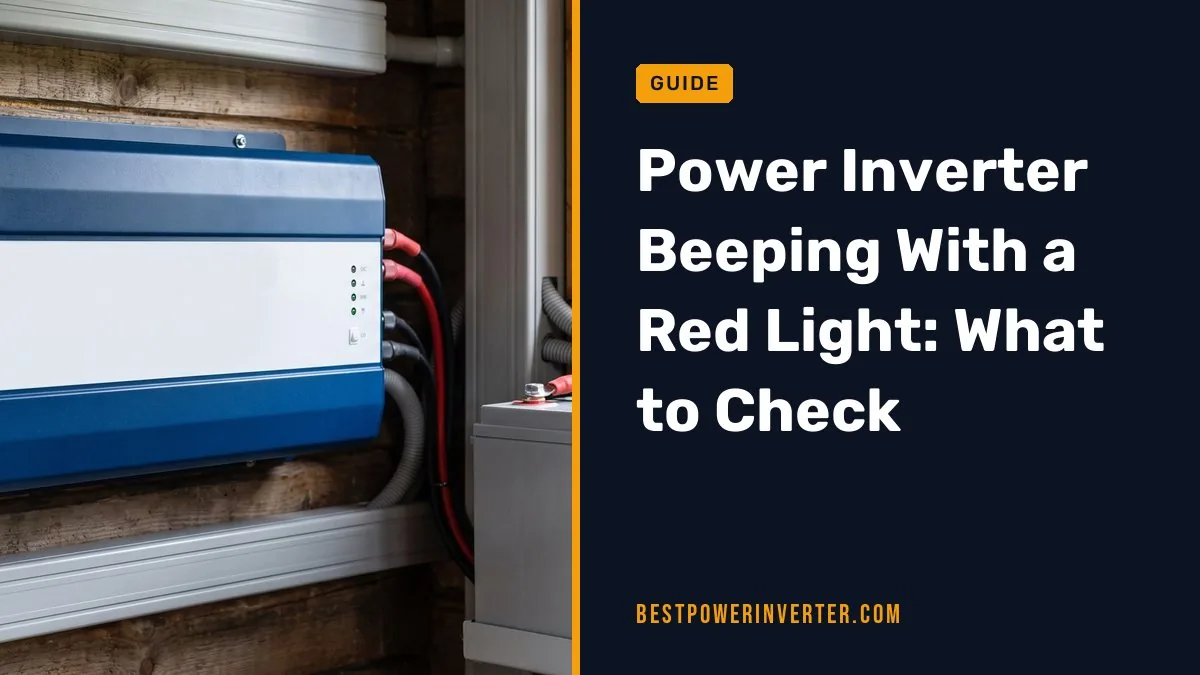
This guide is for vehicle, RV, camping and backup-power owners whose inverter beeps and shows a red light as soon as it is connected or loaded. The red light and beeping usually mean a protection circuit has tripped. The most common causes are low or high battery voltage, overload or a short circuit, overheating, or an internal fault. Disconnect every load first, then check the battery and cables before you reset anything.
Quick answer
A beeping inverter with a red light is reporting a fault, not just a warning. Switch it off, unplug all AC loads, and check battery voltage, cable tightness and airflow. Then read your manual’s beep pattern before you restart.
- Best for beeping with a load: suspect overload or startup surge
- Best for beeping with no load: suspect battery voltage or cables
- Continuous beeping with a flashing red light often means overload. Repeating single beeps often mean low input voltage.
- Overheating and input overvoltage can also cause a red light and alarm.
- Always remove loads before restarting. A short circuit or heavy load left connected can trip it again.
- If the alarm continues with no load, check battery voltage, cable voltage drop and system voltage.
- Your model’s manual and fault table override any general advice.
- What does a red light and beeping mean on an inverter?
- How can I tell low voltage beeps from overload beeps?
- Is the inverter beeping because the battery voltage is too low?
- Can an overloaded or short-circuited appliance cause the red light?
- How do I check for overheating or overvoltage?
- Could loose, undersized, or damaged battery cables cause the alarm?
- What if the inverter beeps with nothing plugged in?
- Six-step troubleshooting checklist
- When is it safe to reset the inverter?
- How to prevent repeated alarms
- Frequently Asked Questions
What does a red light and beeping mean on an inverter?
It means the inverter has detected a condition outside its safe limits and is warning you or shutting down. Enerdrive lists a red light with beeping at one-second intervals for four different faults: over-temperature shutdown, DC input overvoltage, DC input undervoltage and AC output overload. You can read this in the Enerdrive inverter beeping article.
So the red light alone does not name the problem. The beep rhythm, the LED timing and whether a load is connected narrow it down.
How can I tell low voltage beeps from overload beeps?
Listen to the rhythm. Manufacturer documentation commonly describes continuous beeping with a flashing red LED as overload. A repeating single beep with a flashing red LED commonly points to low input voltage. Use the table as a starting point, then confirm in your manual.
| Signal | Likely cause | First action |
|---|---|---|
| Continuous beeping, flashing red | Overload or short circuit | Unplug all loads, switch off 5 seconds, restart |
| Repeating single beeps, flashing red | Low input voltage | Measure battery voltage, charge or start engine |
| Red light, beeping every second | Overheat, over/undervoltage, or overload | Check manual, then work through the checklist |
| Three intermittent beeps, red light | Overload (one Photonic Universe manual) | Reduce the load |
| Red stays on with no load | Battery, cable, wrong voltage or internal fault | Test voltage at the inverter terminals |
Many guides call every beep an overload. That misses low voltage, heat and overvoltage, which sound similar. The Photonic Universe inverter manual shows how one brand splits the patterns: one beep with a green light is a low-battery warning, two beeps mean low-battery shutdown, and three beeps with red mean overload.
Is the inverter beeping because the battery voltage is too low?
It can be, especially if the beep repeats singly. One inverter manual gives reference recharge points below 12.0 V for a 12 V system, 24.0 V for a 24 V system and 48.0 V for a 48 V system. A documented 12 V example sounds its low-voltage alarm near 10.5 V DC, though thresholds vary by model.
Measure at the battery with a multimeter, then at the inverter’s input terminals. If the battery reads fine but the inverter reads much lower, you have voltage drop in the cables or connections. A load can pull a weak or tired battery down the moment you switch on. The inverter may resume when voltage returns to its operating range, or it may stay off until restarted.

Can an overloaded or short-circuited appliance cause the red light?
Yes. Overload is one of the most common causes, and a shorted cord or appliance trips it instantly. One manufacturer specifies overload protection at 125% of rated load, with a possible stop after 20 seconds. Some units shut down and need a manual restart after automatic restart attempts.
Startup surge catches people out. Running watts on a label can look safe while the first second of draw is not. Here is an illustrative example with round numbers. Always check your own labels and spec sheet.
- Inverter: 1,000 W continuous, 2,000 W surge rating.
- Small refrigerator: about 150 W running, but the compressor may briefly pull several times that. If it pulls 600 W, the inverter handles it.
- Power tool: 900 W running looks fine. If the motor draws 2.5 times that at startup, the surge is 2,250 W. That exceeds 2,000 W, so the inverter trips.
- Sustained load: at 125% of 1,000 W, a 1,250 W load could stop the unit after about 20 seconds on a model with that spec.
Pumps and air conditioners behave like the power tool. If the alarm only happens when one appliance starts, that appliance is the suspect. Test a short cord or a different appliance to rule out a short.
How do I check whether the inverter is overheating, or has input overvoltage?
For heat, switch off and touch the case carefully after a few minutes. A very hot case, a spinning-then-stopped fan, or vents blocked by bags, blankets or a tight compartment point to thermal shutdown. Let it cool, clear the airflow, and run a lighter load. Heavy loads in a hot vehicle make this worse.
For overvoltage, check what the inverter is connected to. A 12 V inverter on a 24 V system will alarm at once. One documented 12 V example shuts down near 16.5 V DC input. A charger or alternator running too high can also reach that level. Measure battery voltage while charging. If it is above the inverter’s stated limit, fix the charging source first.
Could loose, undersized, or damaged battery cables cause the alarm?
Yes. Loose lugs, corroded terminals, long runs and thin cable all cause voltage drop. The inverter then sees low input voltage even when the battery is fine. Inverters draw large current, so a small resistance becomes a big voltage loss.
- Tighten terminals with the system off.
- Clean green or white corrosion from posts and lugs.
- Look for melted insulation, warm lugs or cracked cable ends.
- Use the cable size and maximum length in your manual. Do not guess.
What should I do if the inverter beeps with nothing plugged into its AC outlets?
Treat it as a DC-side or internal problem. With no load, overload is off the list unless something is shorted inside. Check battery voltage at the battery and at the inverter terminals, then inspect the cables. Confirm the inverter voltage matches the battery system. Check for heat and blocked vents too.
If the red light stays on after disconnecting every load and voltage is correct, the cause may be an internal fault. Do not keep power cycling it.
- Repeating single beeps? Test battery voltage and cable drop (low voltage).
- Continuous beeps with a load? Remove loads and check startup surge (overload).
- Hot case or blocked vents? Cool it and improve airflow (thermal).
- Wrong battery voltage or charger high? Match system voltage and fix charging (overvoltage).
- Still red with no load and good voltage? Stop and contact support (persistent fault).
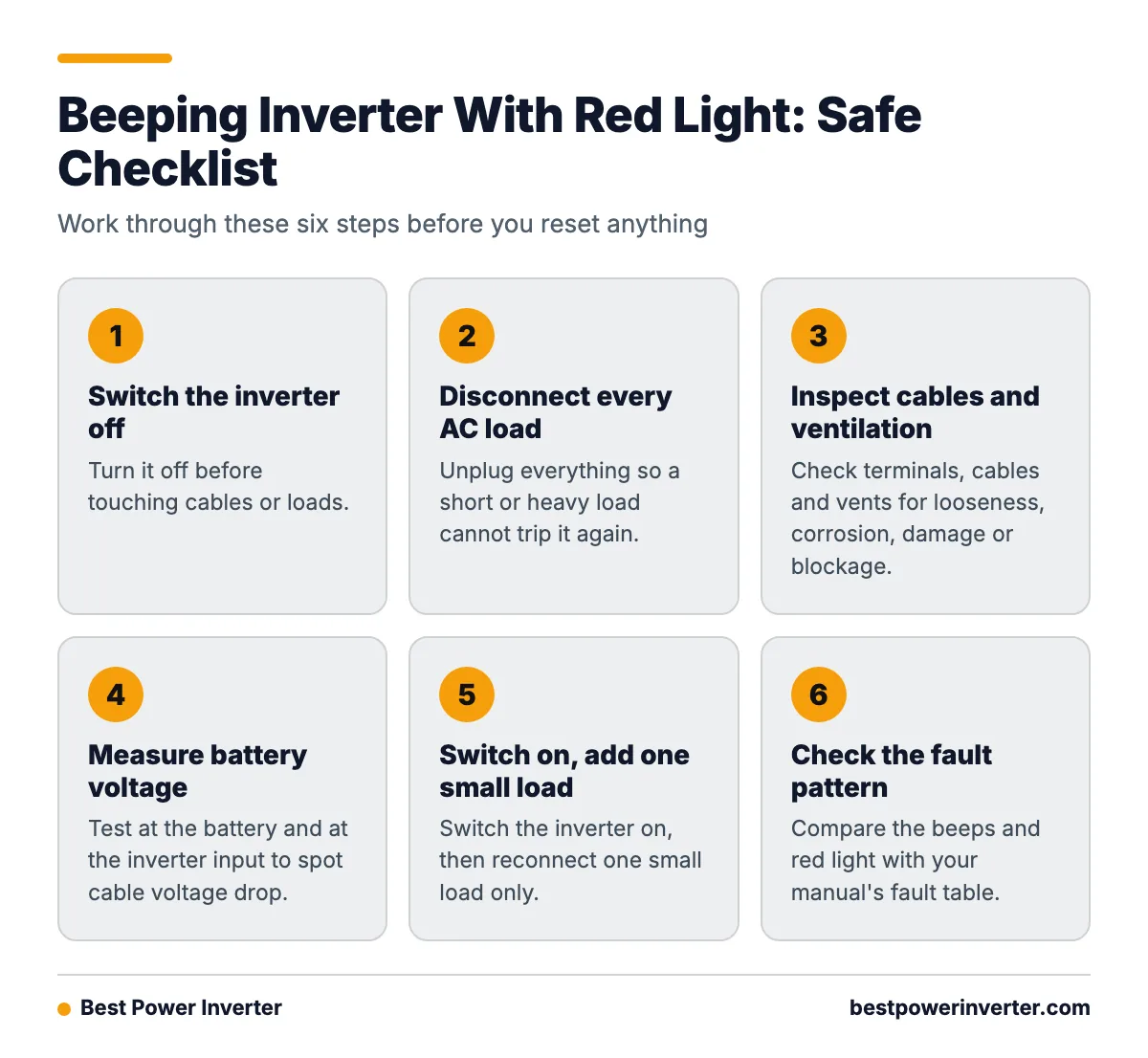
Safe six-step checklist
- Switch the inverter off.
- Disconnect every AC load.
- Inspect cables, terminals and ventilation.
- Measure battery voltage at the battery and at the inverter input.
- Switch on, then reconnect one small load.
- Read the fault pattern against your manual’s table.
Do not restart with loads still attached. That can leave a short circuit or excessive load connected.
When is it safe to reset the inverter, and when should I stop using it?
Reset only after you have fixed the cause. A typical instruction is to switch the inverter off for 5 seconds, reduce or remove the load, and switch it on again. Manuals such as this power inverter instruction manual describe alarm, overload and low-voltage protection in more detail.
Stop using it and contact the manufacturer if you see any of these:
- The red light stays on with no load and correct voltage.
- It trips again at once with a small known-good load.
- You smell burning or see melted plastic or cable insulation.
- It alarms in a cool, ventilated spot on a healthy battery.
How to prevent repeated inverter alarms

- Size the inverter to the surge of your largest motor load, not only running watts.
- Keep the battery charged and in good condition.
- Use correctly sized, short, tight DC cables.
- Leave clear space around vents and fans.
- Match the inverter voltage to the battery system.
Frequently Asked Questions
Why is my power inverter beeping with a red light when plugged in?
It has detected a fault. Common causes are low battery voltage, overload, overheating or input overvoltage. Disconnect loads, check voltage and cables, and compare the beep pattern with your manual.
Why is my inverter beeping?
Continuous beeping often means overload. Repeating single beeps often mean low input voltage. A beep with a hot case suggests thermal shutdown. Patterns vary by model.
What does it mean when my inverter beeps?
The inverter is warning you or protecting itself. It may be a low-battery warning, an overload alert, an overvoltage or overheat shutdown, or an internal fault.
What to do if inverter is beeping?
Switch it off, unplug all AC loads, and check cables, ventilation and battery voltage. Restart for a moment with one small load. If it still alarms with no load, stop and contact the manufacturer.
Sources