
Low input voltage or overload are the two most common reasons a DEWALT inverter beeps. Low voltage points to the battery or cables, while overload means the plugged-in device pulls too much. Unplug the loads first, then check the lights, battery, connections and airflow. Heat and other faults can also trigger it.
Quick answer
Beeping is a protection alarm. Unplug everything, read the LED or LCD pattern, and match it to your model’s manual. Then check battery voltage, tighten connections, let the unit cool, and restart with a smaller load.
- Beep patterns are not universal. Match the sound and lights to your exact model.
- The DXAEPI1000 shuts down below about 10.5 volts DC. The DXAEPI140 shuts down above about 16 volts DC.
- Motors can pull far more power at startup than their running rating.
- Voltage drop in the plug, cable, or fuse can trigger a low-voltage alarm even when the battery tests fine.
- If the fault returns with no load and a good battery, stop and contact DEWALT support.
- Why is my DEWALT power inverter beeping?
- Beep and light patterns by model
- Low input voltage and weak connections
- Overload and motor startup surge
- Overheating, high voltage, and faults
- How to measure voltage with a multimeter
- How to stop your DEWALT inverter from beeping safely
- When to contact DEWALT support
- Frequently Asked Questions
Why is my DEWALT power inverter beeping?
The inverter is warning you, or shutting itself down, to protect the unit, the battery, or your device. Four causes cover most cases:
- Low input voltage: the battery is weak or the power path is losing voltage.
- Overload: the load is too large, or a motor’s startup surge is too high.
- Overheating: airflow is blocked or the space is hot.
- High voltage or a fault: the input is too high, or the unit sees a short circuit or internal problem.
A low-voltage alarm also protects your vehicle battery. Ignoring it can drain the battery too far and damage it.
What does it mean when my inverter beeps? Patterns by model
Beep counts are not a universal code. DEWALT models use different sounds, lights, and thresholds. Use this table as a starting point, then confirm in the manual for your unit.
| Model | Pattern or condition | Likely cause | Threshold | What to do |
|---|---|---|---|---|
| DXAEPI1000 | Three beeps every five seconds with the low-battery indicator | Input voltage too low | Shuts down below about 10.5 ± 0.5 V DC | Unplug loads, charge or start the vehicle, check connections |
| DXAEPI140 | Shutdown from low voltage, high voltage, thermal fault, overload, or short circuit | Depends on the indicator shown | Shuts down above about 16 ± 0.5 V DC | Match the indicator to the manual, then fix that one cause |
| Plug-in models such as the DXAEPIP2W | Model-specific | Check the manual | See manual | Reduce the load, check the socket, allow cooling |
| DCB1800 battery station | Two beeps every 30 seconds with a yellow scrolling indicator | Approaching low battery | See quick-start guide | Reduce the load and recharge |
| DCB1800 battery station | Alternating yellow flashing with ten one-second beeps | System fault | Not applicable | Remove the load, reset, and contact support if it returns |
Sources: the DEWALT DXAEPI1000 manual, the DCB1800 quick-start guide, and the DXAEPIP2W manual.
What does it mean when my inverter beeps three times?
On the DXAEPI1000, three beeps every five seconds with the low-battery indicator means the input voltage is too low. Other models may use three beeps differently, so check your manual.

Low input voltage and weak connections
Low voltage is the most common reason for beeping. The alarm and the shutdown are not the same thing. The alarm warns you. The shutdown, about 10.5 volts DC on the DXAEPI1000 per its manual, is the cutoff.
Can a loose or damaged 12-volt connection make the inverter beep?
Yes. A loose clamp, a worn plug, a corroded terminal, or a weak vehicle socket adds resistance. Under load, the voltage at the inverter drops even if the battery itself is healthy. Also check the fuse, since a poor fuse contact can do the same thing.
Why is my power inverter beeping when nothing is plugged in?
With no load, the cause is almost always the input side: a discharged battery, a bad connection, or an input voltage outside the allowed range. A thermal fault from a hot, enclosed space can also trigger it. Check the battery and the cables first.
Why does my inverter beep only when I plug in a refrigerator or tool?
Motors draw a short burst of power when they start. Refrigerators, compressors, and drills can pull several times their running watts for a moment. The inverter reads that surge as an overload and beeps or shuts off. This is normal protection, not a failed unit.
Worked example: 600-watt appliance on a 1,000-watt inverter
This example uses assumed numbers to show the method. Check your appliance label for real values.
- Running load: 600 watts, which is under 1,000 watts.
- Startup surge: if the motor briefly draws three times its running watts, that is 1,800 watts. This is above the inverter’s limit, so it may trip.
- Battery-side current: 600 watts divided by 12 volts is 50 amps. With an assumed 85 percent efficiency, it is about 59 amps from the battery.
So a 600-watt motor on a 1,000-watt inverter can still fail at startup. It also pulls heavy current through the cables, which makes voltage drop worse.
How to calculate watts before you connect a load
- Find the running watts on the label. If only amps are listed, multiply amps by volts.
- Allow extra for motors. Check the label or manual for starting watts.
- Compare both numbers to the inverter’s continuous and surge ratings.
- Add all loads if more than one device is plugged in.
Why is my inverter beeping and then shutting off?
The beep is the warning, and the shutdown is the protection finishing the job. Low voltage, overload, heat, and high voltage can all do this. Check the indicator to see which one it was.
Overheating, high voltage, and faults
Inverters shed heat through vents and fans. Blocked vents, soft seats, bags, or a hot cabin can trigger a thermal shutdown. Move the unit to open air, clear the vents, and let it cool before restarting. DEWALT manuals advise good ventilation and a reduced load for these cases.
High input voltage is a separate problem. The DXAEPI140 documentation states it shuts down above about 16 volts DC. A 12-volt system should never reach that level, so a high-voltage indication points to a wrong source or a charging fault. A short circuit or system fault, such as the DCB1800’s ten-beep pattern, needs the load removed right away.

What battery voltage makes a DEWALT inverter alarm or shut down?
For the DXAEPI1000, the manual states shutdown below about 10.5 volts DC. For the DXAEPI140, shutdown above about 16 volts DC. For other models, use the manual’s figures. Do not guess.
Multimeter checklist
- Turn everything off and set the meter to DC volts.
- Measure across the battery terminals at rest. A healthy 12-volt battery usually reads around 12.6 volts when fully charged.
- Connect the inverter and start the vehicle if the manual allows it.
- Run a small load.
- Measure again at the inverter’s input terminals while the load runs.
- Compare the two readings. A large gap means voltage drop in the cable, plug, fuse, or socket.
- Battery reads low at rest: charge it or start the engine.
- Battery fine, input reading sags under load: fix or replace the cable, plug, or connection.
- Both readings fine, beeps at startup of a motor: reduce the load or use a larger inverter.
- Unit is hot: move it, clear the vents, and let it cool.
How to stop your DEWALT inverter from beeping safely
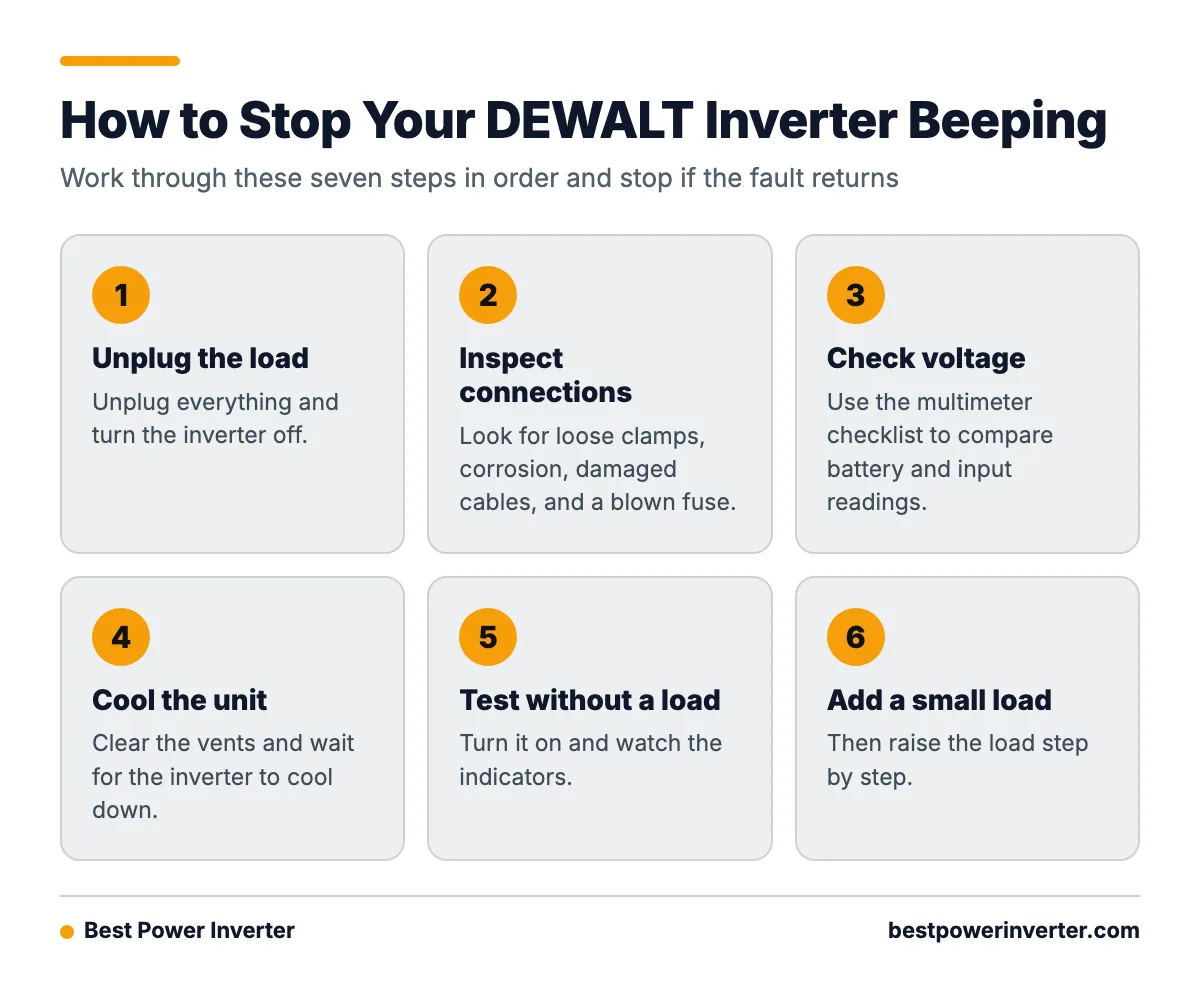
- Unplug the load. Turn the inverter off.
- Inspect connections. Look for loose clamps, corrosion, damaged cables, and a blown fuse.
- Check voltage. Use the checklist above.
- Cool the unit. Clear the vents and wait.
- Test without a load. Turn it on and watch the indicators.
- Add a small load. Then raise it step by step.
- Stop if the fault returns. Do not keep restarting it.
Repeated restarts on a weak battery can leave you unable to start the vehicle. Run the engine while using the inverter on a vehicle battery, if the manual allows it.
When does repeated beeping mean a defective inverter?
Contact DEWALT support if the unit beeps with no load, a good battery, solid connections, and good airflow. The same applies if it shows a system fault, smells hot or burnt, or shuts down immediately each time. Keep the model number and the exact beep and light pattern ready.
Frequently Asked Questions
Why is my DEWALT power inverter beeping?
It is usually warning about low input voltage, overload, overheating, or a voltage or fault condition. Unplug the load, read the indicator, and check the manual for your model.
Why is my power inverter beeping?
Most inverters beep to protect themselves. The common causes are a weak battery, a loose connection, too much load, or heat. Fix the cause before restarting.
Why is my inverter beeping?
Check the battery voltage first, then the connections, then the load size. If it also beeps with no load, look at the input side and the temperature.
What does it mean when my inverter beeps?
It means a protection limit was reached or is close. On the DXAEPI1000, three beeps every five seconds with the low-battery light means low input voltage. Other models differ, so match the pattern to your manual.
Sources