
A Jupiter inverter beeps for one of two main reasons: the battery voltage is too low, or the load is too big. Low DC input voltage is the most common cause, and it often comes from a tired battery, a loose terminal, or cables that drop too much voltage. Overload and overheating can also trigger the alarm, so disconnect your loads and check the battery and connections before you keep using it.
Quick answer
Turn the inverter off, unplug everything, and tighten the DC cable connections. Then measure battery voltage at rest and under load. If it is low, charge or replace the battery. If the voltage is fine, suspect an overload or heat.
- Best for beeping with no load: check battery voltage and terminals
- Best for beeping at startup of an appliance: check surge draw and cable size
- Most beeps mean low DC input voltage, not a broken inverter.
- A battery can look charged at rest and still sag below the alarm point when a big appliance starts.
- Loose terminals and thin or long cables cause false low-battery alarms.
- Overload and overheating have their own protection and should be ruled out.
- Isolate the fault: remove all loads, then add devices back one at a time.
- What Jupiter inverter beeping usually means
- How low can the battery voltage get before a Jupiter inverter alarms?
- Why does my power inverter beep when I turn on an appliance?
- Why is my Jupiter power inverter beeping when nothing is plugged in?
- Can loose, undersized, or long cables make the inverter beep?
- Can overheating cause a Jupiter inverter to beep?
- How do I tell whether the beep means low voltage or overload?
- How do I stop the beeping safely?
- What should I do when the inverter shows a fault light or shuts off?
- Safety precautions
- Frequently Asked Questions
What Jupiter inverter beeping usually means
The beep is a warning that a protection circuit is close to acting. Jupiter manuals say the inverter sounds an alarm when DC input voltage drops too low, and shuts down if voltage falls further to help prevent battery damage. Harbor Freight explains that this protection exists to prevent deep discharge damage to the battery.
Jupiter models also protect against high voltage, high temperature, high current, short circuit, and overload. Exact behavior varies by model, so check your manual for the specific alarm pattern.
How low can the battery voltage get before a Jupiter inverter alarms?
On the 1000-watt pure-sine model, the owner’s manual lists the low-voltage alarm at roughly 10-11 VDC. Low-voltage shutdown follows at roughly 9.5-10.5 VDC.
A healthy resting 12-volt battery sits well above these numbers. The trouble is that voltage at the inverter, under load, is what counts. That reading can be much lower than the resting voltage at the battery.
Why does my power inverter beep when I turn on an appliance?
Startup demand makes the voltage dip. Motors, compressors, and heaters pull a surge at start. Harbor Freight notes that a partially charged battery can trigger low-voltage protection when a sudden surge in demand causes its voltage to drop. This is voltage sag.
It also explains why the inverter may beep even when the battery seems fully charged. A battery that reads 12.6 V at rest but is old or has high internal resistance can collapse under heavy draw.
Worked example: what 1200 watts does to a 12-volt system
Current equals watts divided by volts. A 1200-watt load on 12 volts is 1200 ÷ 12, or roughly 100 amps, before inverter losses. Losses push the real number higher.
At 100 amps or more, a small voltage drop in a cable or a loose lug adds up fast. Even a drop of one volt can push a battery from a safe reading toward the alarm range. That is why battery condition and cable size matter so much.

Overload is the other cause. The 1000-watt manual describes overload shutdown when the load exceeds 105%, and Jupiter documentation warns that going over the continuous watt rating can cause shutdown. Compare your appliance’s running watts, and its startup watts, to the inverter’s continuous rating.
Why is my Jupiter power inverter beeping when nothing is plugged in?
With no load, the cause is almost always the DC side. Check these first:
- A discharged or aging battery
- Loose or corroded terminals
- Reversed or poor connections
- A charger or alternator that is not keeping the battery up
An inverter with no loads draws very little, so a low reading usually means the battery is truly low or the connection is poor.
Can loose, undersized, or long cables make the inverter beep?
Yes. Resistance in the cable run wastes voltage as heat. The inverter sees the lower voltage and alarms, even though the battery is fine. Common problems include:
- Loose lugs on the inverter or battery posts
- Cables thinner than the manual recommends
- Long runs between battery and inverter
- Corrosion on terminals
- A weak ground or chassis connection
Keep cables short, use the gauge your model’s manual calls for, and make sure the polarity is right: red to positive, black to negative.
Can overheating cause a Jupiter inverter to beep?
Yes. Jupiter inverters include high-temperature protection. Blocked vents, a cramped mounting spot, or a hot engine bay can cause the alarm. Move the unit to open air, keep the fan and vents clear, and let it cool before restarting. If it overheats again at a light load, stop using it and have it checked.

How do I tell whether the beep means low voltage or overload?
Match what you hear to when it happens. Your model’s manual has the exact alarm patterns, but this table covers the usual causes.
| Symptom | Likely cause | First check |
|---|---|---|
| Beeping with no load | Low battery, loose terminal | Battery voltage, lugs |
| Beeps when an appliance starts | Voltage sag or startup surge | Battery health, cable size, appliance watts |
| Continuous alarm | Low voltage, overload, or heat | Remove loads, check display |
| Fault light on | Protection tripped | Read the manual’s indicator chart |
| Automatic shutdown | Low-voltage shutdown, overload over 105%, or heat | Cool down, charge, lower the load |
- If it beeps with nothing plugged in, check the battery and DC connections.
- If it beeps only when one device runs, check that device’s watts against the rating.
- If it feels hot, improve airflow and cool it first.
How do I stop the beeping safely?
Do not keep resetting the inverter. Repeated restarts can hide the cause and stress the battery. Use this five-minute isolation checklist:
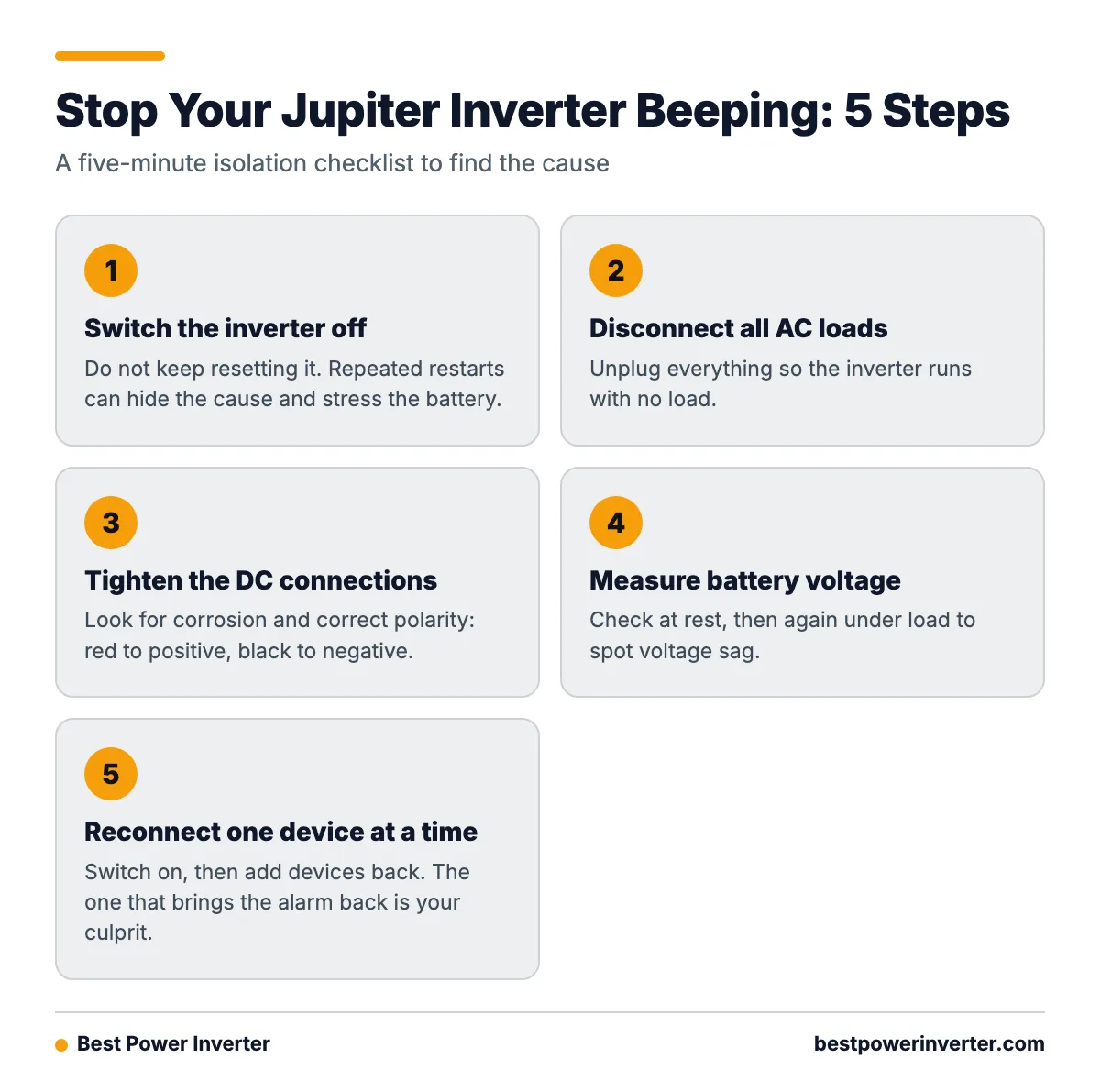
- Switch the inverter off.
- Disconnect all AC loads.
- Inspect and tighten the DC connections. Look for corrosion and correct polarity.
- Measure battery voltage at rest, then again under load.
- Switch on, then reconnect one device at a time.
The device that brings the alarm back is your culprit. It may be too large, or it may expose a weak battery or cable.
What should I do when the inverter shows a fault light or shuts off?
Turn it off, remove the loads, and let it rest. Then look up the light or message in your manual, since indicators differ by model. Charge or test the battery, check the cables, and restart with a light load. If it still faults with no load and a good battery, the inverter may need service. A battery that will not hold voltage needs replacement. Get a professional to check the inverter if it keeps failing.
Safety precautions
- Switch off and unplug loads before touching DC cables.
- Never short the battery terminals. Use insulated tools.
- Connect red to positive and black to negative.
- Keep the battery area ventilated, especially with lead-acid batteries.
- Do not open the inverter. AC output can be dangerous.
Frequently Asked Questions
Why is my Jupiter power inverter beeping?
Most often the DC input voltage is too low. The battery may be discharged, a terminal may be loose, or the cables may drop too much voltage. Overload and overheating can also cause it. Remove loads and check the battery first.
Why is my power inverter beeping?
An inverter beeps to warn of low battery voltage, overload, overheating, or a fault. Note when it beeps: with no load, at appliance startup, or constantly. That timing points to the cause, as shown in the table above.
Why is my inverter beeping?
Check battery voltage and the cable connections first, since low input voltage is the most common trigger. Then confirm your load is under the continuous watt rating and that the vents are clear. Consult your model’s manual for its specific alarm patterns.