

For most household electronics, choose a pure sine wave inverter or portable power station with enough continuous wattage for the combined load, enough surge capacity for motors, and at least 20% headroom. Small models around 300W continuous and 600W surge suit phones, laptops, routers, and lights. Refrigerators, pumps, heaters, and kettles need far more capacity.
Quick answer
Add up your running watts, add the largest startup surge, then add 20% headroom. For phones, laptops, and routers, a small 200W to 300W unit is enough. Heating and compressor loads are not.
- Best for tool-battery owners: the 220W Dewalt-compatible inverter
- Best for whole-home backup: BILT HARD 5500W generator, outdoors only
This guide covers five Amazon listings. Three of them have very little specification data in the product feed, so we flag what you must confirm before buying. All analysis is based on listing information, manufacturer-style specifications, and recurring buyer feedback patterns, not personal testing.
Our Winner: 220W Power Inverter Compatible with Dewalt 20V Battery
It is the only small inverter in this group with a full, verifiable feature list: a 220W rating, one AC outlet, two 18W USB QC ports, a 30W USB-C PD port, a 400-lumen work light, and protection against short circuits, overload, low voltage, and overheating. At $31.99 it is also an inexpensive way to cover phones, laptops, and a router if you already own compatible batteries.
How We Compared These Models
We compared the products on four criteria: continuous wattage versus your actual load, the documented safety protections, how the unit is powered (tool battery, internal battery, or fuel), and the quality of the specification data on the listing. Buyer feedback repeatedly centers on real-world runtime and surge handling, so those matter more than headline numbers. Where a listing does not state waveform or wattage, we say so.
| Product | Key Specs | Our Choice | Action |
|---|---|---|---|
| 220W Dewalt-Compatible Power Inverter | 220W, 1 AC outlet, 2 USB QC, 1 USB-C PD 30W, LED light, battery not included | Editor’s Choice | |
| Small Power Inverter for Home Use (B0F1SR9L9W) | 4.5/5 rating, specs not listed in feed | Runner-Up | |
| Small Power Inverter for Home Use (B0DLKP7BNY) | 4.5/5 rating, specs not listed in feed | Also Consider | |
| Small Power Inverter for Home Use (B0CQ4Q6WB9) | 4.5/5 rating, specs not listed in feed | Also Consider | |
| BILT HARD 5500W Dual Fuel Inverter Generator | 5500W starting, 4000W running (gasoline), 61.7 lb, CO auto-shutoff | Best Premium |
In-Depth Reviews

1. 220W Power Inverter Compatible with Dewalt 20V Battery – Editor’s Choice
Our Verdict: The best small option here for low-wattage home backup if you already own Dewalt 18V/20V batteries. It is inexpensive, documented, and includes useful protections.
The listing says it converts 18V DC to 110V to 120V AC and works with batteries such as the DCB206, DCB205, and DCB204. The battery is not included. That makes it a bare inverter, not a power station, so runtime depends entirely on the pack you attach.
As a rough example, a 5Ah pack at 18V nominal holds about 90Wh. At 85% efficiency and a 50W load, that is roughly 1.5 hours. Treat that as an estimate, not a rating.
The listing does not state waveform. For chargers and laptops this is usually fine, but confirm before powering medical devices or motor loads.
Why We Like It
- One AC outlet plus two 18W USB QC ports and a 30W USB-C PD port charge several devices at once.
- The 400LM work light has three brightness levels, a strobe, and a 90-degree adjustable angle.
- Listed protections include short circuit, overcurrent, low voltage, overheating, overload, and over-discharge, with a built-in cooling fan.
- The $31.99 price is low for an inverter with this port mix.
Pros & Cons
Pros
- Low price
- Strong port variety
- Detailed safety protections
- Reuses existing tool batteries
Cons
- Battery not included
- 220W limit rules out most appliances
- Waveform not stated
- Cooling fan may be audible under load

2. Small Power Inverter for Home Use (B0F1SR9L9W) – Runner-Up
Our Verdict: A well-rated listing (4.5/5) that fits the search, but the data we have is too thin to rank it higher.
The feed gives no wattage, waveform, outlet count, or battery details. Before buying, check the listing for continuous and surge watts, whether output is pure sine wave, and whether it needs an external battery.
Why We Like It
- Carries a 4.5/5 star rating on Amazon.
- Positioned for home use, which suggests a small-load design.
Pros & Cons
Pros
- Strong overall rating
Cons
- Specifications not available to verify
- Price not shown in our data

3. Small Power Inverter for Home Use (B0DLKP7BNY) – Also Consider
Our Verdict: Worth a look if the listing confirms pure sine wave output and a wattage that matches your load.
As with the previous listing, no specifications were available. Use the sizing worksheet below to decide what wattage you need, then compare it with the listing details.
Why We Like It
- 4.5/5 rating on Amazon.
- Marketed for home use rather than only vehicle use.
Pros & Cons
Pros
- Good buyer rating
Cons
- Wattage, waveform, and battery type unverified here
4. Small Power Inverter for Home Use (B0CQ4Q6WB9) – Also Consider
Our Verdict: A 4.5/5 listing with no image or specification data available to us, so verify everything on the product page.
Confirm continuous watts, surge watts, waveform, input voltage, and any safety certifications before purchase.
Why We Like It
- 4.5/5 rating from Amazon buyers.
Pros & Cons
Pros
- Positive buyer rating
Cons
- No verifiable specifications in our data

5. BILT HARD 5500W Dual Fuel Inverter Generator – Best Premium
Our Verdict: The only option here that can handle a refrigerator, pump, or several appliances, but it is a fuel-burning generator for outdoor use, not a small indoor inverter.
- Brand: BILT HARD
- Fuel Type: Gasoline, Liquefied Petroleum Gas
- Weight: 61.7 pounds
- Voltage: 120 volts
- Dimensions: 23.23″L x 18.7″W x 12.6″H
- Engine Type: 4 Stroke
The listing states 5500 starting watts and 4000 running watts on gasoline, or 5000 starting and 3600 running on LPG. It has a 160CC OHV engine, a 1.14-gallon tank, 120V 20A outlets, a 120V 30A RV outlet, 12V DC output, and a USB-C/USB-A adapter. Economy Mode lowers engine speed under light loads, and a display cycles through volts, frequency, amps, watts, runtime, and fuel level.
Safety features include carbon monoxide auto-shutoff, low-oil protection, overload indicators, and AC/DC breakers. Even so, run any gasoline generator outdoors and well away from windows and doors.
Why We Like It
- Surge and running capacity far beyond any small inverter.
- Dual-fuel flexibility with gasoline or LPG.
- Parallel connectors allow pairing two identical inverter generators.
- Highest rating in the group at 4.8/5.
Pros & Cons
Pros
- Powers high-draw appliances
- CO auto-shutoff
- Many outlet types
Cons
- Outdoor use only
- 61.7 lb weight
- Needs fuel and maintenance
- Overkill for phones and routers
What Is the Difference Between a Small Standalone Inverter and a Portable Power Station?
A standalone inverter converts DC power from an external battery to AC, while a portable power station combines the inverter, battery, and battery management in one case. The Dewalt-compatible unit above is the first type. Its runtime depends on the pack you supply.
A power station avoids wiring and external batteries, and its battery-management system typically adds protections such as short-circuit, overcharge, and overvoltage protection. Jackery, for example, lists these on its Explorer 300 Plus specifications, which describe a 300W pure sine wave inverter, 600W surge, and 288Wh battery.
Do I Need a Pure Sine Wave Inverter for Home Appliances?
Pure sine wave is the safer choice for sensitive electronics, motor-driven appliances, variable-speed devices, and medical equipment. Victron notes that pure sine wave output suits sensitive electronics such as computers. Modified sine wave units can cause heat, noise, or charger problems on some devices.
If a listing does not state the waveform, assume you need to confirm it before powering anything important.
How Many Watts Do I Need for a Laptop, Router, TV, Lights, or CPAP Machine?
Most of these devices draw well under 150W each. The figures below are typical ranges, so check the label on your own equipment.
- Phone charger: about 5W to 20W
- Router or modem: about 10W to 20W each
- Laptop: about 45W to 100W
- LED bulb: about 8W to 15W each
- TV: about 50W to 150W
- CPAP: often 30W to 60W, higher with a heated humidifier
How Do I Calculate Continuous Wattage and Startup Surge?
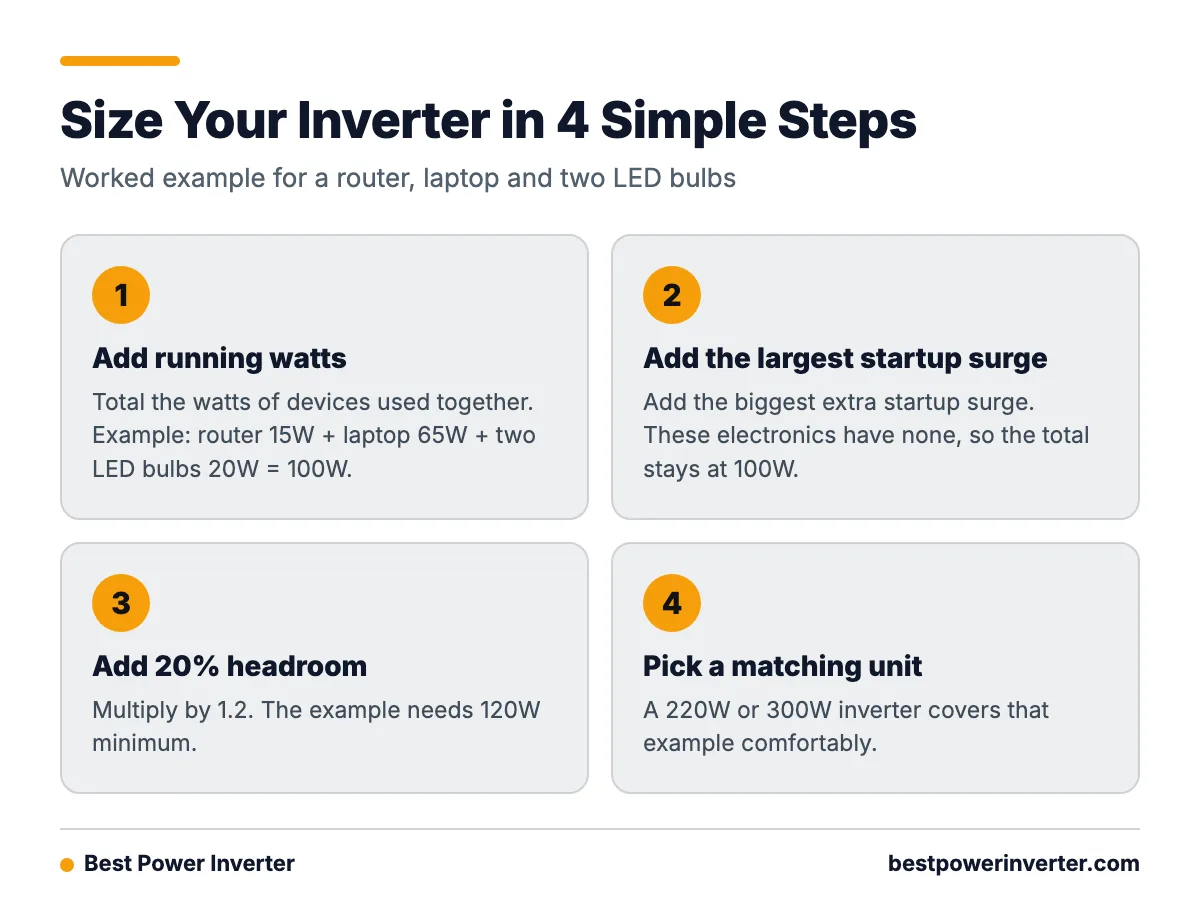
Add the running watts of everything that will run at once, add the largest single startup surge, then add at least 20% headroom. Victron advises sizing for both the continuous load and the expected simultaneous peak, and this inverter size chart recommends the same 20% margin.
Sizing Worksheet
- Step 1: Total running watts of devices used together (example: router 15W + laptop 65W + two LED bulbs 20W = 100W).
- Step 2: Add the largest extra startup surge (none for these electronics).
- Step 3: Multiply by 1.2 for headroom. Result: 120W minimum.
A 220W or 300W inverter covers that example comfortably.
Can a Small Inverter Run a Refrigerator, Microwave, Kettle, Heater, or Fan?
A small inverter can run a fan, but not reliably a refrigerator, and it cannot run a kettle, heater, or microwave. Heating appliances commonly draw 1,000W to 1,800W continuously. Refrigerators have compressors that need a startup surge of several times their running watts.
Is a 300W Inverter Enough for Emergency Home Backup?
A 300W inverter is enough for communications and light, not for whole-home backup. It covers phones, laptops, a router, and a few LED lights. It will not support cooking, heating, cooling, or most kitchen appliances.
Emergency-Load Checklist
- Suitable: phones, tablets, laptops, routers, LED lights, small fans, many CPAP units (verify wattage)
- Unsuitable: kettles, space heaters, microwaves, hair dryers, central air conditioners, well pumps
What Battery Capacity in Watt-Hours Should I Choose, and How Long Will It Run?
Runtime is roughly battery watt-hours multiplied by inverter efficiency, divided by load watts. Watt-hours measure stored energy, while inverter watts measure how much power can be delivered at once. These are different limits.
Worked example: a 288Wh station supplying 100W at 85% efficiency gives 288 x 0.85 / 100, or about 2.4 hours before reserve losses. For eight hours at 100W, you would need roughly 940Wh.
What Input Voltage and Battery Type Are Compatible With the Inverter?
Input voltage must match the source exactly. The Dewalt-compatible unit above expects 18V/20V tool batteries. Other bare inverters use 12V or 24V batteries. Use cables rated for the DC current, keep them short, and allow ventilation.
Which Safety Features and Certifications Should I Check?
Look for overload, short-circuit, low-voltage, and overheating protection, plus a low-battery shutdown. Check the listing for recognized safety certifications such as UL or ETL. If none are listed, ask the seller before using it for important loads.
What Do Owners Say?
Owners like
- Compact units are convenient for charging phones, laptops, routers, lights, and other low-wattage devices.
- Built-in displays make remaining battery capacity and output load easy to monitor.
- Pure sine wave models generally work well with sensitive electronics and standard chargers.
- Portable power stations avoid the wiring and external-battery setup required by standalone inverters.
Common complaints
- Some owners report disappointing inverter performance under heavier or surge-intensive loads.
- Advertised battery capacity overstates practical AC runtime because conversion losses and reserve limits reduce usable energy.
- Small units cannot reliably run heating appliances, microwaves, refrigerators, or other high-surge loads.
- Fans may become noticeable under sustained loads.
- Charging and recharging can take longer than expected when using low-power inputs such as small solar panels.
Summarised from owner reviews and long-term user reports; individual experiences vary.
Frequently Asked Questions
Can I use the Dewalt-compatible inverter without a battery?
No. The listing states the battery is not included, and the unit needs a compatible Dewalt 18V/20V pack to operate.
Is the BILT HARD generator safe to use indoors?
No. Gasoline and LPG engines produce carbon monoxide. Run it outdoors, away from windows and doors. The built-in CO auto-shutoff is a backup, not permission to use it inside.
Why does my battery run out faster than the math suggests?
Conversion losses, reserve limits, and higher loads reduce usable energy. Buyers commonly report that real AC runtime is lower than the rated capacity implies.
Should I buy a small inverter or a power station for outages?
Choose a power station if you want a plug-and-play setup with integrated battery protection. Choose a bare inverter only if you already own the battery and understand the wiring and voltage requirements.
Conclusion
For basic outage needs like charging phones, running a router, and powering lights, the 220W Dewalt-compatible inverter is the best-documented small option in this group, especially for anyone who already owns the batteries. The three generic listings are worth checking only after you confirm wattage, waveform, and input requirements. The BILT HARD generator is the choice when you need to run appliances, but it belongs outdoors and is a different product category. Size your load with the worksheet above, keep 20% headroom, and avoid heating and compressor loads on small units.
Sources
Affiliate Disclosure: As an Amazon Associate, we may earn commissions from qualifying purchases from Amazon.com. This comes at no extra cost to you and helps support our research.