
Many people add up every appliance in the house and compare the total to 5,000 watts. That is the wrong test. A 5 kW inverter can supply up to 5,000 W of continuous AC power, so you only need to add the loads that run at the same time, plus motor startup surges. That is usually enough for lights, a fridge, a TV, Wi-Fi, laptops and a few kitchen or laundry items, but not an oven, kettle, water heater and dryer together.
Quick answer
A 5 kW inverter can run about 5,000 W of loads at once. Think essentials: lighting, refrigeration, electronics, a microwave and a washing machine. Heavy heating appliances use up the budget fast, so run them one at a time.
- Best for essential backup: fridge, lights, Wi-Fi, TV, laptops
- Best for a busy kitchen: stagger the kettle, oven and microwave
- 5 kW means 5,000 watts of continuous output, but only if the label says kW and not kVA.
- Size by what runs at the same time, not by every appliance you own.
- Motors in fridges, pumps and compressors can draw much more at startup than while running.
- Add about 25% to your calculated load as a safety margin.
- Battery current, efficiency, heat and settings can all reduce real output.
- A 5 kW inverter and a 5 kW solar array are two different ratings.
- What does a 5 kW inverter mean?
- How much does 5 kW power in watts?
- What will a 5 kW inverter run at the same time?
- Can a 5 kW inverter run a refrigerator, freezer, pump, or air conditioner?
- Why can’t a 5 kW inverter run every appliance in my home?
- How many watts does my inverter need to be?
- What affects the output you actually get?
- Grid-tied, off-grid and hybrid inverters
- Is a 5 kW inverter the same as a 5 kW solar array?
- Why is my inverter not producing power?
- Does an inverter consume power with nothing connected?
- What do owners say?
- Frequently Asked Questions
What does a 5 kW inverter mean?
It means the inverter is rated to deliver 5 kilowatts, or 5,000 watts, of continuous AC output. That is the power it can feed to your appliances for hours, not just for a second.
The label matters. Some inverters are rated in kVA, not kW. kVA is apparent power. Real power is kVA multiplied by the power factor. A 5 kVA inverter with a 0.8 power factor delivers about 4 kW of real power. A model with a power factor near 1.0 may deliver close to 5 kW. So a “5 kVA” unit and a “5 kW” unit are not always the same size.
Look for three numbers on the datasheet: continuous output in watts, surge (peak) output, and the time the surge can last. The continuous number sets your everyday limit. The surge number sets what you can start for a moment.
How much does 5 kW power in watts?
5 kW equals 5,000 watts. Every appliance label shows watts, so the math is simple: the running watts of everything on at once must stay under that number. Better yet, stay well under it.
The table below shows typical ranges. Wattages vary a lot by model and age, so treat these as planning estimates and verify against the nameplate.
| Appliance | Typical running watts | Likely starting watts | Practical on 5 kW? |
|---|---|---|---|
| LED lighting (whole home) | 100-300 | Same as running | Yes |
| Wi-Fi router and modem | 20-40 | Same as running | Yes |
| Laptop | 45-100 | Same as running | Yes |
| Television | 80-250 | Same as running | Yes |
| Refrigerator | 100-250 | Often 3 times running or more | Yes |
| Chest freezer | 100-200 | Often 3 times running or more | Yes |
| Microwave | 1,000-1,500 | Close to running | Yes, alone with light loads |
| Washing machine | 500-1,000 | Higher at motor start | Yes |
| Water pump (small) | 500-1,000 | Often 2-3 times running | Usually, check surge |
| Window or small split AC | 500-1,500 | Often 2-3 times running | Usually, one unit |
| Electric kettle | 1,500-2,000 | Same as running | Yes, briefly |
| Electric oven or cooktop | 2,000-3,500 | Same as running | One at a time |
| Electric dryer | 2,000-5,000 | Higher at motor start | Rarely with other loads |
| Electric water heater | 3,000-4,500 | Same as running | Rarely with other loads |

What will a 5 kW inverter run at the same time?
It will run any mix of loads whose combined running watts stay under the continuous rating, with room left for startup surges. A worked example shows how to check this.
Say a household wants lights, a refrigerator, Wi-Fi, a television, a laptop, a microwave and a washing machine all on together.
| Load | Planning watts |
|---|---|
| Lights | 300 |
| Refrigerator | 200 |
| Wi-Fi | 30 |
| Television | 200 |
| Laptop | 70 |
| Microwave | 1,400 |
| Washing machine | 800 |
| Total | 3,000 |
Now add the 25% margin. 3,000 W times 1.25 equals 3,750 W. That is under 5,000 W, so a 5 kW inverter fits this load with about 1,250 W of headroom for fridge and washer startup. A smaller 3 kW unit would not.
Now change the picture. Add an electric kettle at 1,800 W and an oven at 2,500 W. The total jumps to about 7,300 W. That is too much. The fix is not a bigger inverter first. It is scheduling: boil the kettle, then start the washer.
If your total with margin is under 5,000 W: a 5 kW inverter should fit.
If it is 5,000 W or more: stagger the heavy loads, or move to a larger inverter.
If motors are the big loads: check the surge rating before you decide.
Can a 5 kW inverter run a refrigerator, freezer, pump, or air conditioner?
Usually yes for a refrigerator and freezer, often yes for a small pump, and sometimes for one air conditioner. The catch is startup power, not running power.
Motors and compressors, such as those in fridges, pumps and power tools, can draw substantially more power for a moment when they start. A fridge that runs at 150 W may pull several times that for a second or two. A 5 kW inverter normally has a surge rating well above 5,000 W, but you must confirm it on the datasheet and check how long the surge is allowed.
- Refrigerator and freezer: easy. Even with both starting, the load is small compared to 5 kW.
- Well or water pump: check the nameplate for running and locked-rotor amps. Convert amps to watts by multiplying by voltage.
- Air conditioner: one window or small split unit is usually fine. Large central units may not be. Inverter-type (variable speed) units start more gently than fixed-speed ones.
- Power tools: a table saw or compressor can spike hard. Run one at a time.
Why can’t a 5 kW inverter run every appliance in my home?
Because a home’s connected load is much bigger than 5,000 W, and the inverter only has that much output at any moment. Add up the nameplates on every appliance and the total often passes 15,000 W. You never use it all at once, but a few heating appliances running together can still pass the limit.
Three things usually cause trouble:
- Too many heating loads at once. Oven, kettle, dryer and water heater together can pass 10,000 W.
- Surges stacking up. Two motors starting together can trip the inverter even if running watts look fine.
- Voltage mismatch. Some homes use 240 V loads, and a single-phase 5 kW unit must be wired and rated for them.
The usual answer is a priority list. Put essential circuits on the inverter and leave the heavy ones off, or run them by hand when the rest of the house is quiet.
How many watts does my inverter need to be?
It needs to be at least your highest simultaneous running load plus about 25%, and its surge rating must cover your biggest motor starts. Sizing guides, such as this inverter sizing guide from SolarZA, base the calculation on what runs together, not on daily energy use or the number of appliances.
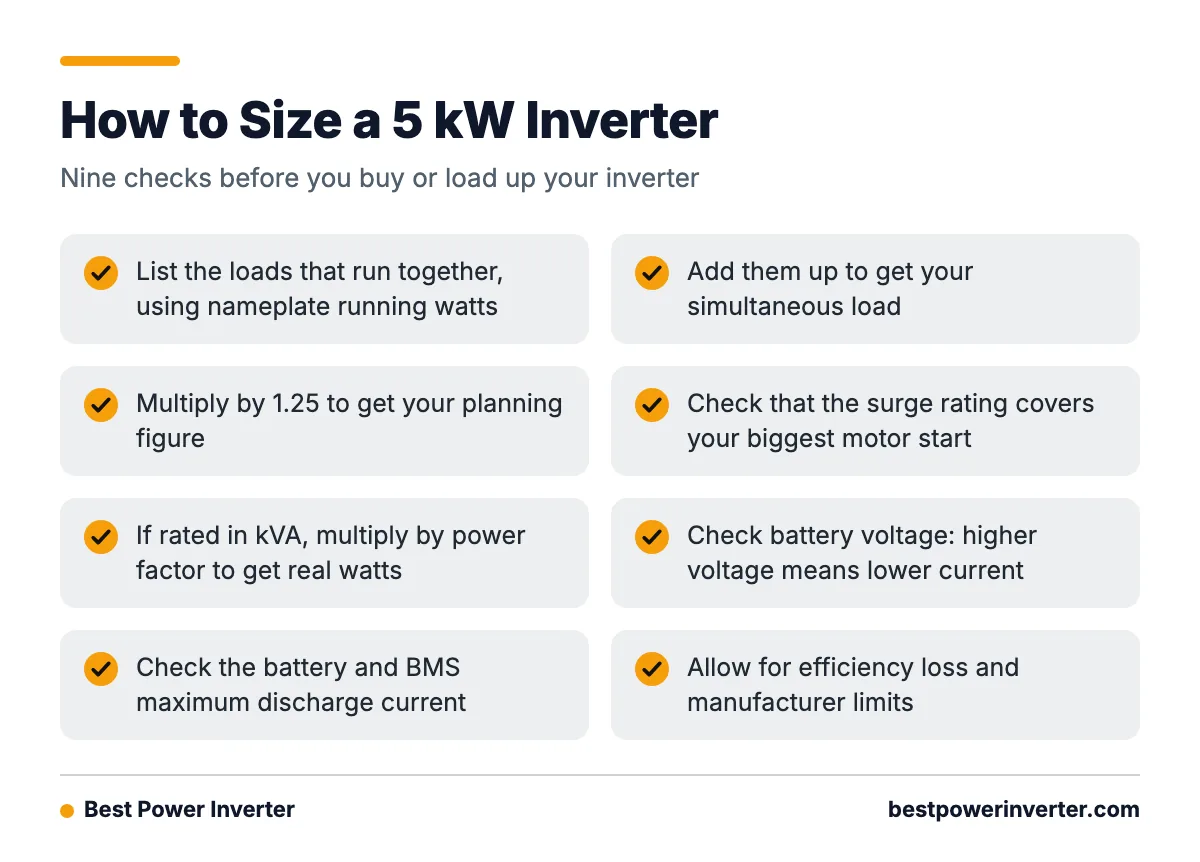
Use this checklist:
- List the loads that run together. Write the running watts from each nameplate.
- Add them up. That is your simultaneous load.
- Multiply by 1.25. This is your planning figure. Use a bigger margin for motor-heavy homes.
- Check surge. Find the largest motor start and make sure the inverter’s surge rating covers it with the other loads on.
- Check power factor. If the unit is rated in kVA, multiply by its power factor to get real watts.
- Check battery voltage. Higher voltage means lower current for the same power.
- Check maximum discharge current. The battery and its BMS must supply what the inverter asks for.
- Check efficiency. Expect some loss between battery and outlet.
- Read the manufacturer limits. Temperature, altitude and input limits can all lower output.
A broader walk-through of battery and panel sizing is in this solar system sizing guide.
How do battery voltage, efficiency, surge capacity, and power factor affect available output?
Each one can lower the power you can really use, even when the inverter label says 5 kW.
Battery voltage and current. A 5 kW inverter on a 48 V battery needs roughly 104 A at full load. That is 5,000 divided by 48, before losses. On a 24 V system the same load needs about 208 A, and on 12 V about 417 A. Higher current means thicker cables, bigger fuses and more heat. This is why 5 kW inverters are commonly paired with 48 V batteries.
Efficiency. Typical inverter efficiency is about 90% to 95%. At 92%, delivering 5,000 W takes about 5,430 W from the battery, or roughly 113 A at 48 V. Check the datasheet efficiency curve, because efficiency is lower at very light loads.
Battery limits. A battery’s maximum discharge current and its BMS can cap output below what the inverter could deliver. A small battery that allows only 50 A at 48 V gives about 2,400 W, no matter what the inverter label says. Weak cables and loose lugs add voltage drop and heat.
Surge capacity. This is the short burst the inverter can give for motor starts. It is a separate number from the continuous rating, and it only lasts for a short time.
Power factor. This matters most when ratings are in kVA. Always convert to real watts before you compare.

Grid-tied, off-grid and hybrid: what is the difference?
The type decides whether the inverter can run your home when the grid fails.
- Grid-tied: feeds solar power into the grid. It shuts down during an outage as a safety rule, so it will not power your fridge in a blackout.
- Off-grid: runs from batteries and solar only. It has to cover every load itself, so sizing is stricter.
- Hybrid: works with solar, batteries and the grid. It can switch to backup mode during an outage and power an essential-loads panel.
Backup ports on some hybrid models carry less power than the main output. Check whether the 5 kW rating applies to the backup side too.
Is a 5 kW inverter the same as a 5 kW solar array?
No. A 5 kW solar array describes how much DC power the panels can produce in ideal sunlight. A 5 kW inverter describes the most AC power it can output. One is potential generation. The other is a ceiling on delivery.
Neither one tells you daily energy, which is measured in kilowatt-hours. A 5 kW array may make far less than 5 kW on a cloudy morning, and it will only make a few hours of full output in a day. Arrays are often a little larger than the inverter on purpose. For a deeper look at off-grid sizing, see this 5 kW off-grid sizing guide.
Why is my inverter not producing power?
The most common causes are an empty battery, an overload, a wrong operating mode, a tripped breaker or a fault. Work through them in order, from the simplest to the hardest.
- Check the operating mode. Many hybrids have modes such as grid-first, battery-first or solar-first. A wrong setting can stop output.
- Check battery voltage. A low battery can trigger a low-voltage cutoff. Charge it and test again.
- Check for overload. Unplug everything, then add loads back one by one. If it trips when a motor starts, you have a surge problem.
- Read the fault codes. The display or app usually shows a code. Look it up in the manual before resetting.
- Check AC breakers. Both the inverter’s own breaker and the panel breaker must be on.
- Check temperature. Hot inverters reduce output (derate) or shut down. Clear vents and dust, and make sure the fan runs.
- Check solar or grid input. If the PV input voltage is too low, or the grid is out of range, the unit may not start or may limit power.
If output is low rather than zero, the cause is often a battery discharge limit, a derating setting or a surge-only trip. Also check cables and connections for heat and loose terminals, with the system fully off first.
Does an inverter consume power with nothing connected?
Yes. Every inverter uses a small amount of power just to stay on, called idle, standby or no-load consumption. The datasheet lists it. It is small compared with 5,000 W, but it runs all day and night, so over a day it takes real energy from the battery.
This matters most for small backup systems that sit idle for days. If your model has a sleep or eco mode, it can lower idle draw, though it may not wake for very small loads. Test it with your own devices before relying on it.
What do owners say?
Owners like
- Reliable operation for essential household loads when correctly sized
- Useful app monitoring and energy metering on supported hybrid models
- Straightforward setup on common 48 V systems
- Ability to keep refrigeration, lighting, networking and electronics running during outages
Common complaints
- Wi-Fi dongles or monitoring connections can disconnect
- Cooling fans may become noisy over time
- Some users report support or documentation difficulties
- Low-light solar production can expose MPPT or charging limitations on some models
Summarised from owner reviews and long-term user reports; individual experiences vary.
Frequently Asked Questions
What can 5kw inverter power?
It can power essential household loads such as lights, a fridge or freezer, a TV, Wi-Fi, laptops, a microwave and a washing machine, as long as the running total stays under 5,000 W with a safety margin. Heavy heating loads like ovens, dryers and water heaters should run one at a time.
How much does 5kw power?
5 kW equals 5,000 watts. That could be about 50 100-watt bulbs, or a mix such as a fridge, TV, router and microwave together. Remember that motor startup surges need extra headroom.
What can an inverter power?
It can power anything whose total running watts and startup surge fit within its continuous and surge ratings, and whose voltage matches the inverter’s output. Check each appliance’s nameplate, and check that the battery can supply the current.
What does a 5kw inverter mean?
It means the inverter is rated for 5,000 watts of continuous AC output. Check whether the label says kW or kVA. A 5 kVA unit at a 0.8 power factor gives about 4 kW of real power.
Why is my inverter not producing power?
Common causes are a wrong operating mode, a low battery, an overload, a fault code, a tripped breaker, overheating, or missing solar or grid input. Check them in that order, and read the fault code in your manual before resetting.
Does inverter consume power?
Yes. Even with no appliances connected, an inverter uses a small amount of power to stay on. The datasheet lists this as no-load or standby consumption. Over a full day it can noticeably drain a small battery.
What will 5kw power?
A typical set is lights, refrigeration, a television, networking gear, a microwave and a washing machine, totaling about 3,000 W, which stays inside 5 kW after a 25% margin. It usually will not carry an electric oven, kettle, water heater and dryer all at once.
How many watts does my inverter need to be?
Add up the running watts of everything that will run together, multiply by 1.25, then check that the surge rating covers your biggest motor start. If the result is under 5,000 W, a 5 kW inverter should suit you. For help with the math, try this inverter sizing guide.
Sources