
Inverters use power when they are switched on with nothing plugged in. The idle draw is usually 0.5-3% of rated output, so about 10-50 W on a 1000-3000 W unit. Switched off at the power switch, most draw very little, but only a physical disconnect from the battery stops all drain.
Quick answer
An inverter that is on and idle burns battery power all day. A 2000 W unit idling at 25 W can flatten a 100Ah lead-acid battery to 50% in about a day. Switch it off when unused, and disconnect the battery for long storage.
- Best for daily use: power saver mode, with a known small-load limit
- Best for storage: a DC isolator or disconnected battery cable
- On with no load: it draws idle current, often 10-50 W on 1000-3000 W units.
- Off at the switch: draw is usually tiny, but remote ports and displays can still pull a few mA.
- Search or eco mode can cut idle draw to roughly 1-10 W, but may miss small loads.
- Divide watts by volts to get amps. 25 W at 12V is about 2.1 A, or 50 Ah a day.
- Only a disconnect (isolator or cable) guarantees zero drain.
- Do inverters use power when nothing is plugged in?
- Why does an inverter draw power with no load?
- How many watts does an idle inverter draw?
- Do inverters use power when turned off?
- What is search mode, and does it help?
- Pure sine, modified sine, inverter/chargers and UPS units
- Does an inverter drain a car battery?
- How can I stop an inverter draining my battery?
- How to measure idle draw
- What do owners say?
- Frequently Asked Questions
Do inverters use power when nothing is plugged in?
Yes. An inverter that is switched on keeps its circuits running whether or not a device is connected. That draw is called no-load or idle consumption. An inverter has four states, and each one behaves differently:
- On, no load: full idle draw, typically 0.5-3% of rated power.
- On, search or eco mode, no load: a much smaller draw, roughly 1-10 W.
- Off at the switch or remote: little or nothing, but standby circuits may pull a few mA.
- Disconnected from the battery: zero.
Why does an inverter draw power with no load?
An inverter must stay ready to deliver clean AC the instant you plug something in. That readiness costs energy in four places:
- Switching stage: transistors keep switching and losing a little heat each cycle.
- Transformer or output stage: it stays energized, so it wastes power in the core.
- Control circuits: microcontroller, sensors, and protection logic run all the time.
- Fan and display: these add more draw, and the fan adds noise.
Efficiency makes this worse at light loads. Inverters typically reach 85-95% efficiency under load, but efficiency is lowest at very light loads, because the fixed idle cost is spread over almost no output.

How many watts does an idle inverter draw?
Many inverters idle at around 0.5-3% of rated output, often 10-50 W on 1000-3000 W units. The table below uses example idle figures within that range. Your model will differ, so check the datasheet.
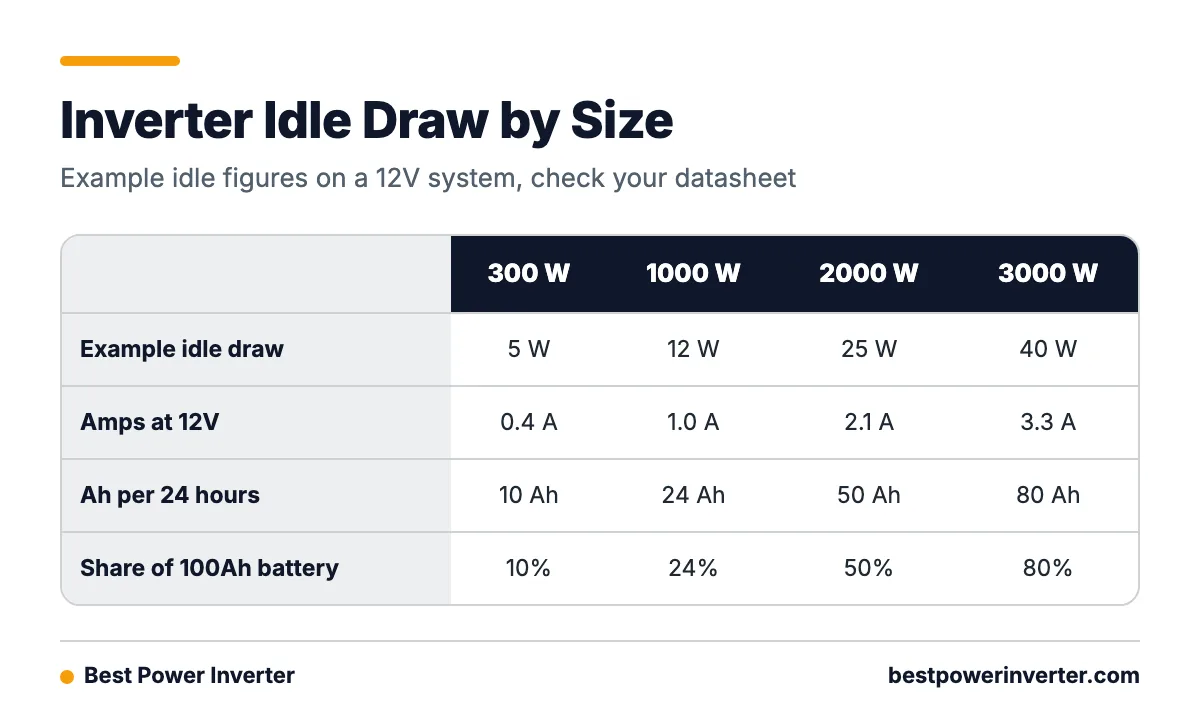
| Inverter size | Example idle draw | Amps at 12V | Ah per 24 hours | Share of a 100Ah battery |
|---|---|---|---|---|
| 300 W | 5 W | 0.4 A | 10 Ah | 10% |
| 1000 W | 12 W | 1.0 A | 24 Ah | 24% |
| 2000 W | 25 W | 2.1 A | 50 Ah | 50% |
| 3000 W | 40 W | 3.3 A | 80 Ah | 80% |
How long will an idle inverter take to drain a 100Ah 12V battery?
Use this formula: amps = watts / volts. Then multiply by hours.
- 25 W / 12 V = about 2.1 A.
- 2.1 A x 24 h = about 50 Ah per day.
- Lead-acid batteries should generally not go below 50% discharge, so 50 Ah is all you get from a 100Ah battery.
Result: a 2000 W inverter left idling flattens a 100Ah lead-acid battery to its safe limit in about one day. Lithium (LiFePO4) can go deeper, so it lasts longer, but the energy is still wasted.
Do inverters use power when turned off?
Usually very little, but not always zero. When the power switch is off, the main conversion stage stops. Some models keep a small standby circuit alive for a remote port, Bluetooth, or a display. Datasheets often list this as off consumption, commonly a few mA up to tens of mA.
Take 20 mA as an example. Over a day that is about 0.5 Ah, and over a month about 14 Ah. That will not flatten a battery overnight. It can matter for a boat or cabin left for months.
The big catch is remote switching. If you turn the inverter off from a remote panel, the unit itself may stay in a standby state with the control circuits awake. A hard switch on the unit, or a disconnect, is more complete. Victron’s Inverter datasheet lists separate consumption figures for zero load and for eco mode, a good example of how much the state matters.
What is search mode, and does it help?
Search mode (also called power saver or eco mode) puts the inverter to sleep and sends a short pulse every second or so. If it detects a load above a set threshold, it wakes fully. If not, it keeps sleeping. This can cut idle draw to roughly 1-10 W.
The drawback is small loads. Many owners find that LED lights, phone chargers, and some electronics sit below the wake threshold. The result is a device that never turns on, or one that flickers or cycles on and off.
If you run only larger loads (a kettle, a power tool, a microwave): use search mode.
If you run small chargers or LED lights: lower the threshold, or turn search mode off and switch the inverter off when not needed.
If a device flickers: add a small constant load, or disable search mode.
Pure sine, modified sine, inverter/chargers and UPS units
Pure sine wave inverters often have slightly higher idle draw than basic modified sine units, though models vary widely. Do not pick a waveform based on idle draw alone. Compare the datasheet figure.
Inverter/chargers add another layer. They also draw from the wall for charging and standby when plugged into shore power. UPS units are similar: they sip mains power constantly to keep their battery topped up and the electronics ready. Solar and battery systems have standby draw too. The Indevolt standby power note explains how this kind of standby consumption shows up in home energy systems.

Does an inverter drain a car battery?
Yes, if it stays powered with the engine off. A small plug-in inverter in a cigarette socket may draw a few watts, and some sockets stay live with the ignition off. Unplug it when you park.
Larger inverters wired straight to the battery are worse. A car starter battery is not built for deep discharge, so even a modest idle draw over a few days can leave it too weak to start the engine. The alternator only helps while the engine runs.
How can I stop an inverter draining my battery?
Use this checklist, from simplest to most complete:
- Switch it off at the unit whenever you do not need AC.
- Turn off remote panels too, and check whether the unit itself is truly off.
- Enable search or eco mode if your loads are big enough to wake it.
- Set the low-voltage cutoff so the inverter shuts down before the battery goes flat.
- Fit a DC isolator or battery switch on the inverter’s positive cable.
- Disconnect the battery for long storage.
A relay or timer on the inverter’s remote switch input is a good option for off-grid cabins. It turns the inverter on only when needed.
How to measure idle draw
You can measure idle draw in minutes, so you do not have to trust the datasheet:
- Turn off or unplug every AC load.
- Clamp a DC clamp meter around the inverter’s positive battery cable. A battery monitor with a shunt works too.
- Switch the inverter on and wait a minute for startup to settle.
- Read the amps. This is your idle current.
- Multiply by 24 for Ah per day, or by battery volts for watts.
- Repeat in search mode, then with the switch off, then with the remote off.
If the off reading is above zero, that is your standby drain. Decide whether it is small enough to live with, or whether you need an isolator.
What do owners say?
Owners like
- Power saver or search mode noticeably reduces idle drain for off-grid and RV owners.
- A physical on/off switch or remote panel makes it easy to shut the inverter off when not needed.
- Models with low-voltage cutoff protect the battery from being drained flat.
Common complaints
- Battery found flat after leaving the inverter on with nothing plugged in.
- Inverter still drains slowly when off via remote, and needs the battery disconnected.
- Search mode fails to detect small loads like LED lights or chargers.
- Fan noise and heat from idling inverters.
Summarised from owner reviews and long-term user reports; individual experiences vary.
Frequently Asked Questions
Do inverters use power when not in use?
Yes, if they are switched on. An idle inverter typically draws 0.5-3% of its rated power, often 10-50 W on 1000-3000 W units. Search mode lowers this, and switching off or disconnecting lowers it further.
Do inverters use power when turned off?
Most use very little, and some use none. Models with remote ports, Bluetooth, or displays can still pull a few mA to tens of mA. Check the off consumption on the datasheet. To guarantee zero, disconnect the battery or use a DC isolator.
Does an inverter draw power when not in use?
It does when it is on and idle. The draw comes from conversion losses, the transformer, control circuits, and the fan. It grows with inverter size, so a 3000 W unit wastes much more than a 300 W unit.
Can I leave an inverter connected to my battery all the time?
You can, if it is switched off and its off draw is tiny. For months of storage, disconnect it. Even a few mA adds up over a long period, and a flat lead-acid battery can be damaged.
Sources