
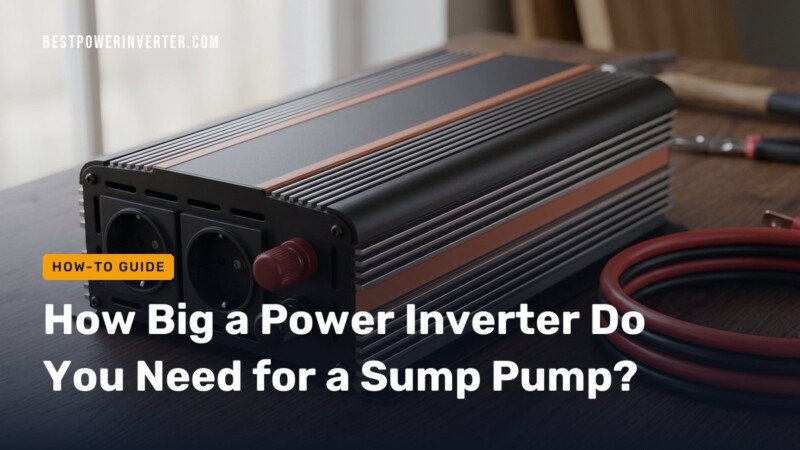
Size the inverter for the pump’s startup surge, not just its running watts. Many 1/3 HP sump pumps work with a 2,000W pure sine wave inverter, and many 1/2 HP pumps need 3,000W or more. This guide shows how to read your pump label, do the math, and pick a unit that will not shut down when the power goes out.
- A sump pump motor can pull about 3 to 6 times its running watts for a split second at startup.
- Typical picks: about 2,000W for 1/3 HP, 3,000W or more for 1/2 HP, and larger for 3/4 HP and 1 HP pumps.
- Choose a pure sine wave inverter. Motors run cooler and safer on it.
- Continuous rating should be at least 1.25 times running watts. Surge rating must beat the starting spike.
- Add up every other load on the inverter. Startup surge stacks.
- Why Surge Watts Matter
- How to Find the Wattage of Your Sump Pump
- Inverter Size by Pump Horsepower
- Worked Example With a Real Nameplate
- Pure Sine Wave vs Modified Sine Wave
- Battery Capacity for an Outage
- Running Other Devices on the Same Inverter
- Sizing Mistakes to Avoid
- Backup Inverter Checklist
- Frequently Asked Questions
Why Does a Sump Pump Need a Much Larger Surge Rating Than Running Watts?
A sump pump uses an induction motor. At rest, the rotor is still, so the motor draws a huge burst of current to get it spinning. This is called inrush or locked-rotor current. It can be about 3 to 6 times the running load.
That burst lasts only a fraction of a second. But the inverter must handle the peak without tripping. If it cannot, it shuts down or throws an overload alarm, and the pump never starts.
Know three terms before you shop:
- Continuous wattage: what the inverter can supply all day without overheating.
- Surge (peak) wattage: what it can supply for a very short burst.
- Surge duration: how long that burst is allowed. Many budget units list a big surge number but only hold it for a moment.
How Do I Find the Wattage of My Sump Pump?
Look at the nameplate on the pump body or in the manual. You want three items: volts, amps, and horsepower. Most home pumps are 120V.
How do I convert amps to watts for a sump pump?
Use this formula: watts = volts × amps. A 120V pump rated at 9 amps draws about 1,080 watts while running. This is a sizing estimate. It is close enough, and it errs on the safe side.
What Inverter Size Do I Need by Pump Horsepower?
This table uses common figures for residential pumps. Your label always wins over a chart.
| Pump Size | Typical Running Watts | Typical Startup Surge | Minimum Continuous (x1.25) | Suggested Inverter |
|---|---|---|---|---|
| 1/3 HP | ~800W | 1,600W to 2,400W | ~1,000W | 2,000W pure sine wave |
| 1/2 HP | ~1,050W | 2,100W to 3,150W | ~1,300W | 3,000W pure sine wave |
| 3/4 HP | ~1,500W | 3,000W to 4,500W | ~1,900W | 4,000W or larger, with a surge rating above 4,500W |
| 1 HP | ~2,000W | 4,000W to 6,000W | ~2,500W | 5,000W or larger, with a surge rating above 6,000W |
What size inverter do I need for a 1/3 HP sump pump?
Plan on about 2,000W of pure sine wave capacity. The pump runs near 800W, but the startup spike can reach 2,400W. A 2,000W inverter with a higher peak rating covers it. This matches the minimum suggested in the Power Inverter for Sump Pump backup power guide.
What size inverter do I need for a 1/2 HP sump pump?
Plan on 3,000W or more. A 1/2 HP pump runs around 1,050W and can spike past 3,000W. A 2,000W unit is a gamble here.
- If your pump is 1/3 HP and nothing else shares the inverter, start at 2,000W.
- If your pump is 1/2 HP, start at 3,000W.
- If your pump is 3/4 HP or 1 HP, size from the label and expect 4,000W to 5,000W or more.
- If the label amps are higher than the chart suggests, trust the label.
Worked Example With a Real Nameplate
Say the label on a 1/2 HP pump reads: 120V, 60Hz, 9.0A. Here is the full process.
- Running watts: 120V × 9.0A = 1,080W.
- Continuous rating: 1,080W × 1.25 = 1,350W minimum.
- Startup surge: 2 to 3 times running watts gives about 2,160W to 3,240W. Motors can spike higher, so treat this as the low end.
- Pick a size: a 3,000W pure sine wave inverter with a peak rating well above 3,240W.
The 3,000W unit has far more continuous capacity than the 1,350W minimum. That is fine. The extra room exists for the surge, and it also keeps the inverter from running near its limit.
Do I Need a Pure Sine Wave Inverter for a Sump Pump?
Yes, for nearly every case. Induction motors are built for the smooth waveform from the wall outlet. A pure sine wave inverter matches it.
Modified sine wave output is choppier. Motors on it can run hotter, hum, lose efficiency, and wear out sooner. Some pumps with electronic switches or controllers may not start at all. A sump pump is your flood defense, so skip the risk.
What happens if the inverter is too small for pump startup?
- The inverter trips on overload and shuts off.
- The pump hums but does not turn, which strains the motor.
- The pump short cycles as it tries to start again and again.
- The water level keeps rising while the pump sits stalled.
How Much Battery Capacity Do I Need to Keep the Sump Pump Running?
A pump does not run non-stop. It runs when the pit fills. So battery math depends on how often and how long it cycles. These numbers are assumptions for illustration. Watch your own pump during a wet spell to get real figures.
Example: the 1,080W pump runs about 10 minutes every hour.
- Energy per hour: 1,080W × (10 ÷ 60) = 180Wh.
- For 12 hours: 180Wh × 12 = 2,160Wh.
- Add about 15% for inverter losses: roughly 2,500Wh.
On a 12V system, 2,500Wh is about 208Ah of usable capacity. Lead-acid batteries should not be drained past about 50%, so you would need around 400Ah of them. Lithium iron phosphate (LiFePO4) allows much deeper use. During heavy storms the pump may run more often, so build in extra. For a ready-made option, the guide on sizing a power station for a sump pump walks through runtime for portable units.
Can I Run Other Devices on the Same Inverter at the Same Time?
You can, but only if you size for it. The pump’s surge comes on top of everything already running. Add the running watts of other loads to the pump’s surge figure.
Example: a 1/3 HP pump (2,400W surge) plus a 100W router, 150W of lights, and a 700W refrigerator running. That is 2,400 + 100 + 150 + 700 = 3,350W at the worst moment. A 2,000W inverter will not do. A 3,000W unit is borderline. Plan on 4,000W or add a dedicated inverter for the pump.
The cleaner option is a separate inverter and battery for the pump alone. Then a refrigerator cycling on cannot cause a pump failure.
Sizing Mistakes to Avoid
- Sizing to running watts only. This is the most common error, and it causes startup failures.
- Trusting the peak number on the box. Check how long the surge is held.
- Buying modified sine wave to save money. The savings are small and the risk is not.
- Ignoring wire and fuse size. High-wattage inverters pull heavy DC current. Undersized cables cause voltage drop and shutdowns. A battery backup whitepaper from Tripp Lite, Selecting and Installing a Battery Backup System for Your Sump Pump, covers installation basics.
- Skipping the manual. Some pumps list higher startup current than the chart average.
- Never testing. Unplug the pump from the wall, run it on the inverter, and fill the pit with a bucket of water before storm season.
Backup Inverter Checklist for Sump Pump Use
- Pure sine wave output.
- Continuous rating at least 1.25 times the pump’s running watts.
- Surge rating above the pump’s starting spike, with a stated surge duration.
- Extra headroom for any other connected loads.
- Battery sized for your expected hours of outage plus losses.
- Correct cable gauge and fuse for the DC current.
- Low-battery alarm and automatic transfer or an easy plug-in setup.
Frequently Asked Questions
How big power inverter to run sump pump?
It depends on the pump. Plan on about 2,000W pure sine wave for a 1/3 HP pump and 3,000W or more for a 1/2 HP pump. Larger 3/4 HP and 1 HP pumps need 4,000W to 5,000W or more. Always confirm with the amps on your pump label.
How do I find the wattage of my sump pump?
Read the nameplate for volts and amps, then multiply them. A 120V, 9A pump uses about 1,080W while running. The startup surge will be roughly two to three times higher or more.
Do I need a pure sine wave inverter for a sump pump?
Yes. Pure sine wave power is gentler on the motor and starts it more reliably. Modified sine wave can cause heat, noise, and early motor wear.
What happens if the inverter is too small for pump startup?
The inverter will overload and shut down, or the pump will hum without turning. In both cases the pit keeps filling.
How much battery capacity do I need to keep the sump pump running during an outage?
Multiply running watts by the hours the pump actually runs, then add about 15% for losses. A 1,080W pump running 10 minutes per hour needs roughly 2,500Wh for 12 hours. Heavy rain means more run time, so add a buffer.
Can I run other devices on the same inverter at the same time?
Yes, but add their running watts to the pump’s surge when sizing. If that total passes the inverter’s surge rating, the pump may not start. A dedicated pump inverter avoids the problem.
