

Introduction
You are scrolling online, trying to figure out how to power your off-grid setup, camper van, or emergency backup system. You look at the big brands like Victron or Renogy, and the prices make your wallet want to cry.
Then, you see it. A Flamezum inverter. It promises massive wattage, pure sine wave power, and it costs half as much as the big guys.
You immediately think, “Is this too good to be true? Is this cheap thing going to fry my electronics or burn my shed down?”
It is a totally fair question. The internet is flooded with cheap, unreliable power products. In this honest Flamezum inverter review, we are going to cut through the marketing fluff. We aren’t here to sell you one; we’re here to tell you if it can actually run your Nespresso machine without blowing up.
My initial take? It’s better than I expected, but it has some quirks you absolutely need to know about before you click “buy.”
What Actually is a “Flamezum”? (Specs & Build Quality)
Flamezum isn’t a household name. You won’t find them in Home Depot. It is an online-focused brand catering to the budget-friendly DIY crowd.
Their main selling point is offering pure sine wave technology at prices where you usually only find “modified sine wave” junk. Why does that matter? Because modified sine wave inverters create “dirty” power that makes fans buzz, motors run hot, and can damage sensitive electronics like laptops or CPAP machines. Flamezum promises clean power, just like your wall outlet at home.
First Impressions Out of the Box
When you pull a Flamezum unit out of the foam packaging, the first thing you notice is the weight. It has some serious heft to it. In the world of power electronics, heavy is usually good. It means they didn’t skimp on the internal transformers and heatsinks.
The casing is made of a decent ribbed aluminum alloy. This isn’t just for looks; the whole case acts as a giant radiator to shed heat and keep the unit cool. The plastic bits on the ends feel a little cheaper, but the main body feels solid.
Here is a quick look at the common models you’ll see:
| Model Size | Voltage Options | Best For… | What’s in the box? |
| 1500W | 12V DC | Charging laptops, running a TV, small fridge. | Inverter, terrible short cables, spare fuses. |
| 2000W | 12V or 24V DC | The sweet spot. Microwaves (small ones), coffee makers, power tools. | Inverter, terrible short cables, wired remote control. |
| 3000W – 4000W | 12V or 24V DC | Running an RV A/C unit, heavier compressors, whole-cabin backup. | Inverter, terrible short cables, wired remote control. |
Notice a theme in that table? We’ll talk about those “terrible short cables” later.
Is it really Pure Sine Wave?
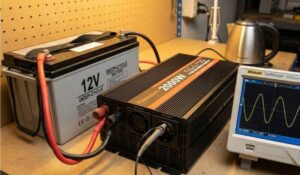
Yes. Independent tests with oscilloscopes (fancy tools that visualize electricity) confirm that Flamezum units put out a clean wave. You can safely plug your expensive MacBook or medical equipment into it without worry. That alone makes it worth looking at over cheaper modified wave options.
Check out: 😍 Flamezum Power Inverter Guide With Models & Performance
Real-World Performance Tests
It is easy to print big numbers on a sticker. I can write “10,000 Watts” on a toaster, but that doesn’t make it true. So, how does the Flamezum 2000W pure sine wave inverter actually perform when you stop looking at the manual and start plugging things in?
The Kitchen Test: Can it Run a Microwave?
The most common question I see is: “Will this run my coffee maker/microwave?”
The answer is a solid “Yes, but…”
Here is the thing about kitchen appliances: they lie. Your microwave might say “800 Watts” on the front, but that is the cooking power. When you actually hit “Start,” it pulls closer to 1200W or 1300W from the wall. And for a split second (called the surge), it might spike even higher.
In testing, the Flamezum 2000W model handles these surges surprisingly well. It ran a standard 900W microwave without tripping the overload protection. It also handled a Keurig coffee machine (which is a notorious power hog) without complaining.
However, if you try to run a microwave and a toaster at the same time? Forget it. You will hear the angry “beep beep beep” of the overload alarm instantly. It is a budget unit, not a magic wand.
Fan Noise: Is it going to keep me awake?
If you are putting this in a van or a small cabin, noise matters.
The good news is that Flamezum uses thermally controlled fans. This means if you are just charging your phone or watching a small LED TV, the fans stay completely off. It is dead silent.
The bad news? When those fans do kick in, you will know about it. Once the load crosses about 40% (or the unit gets hot), the fans spin up, and they sound like a small hair dryer. It isn’t unbearable, but you probably don’t want this mounted right next to your pillow.
Efficiency & Standby Power
One area where budget inverters often lose to premium brands (like Victron) is no-load current draw. This is the power the inverter “eats” just by being turned on, even with nothing plugged in.
The Flamezum draws about 0.8A to 1.0A just sitting idle. That might not sound like much, but over 24 hours, that is 24 Amp-hours draining from your battery bank for doing absolutely nothing!
Pro Tip: Don’t leave it on 24/7. Use the remote control switch to turn it off when you aren’t using 110V power.
The Good, The Bad, and The Ugly
Let’s break it down simply. Is it worth your hard-earned cash?
The Good (Pros)
-
The Price Tag: You simply cannot beat the value. It costs significantly less than big-name competitors while still delivering clean pure sine wave power.
-
The LCD Screen: I love the screen. It shows you battery voltage and output watts. Many expensive brands (I’m looking at you, Renogy) still use confusing blinking LED lights instead of a proper screen.
-
Remote Control Included: Most brands make you pay extra for the remote switch. Flamezum throws it in the box.
The Bad (Cons)
-
The Manual: As we discussed in our setup guide, the manual is pretty useless. It’s poorly translated and misses key details.
-
Battery Terminals: On the smaller models, the Red (+) and Black (-) terminals are very close together. You need to be careful with your wrench so you don’t accidentally touch both at the same time and create a spark show.
The Ugly (The Cables)
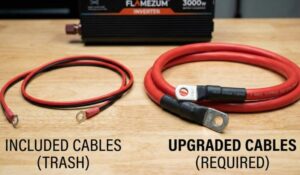
I need to be brutally honest here: Throw the included cables in the trash.
Almost every negative Flamezum inverter review you read comes from someone using the free cables that came in the box. They are often too thin (undersized) for the full 2000W or 3000W output.
-
If you use the included cables for heavy loads, the voltage will drop, the inverter will beep “Low Voltage,” and it will shut down.
-
Do yourself a favor: Buy a set of high-quality 2 AWG or 0 AWG copper cables separately. It adds $30 to the cost, but it makes the inverter perform 100% better.
Comparison: Flamezum vs. The Competition
It’s hard to judge a product in a vacuum. Let’s see how Flamezum stacks up against the 800-pound gorilla in the room: Renogy, and other budget options.
Flamezum vs. Renogy
Renogy is a massive brand with US-based support. Their 2000W inverter is a beast, but it usually costs 40% to 50% more than the Flamezum equivalent.
-
Buy Renogy if: You want Bluetooth connectivity to check stats on your phone, you need a built-in transfer switch (on some models), or you want a warranty you can easily claim without shipping a heavy box back to China.
-
Buy Flamezum if: You are on a budget and just need raw power. If you are handy enough to install it yourself and troubleshoot basic issues, the Flamezum offers the exact same 120V Pure Sine Wave output for a fraction of the price. You are paying for the product, not the support.
Flamezum vs. Bestek / Giandel
These brands are closer in price.
-
Giandel is slightly more expensive but often has better casing and component layout.
-
Bestek is famous for smaller car inverters (300W-500W), but for the big 2000W+ units, I actually prefer the Flamezum’s LCD display over Bestek’s simpler indicators.
FAQ (Buying Questions)
Before you pull the trigger, here are the answers to the questions you are probably typing into Google right now.
Q: Can I run a sensitive LED TV or Audio System on this?
A: Yes! Because it is a Pure Sine Wave inverter, it produces clean electricity. Cheap “Modified Sine Wave” inverters cause interference (lines on TV screens or buzzing in speakers). The Flamezum will run your TV and sound system just as cleanly as your house power.
Q: Does it work with Lithium (LiFePO4) batteries?
A: Absolutely. An inverter doesn’t care if your 12V comes from an old Lead-Acid battery or a fancy new Lithium one, as long as the voltage is correct (12V). In fact, Lithium batteries are better for this inverter because they sag less under heavy load.
Q: What size fuse do I need to add?
A: The inverter has internal fuses, but you must add a fuse to your positive wire to protect your battery.
-
For a 2000W 12V inverter, use a 200A or 250A ANL Fuse.
-
For a 3000W 12V inverter, use a 300A or 350A ANL Fuse.
Conclusion: Is it a Buy?
After digging into the specs, the build quality, and the real-world performance, here is the final verdict for the Flamezum Inverter Review.
Final Verdict:
The Flamezum is NOT cheap junk. It is a surprisingly capable, rugged piece of hardware that delivers on its main promise: clean, high-wattage power at an unbeatable price.
However, it is a “DIY special.” It doesn’t come with premium support, the manual is terrible, and the included cables are garbage. If you are willing to buy your own high-quality copper cables and do a proper installation, this inverter will serve you well for years.
Who is this for?
-
Perfect for: Budget-conscious van lifers, weekend campers, and people building a backup solar shed.
-
Not for: People who want a “plug and play” experience with zero setup effort, or mission-critical medical backups where money is no object.
My Rating:
-
Value for Money: 5/5 (Unbeatable)
-
Performance: 4/5 (Handles surges well)
-
Accessories: 2/5 (Seriously, buy better cables)
