
Most people swap the inverter first and test nothing else. That wastes money, because most failures come from low or poorly connected DC input voltage, an overload (often a motor’s start-up surge), a blown fuse, or heat. Check the battery voltage, the cable and fuse connections, the load wattage, and the alarm or LED code, in that order.
Quick answer
Measure DC voltage at the inverter’s own terminals while the load is running. If it stays above about 11V on a 12V system and the inverter still has no output, the inverter is likely faulty. If it drops to 10 to 10.5V, fix the battery, cables, or fuse first.
- Best for beeping: check input voltage, then load watts
- Best for no power at all: check the fuse and terminals
- Test the DC side before blaming the inverter. Voltage drop in cables and loose terminals cause many shutdowns.
- Motor loads can need 2 to 3 times their running watts at startup, so a sump pump can trip an inverter that looks big enough.
- Idle draw is real. At 1A on 12V, an idle inverter uses about 24Ah per day.
- Car sockets are fused at 10 to 15A. Anything bigger goes straight to the battery with a fuse.
- At 4000 to 5000W, use 24V or 48V to keep current and cable size under control.
- Why Is My Power Inverter Not Working?
- How Do I Know If the Inverter Is Faulty?
- What Do the Beeps and LED Indicators Mean?
- Do I Need to Read the Inverter Manual?
- Overload and Start-Up Surge
- How Big an Inverter Do I Need?
- Overheating and Ventilation
- How Much Power Does an Inverter Drain?
- How Big an Inverter Can My Truck Handle?
- 4000W, 5000W and 48V Inverters
- When Should I Repair, Replace, or Call an Electrician?
- Frequently Asked Questions
Why Is My Power Inverter Not Working and What Should I Check First?
Start with the simplest causes and work toward the hardest. Most dead or beeping inverters are fixed in the first four steps.
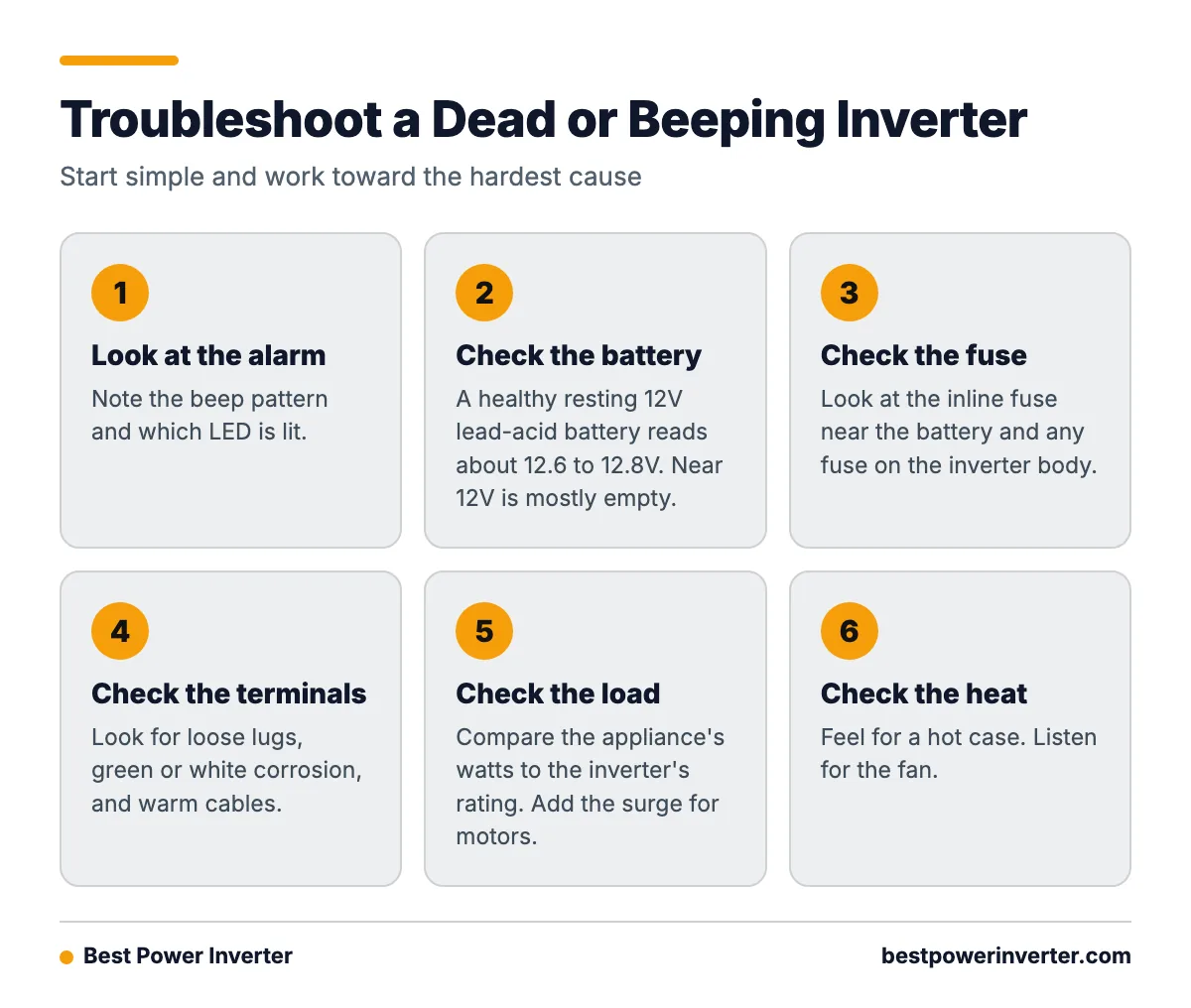
- Look at the alarm. Note the beep pattern and which LED is lit.
- Check the battery. A healthy resting 12V lead-acid battery reads about 12.6 to 12.8V. A reading near 12V means it is mostly empty.
- Check the fuse. Look at the inline fuse near the battery and any fuse on the inverter body.
- Check the terminals. Look for loose lugs, green or white corrosion, and warm cables.
- Check the load. Compare the appliance’s watts to the inverter’s rating. Add the surge for motors.
- Check the heat. Feel for a hot case. Listen for the fan.
Use this table as a quick flow for common symptoms.
| Symptom | Likely cause | Test | Fix |
|---|---|---|---|
| No lights, no output | Blown fuse, loose cable, reversed polarity | Meter on DC terminals | Replace fuse with the same rating, tighten lugs, check polarity |
| Beeps, shuts off under load | Low DC voltage or voltage drop | Voltage at inverter terminals under load | Charge battery, shorten or thicken cables, clean terminals |
| Runs small loads, trips on big ones | Overload or start-up surge | Compare nameplate watts and surge | Run fewer loads or buy a larger, pure sine unit |
| Shuts off after some minutes | Overheating | Check fan, vents, ambient temperature | Clean vents, add airflow, lower the load |
| Lights on, no AC output | Internal fault or tripped protection | AC meter at outlet, test with a small lamp | Reset by power cycling, then see the manual or replace |
How Do I Know If the Inverter Is Faulty Rather Than the Battery, Cable, Fuse or Appliance?
Use a multimeter to measure DC voltage at the inverter’s terminals while the load is running. This one test separates an input problem from an inverter fault. Many guides skip it.
If voltage at the battery is low (under about 12.2V resting): charge or replace the battery.
If battery voltage is good but the inverter terminals read much lower under load: you have voltage drop. Look for loose lugs, corrosion, thin cable, long cable, or a bad fuse holder.
If the inverter terminals stay above about 11V under load but the inverter shuts down: the inverter is overloaded or overheated. Reduce the load and let it cool.
If DC input is good, the load is small, it is cool, and there is still no AC output: the inverter is likely faulty.
If the inverter works with a lamp but not with your appliance: the appliance is the problem, or it needs more surge than the inverter can give.
Many inverters shut down on low DC input at around 10 to 10.5V on a 12V system. A battery that shows 12.5V at rest can sag below that when a heavy load starts. That is why you test under load, not just at rest.
Always switch the inverter off and disconnect the battery before you tighten or clean anything. Keep your hands away from the AC outlets and wiring while it runs.

What Do the Beeps and Red/Green LED Fault Indicators Mean?
Beeps and LEDs tell you which protection tripped: low voltage, overload, or overtemperature. Patterns differ by brand, so treat this table as typical behavior and confirm in your manual.
| Indicator | Typical meaning | First action |
|---|---|---|
| Green LED steady | Normal operation | None |
| Slow beeping, input voltage warning | Battery is getting low | Start the engine or charge the battery |
| Constant alarm, red LED, low voltage | DC input fell below the cutoff | Check battery and voltage drop |
| Red LED, overload | Load too big or surge too high | Unplug devices, restart, add one at a time |
| Red LED, overtemp | Case or heat sink too hot | Cool it, clear vents, check fan |
| High-voltage alarm | Input above the upper limit | Check charger or alternator output |
Do I Need to Read the Power Inverter Manual?
Yes, it is worth ten minutes. A troubleshooting guide cannot know your model’s exact fault codes, fuse size, cable gauge, surge rating, or grounding rules. The manual does.
Look for these items:
- The fault code or LED table
- The low-voltage and high-voltage cutoff values
- Recommended cable gauge and maximum cable length
- Fuse size and where to place it
- Continuous rating and surge rating
- Ground and wiring instructions
For a sense of how detailed these documents get on large units, see the Voltronic Axpert 5KW manual. For a compact unit, the Harbor Freight inverter manual shows the style of fuse, cable, and warning information smaller models include. Your own model’s manual always wins over any general guide.
Overload and Start-Up Surge: Why a Big Enough Inverter Still Trips
Motors pull far more power for a moment at startup than they do while running. Sump pumps and refrigerator compressors can need roughly 2 to 3 times their running watts at startup. An inverter sized only for running watts will trip, beep, or shut down the instant the motor kicks on.
Waveform matters here too. Pure sine wave inverters start motors more easily and keep them cooler. Modified sine wave units can make motors hum, run hot, or fail to start. If a pump or fridge trips a modified sine inverter, try a pure sine unit before anything else.
Here is a simple case. A sump pump runs at about 900W. At startup it may need 1,800 to 2,700W. A 1,000W inverter fails at once. A 2,000W inverter might survive the lower end, but only if its surge rating covers it.
How Big a Power Inverter Do I Need for a Sump Pump, Mini Fridge, Drill, 32″ TV, or Printer?
Take the highest wattage the device will pull, including surge, and add 20 to 25% headroom. The table below uses the brief’s typical ranges. Your nameplate is the final word, especially for drills.
| Device | Typical running watts | Surge multiplier | Suggested minimum inverter |
|---|---|---|---|
| Sump pump (1/3 to 1/2 HP) | About 800 to 1,000W | 2 to 3x | 3,000 to 4,000W pure sine |
| Mini fridge | About 50 to 100W | Several times at compressor start | 500 to 600W pure sine |
| Corded drill | Check nameplate (example: 600W) | About 2x | 1,500W for a 600W drill |
| 32″ TV | About 30 to 60W | About 1x | 150 to 300W |
| Inkjet printer | About 20 to 50W in use | Low | 150 to 300W |
| Laser printer | Several hundred watts briefly when warming up | High short burst | 1,000W or more |
The sump pump row shows how sizing and troubleshooting connect. A 900W pump at 3x surge needs 2,700W. Add 20% and you land near 3,240W, so a 3,000 to 4,000W unit is the safe call.
Overheating and Ventilation
Inverters make heat, since typical efficiency runs about 85 to 95%. A 2000W load at 90% efficiency wastes roughly 200W as heat inside the case. If the fan fails or the vents clog, thermal protection trips.
- Keep several inches of open space around the vents.
- Do not bury the unit under blankets, bags, or cargo.
- Blow out dust with compressed air while the unit is off and disconnected.
- Check that the fan spins and is not rattling.
- Expect lower output in a hot engine bay or sealed cabinet. Many makers derate output at high temperatures, so read your spec sheet.
If the unit only overheats at one specific load, the load is probably too close to the rating. Move up a size.

How Much Power Does an Inverter Drain From the Battery When Idle or Running a Load?
An idle inverter still draws power. For mid-size units, no-load draw is commonly about 0.5 to 2A on 12V, but check your spec sheet. Left on all day, that adds up fast.
Idle math: 1A at 12V is 12W. Over 24 hours that is 288Wh, or 24Ah from a 12V battery. At 0.5A you lose 12Ah per day. At 2A you lose 48Ah per day.
Running math: divide load watts by efficiency, then by battery volts. A 50W TV at 90% efficiency needs about 55.6W from the battery. That is roughly 4.6A at 12V. Four hours uses about 18.5Ah, plus the idle draw.
Lead-acid batteries should not be drained fully. Plan to use about half of the rated amp-hours. A 100Ah lead-acid battery gives about 50Ah of usable power, so the TV example plus idle would use a large part of it.
For rule-of-thumb current, remember that current equals watts divided by volts. A 1000W load on 12V draws about 83A before losses, or about 92A at 90% efficiency.
How Big of a Power Inverter Can My Truck Handle?
The limit is set by your wiring and your alternator, not by the truck’s size. Through the cigarette-lighter socket, you are capped at about 120 to 180W, because those sockets are typically fused at 10 to 15A.
For anything larger, connect the inverter directly to the battery with thick cable and a fuse close to the battery. Run the engine while using it so the alternator supplies the current.
Compare the inverter’s DC draw to your alternator’s rated output, which is on the alternator label or in the service specs. A 2000W load pulls about 185A at 12V after losses. If that is more than your alternator can supply, the battery covers the gap until it runs low. For short heavy jobs this is fine. For long jobs, keep the load well below alternator output.
Under about 150W (phone, laptop, small TV): the accessory socket is fine.
150 to 400W: wire it to the battery, even if the inverter has a socket plug.
Over 1000W: direct battery connection, fuse near the battery, engine running, and a deep-cycle battery bank if used for long periods.
When Is a 4000 Watt Power Inverter or a 48 Volt Power Inverter the Right Choice?
Choose 4000W when you must run a sump pump, a well pump, a large power tool, or several devices at once. Choose 24V or 48V when the inverter is 3000W or bigger. The reason is current. A 4000 to 5000W inverter on 12V can draw over 400A, which needs enormous cable and fuses.
Here is the same 2000W load on two voltages, before efficiency losses.
| System | Current at 2000W | At about 90% efficiency | Implied wiring |
|---|---|---|---|
| 12V | About 167A | About 185A | Very heavy cable (around 2/0 AWG or larger on short runs) and a fuse near 200A or more |
| 48V | About 42A | About 46A | Far thinner cable (around 6 AWG class) and a fuse near 60A |
These cable and fuse figures are rough. Use the manual’s chart for your exact model and cable length. Long runs need thicker cable to keep voltage drop low.
Battery bank for a 5000W inverter: divide 5000W by 0.9 efficiency to get about 5,556W from the battery. On 48V that is about 116A. One hour at full load uses about 5.56kWh, or about 116Ah at 48V. Lead-acid should only be drained about half, so plan for roughly 230Ah at 48V per hour of full load. Lithium allows deeper use, so a smaller bank can work. Most loads are far below full power, so size the bank for your real usage, not just the label.
On 12V, the same 5000W load would need about 463A. That is why 48V is the common choice here.
When Should I Repair, Replace, or Call an Electrician?
Repair what is outside the case. Replace the unit when the inside has failed. Call an electrician for any permanent or AC-side wiring.
- Repair yourself: blown inline fuse, loose or corroded terminals, clogged vents, a weak battery, too-thin cables.
- Replace: no output despite good DC input and a small load, a burnt smell, melted terminals, repeated overload faults on a correctly sized load, or a dead fan you cannot source.
- Call an electrician: home backup wiring, transfer switches, grounding questions, tripping breakers, or anything involving the AC side of a hardwired system.
Check your warranty before opening the case, since that can void it. Also stop using any inverter that sparks, smokes, or gets too hot to touch. Those are safety problems, not nuisance faults.
Frequently Asked Questions
Why is my power inverter not working?
Most often the DC input is the problem: a low or sagging battery, loose or corroded cables, or a blown fuse. After that, check for overload, especially from motors, and for overheating. Read the alarm or LED code to see which protection tripped.
How do you know if the inverter is not working?
Measure DC voltage at the inverter’s terminals under load. If it is healthy (above about 11V on 12V) and the inverter has a small load, no fault light, and still no AC output, the inverter is likely bad. Also try a simple lamp to rule out the appliance.
How big power inverter to run sump pump?
A typical 1/3 to 1/2 HP pump runs at about 800 to 1,000W but can need 2 to 3 times that at startup. A pure sine inverter in the 3,000 to 4,000W range, with a surge rating that covers the start-up spike, is the safer choice.
How big of a power drain is an inverter?
Idle draw varies by model, but mid-size inverters commonly use about 0.5 to 2A on 12V. At 1A, that is about 24Ah per day. Running a load adds the load watts divided by efficiency (about 85 to 95%).
How big power inverter for 5000W battery?
If you mean a 5000W inverter, size the battery for about 5,556W (5000W divided by 0.9). On 48V that is about 116A, or about 116Ah per hour of full load. Lead-acid needs roughly double that usable capacity. 48V is recommended because 12V would pull over 400A.
How big an inverter to power a 32 TV?
A 32-inch TV typically uses about 30 to 60W. A 150 to 300W inverter covers it with headroom. Leave extra for a game console or soundbar if they share the inverter.
How big of a power inverter can my truck handle?
Through the cigarette-lighter socket, about 120 to 180W (10 to 15A fuse). For larger inverters, wire directly to the battery with a fuse near the battery and run the engine. The practical limit is your alternator’s output and the cable you install.
Sources