

Edecoa’s 12V 1500W inverters are specified for 1500W continuous output, 3000W surge output and pure-sine AC power, but voltage, frequency, ports and protections differ by model. At full load a 12V system can draw roughly 125-150A once inverter losses are counted, so battery capacity, short heavy cables, fusing and ventilation matter as much as the inverter itself.
As an Amazon Associate, we earn from qualifying purchases. This doesn’t change the price you pay.
Quick answer
It suits buyers with a properly sized 12V battery bank and short, fused heavy cables. Match the model to your mains voltage first. Avoid it for long full-load use on a single small battery.
- Best for vans and RVs: a 200Ah+ lithium bank
- Best for car use: loads under about 300W
- Avoid for: kettles and heaters on 12V
This review is based on manufacturer specifications and the product listings, not on bench measurements. It sits between small inverters that only charge phones and laptops and larger units built for heavy appliances. The Edecoa 1500W Power Inverter converts DC power from a battery into AC power for everyday devices, and the sections below cover what that means in practice.
What are the exact specifications of the Edecoa 1500W inverter?
All versions share a 12V DC input, 1500W continuous rating, 3000W surge rating and pure-sine output. The AC voltage, frequency and extras change by version, which is where buyers get caught out. Edecoa’s own 110-120V 1500W inverter page lists the US-style version.
| Version | Input | Output and frequency | Efficiency and no-load draw | Other listed details |
|---|---|---|---|---|
| 110-120V | 12V DC, 10.5-15V range | 110-120V, 60Hz, pure sine | Above 85% at loads above 90% | 3000W surge; distortion below 5% on a linear load |
| 220-240V | 12V DC | 220-240V, 50Hz | Check the listing for this version | 1500W continuous; confirm surge and ports on the listing |
| 240V | 12V DC | 240V, pure sine | Above 87% at loads above 90%; no-load current below 1.0A | 3000W surge |
| 220-240V Bluetooth-compatible | 12V DC | 220-240V, 50Hz | Check the listing | 5V/2.1A USB; alarm at 10.5V, shutdown at 10V, high-voltage shutdown at 15V |
Figures are the manufacturer’s. Where a cell says to check the listing, that detail was not confirmed for this article, so read the product page for your exact model.
What is the difference between the 110-120V, 220-240V and 240V versions?
The difference is the AC output your appliances receive. The 110-120V model outputs 60Hz, while Edecoa’s 220-230V version and the 240V model are 50Hz-class units for regions on higher-voltage mains. Plugging a 120V appliance into a 230V inverter can destroy it, so confirm the output voltage before ordering.
- North America: choose the 110-120V, 60Hz version.
- UK, most of Europe, Australia: choose a 220-240V or 240V version. The Amazon listing linked in this article is an amazon.co.uk page, so check that its stated output voltage matches your appliances.
- Edecoa lists user manuals separately, and each should be matched to the exact model and regional version. The Edecoa user manuals page is the place to confirm fuse, cable and protection details.
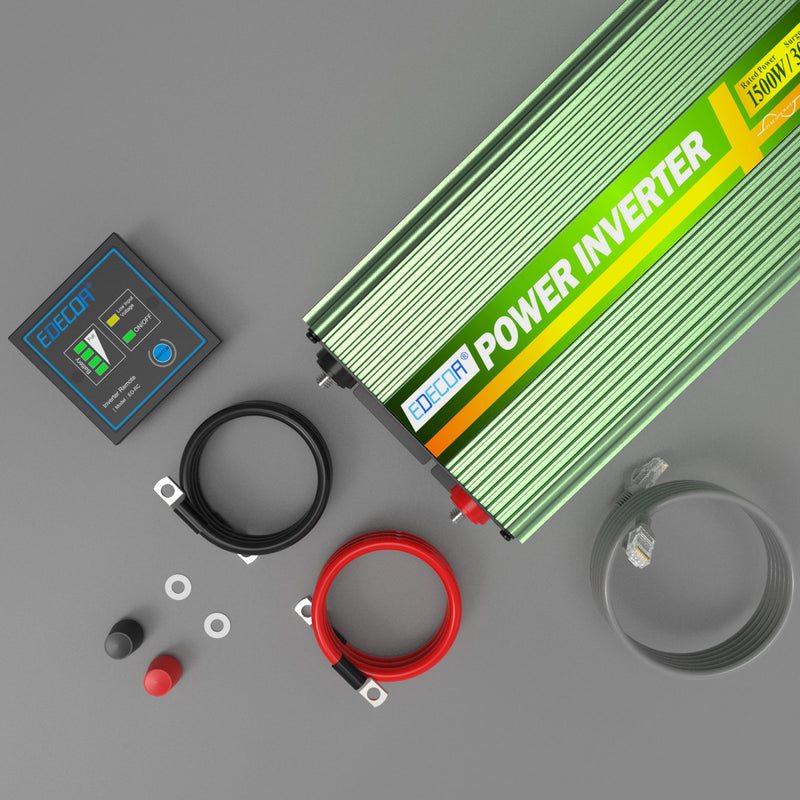
Is the model pure sine wave, and which appliances can it safely run?
Yes, the listed Edecoa 1500W models output a pure sine wave. The manufacturer quotes waveform distortion below 5% on a linear load for the 110-120V version. A clean waveform suits laptops, TVs, chargers, LED lighting, small fridges and tools with electronic speed control, which can misbehave on modified sine.
The inverter converts battery DC to household-style AC, so it can power most small appliances and tools within its limits. Sensitive electronics are a good fit for pure sine. The limit is wattage, not waveform.
Can it actually run a 1500W appliance continuously?
On paper, yes: 1500W continuous is the rating. In practice it needs a battery and cabling that can deliver 140-150A for as long as the load runs, plus airflow around the inverter. Cooling fans and over-temperature protection are fitted, but a hot, enclosed install will cause derating or shutdown long before the label rating is a problem.
Treat 1500W as a ceiling. For regular use, planning around 1000-1200W leaves headroom, keeps the fan quieter and reduces cable heating.
How much battery current does a 1500W load require from a 12V system?
An ideal 1500W load at 12V needs 125A (1500 ÷ 12). Real inverters lose energy as heat, so divide by efficiency first.
- At 85% efficiency, the figure Edecoa quotes as a minimum for the 110-120V model at high load: 1500 ÷ 0.85 = about 1765W from the battery.
- 1765W ÷ 12V = about 147A.
- At 87%, the 240V model’s quoted figure: 1500 ÷ 0.87 = about 1724W, or roughly 144A.
- Battery voltage sag under load pushes the current higher still. At 11V the same load pulls about 160A.
Worked runtime example for a 100Ah battery
| Battery (12V, 100Ah) | Usable capacity | Usable energy | Runtime at 1500W | Runtime at 300W |
|---|---|---|---|---|
| Lead-acid or AGM, 50% usable limit | 50Ah | about 600Wh | about 20 minutes | about 1.7 hours |
| Lithium iron phosphate, about 80% usable | 80Ah | about 960Wh | about 33 minutes | about 2.7 hours |
These estimates use the 85% efficiency figure, so 1500W AC is about 1765W from the battery and 300W AC is about 353W. Real runtime will be shorter because of voltage sag, cable losses and idle draw. A single 100Ah battery is also a poor match for a 150A draw, since many batteries have a maximum continuous discharge rating below that. Check yours.
What battery size and cable or fuse rating are appropriate?
For regular loads above 1000W, plan on 200Ah or more of 12V lithium, or a larger lead-acid bank, and use cables and fuses sized for roughly 150A or more. Follow the sizing in the Edecoa manual for your model, and treat the points below as general practice.
- Cable: keep the run as short as practical, ideally under 1 metre each way. Wire-sizing charts for about 150A over short runs point to very heavy gauge, around 2/0 AWG or 50-70 mm². Thin cable is the usual cause of voltage drop and low-voltage alarms at high load.
- Fuse: fit a suitably rated DC fuse or breaker on the positive cable close to the battery. A rating of around 200A is typical for this class, but confirm against the manual and your cable.
- Connections: use crimped lugs and tight terminals. A loose lug at 150A heats up quickly.
- Grounding: follow the manual’s chassis grounding instructions for your region.
- Ventilation: leave clear space around the vents and keep the unit off carpet or bedding. The vents must stay unblocked for the fans to work.
How much surge power is available, and will it start motors, refrigerators, pumps, or power tools?
The surge rating is 3000W, which is double the continuous rating, and it is meant for short startup spikes only. Whether a given motor starts depends on its startup draw, so check the appliance nameplate rather than assuming.
| Appliance | Typical running watts | Typical startup watts | Fit for a 1500W inverter |
|---|---|---|---|
| Laptop, TV, LED lights | 20-150W | Close to running | Easy |
| Compact fridge | 60-200W | Often 3-5 times running | Usually fine |
| Water pump | 100-400W | Often 2-3 times running | Usually fine |
| Drill or small grinder | 500-900W | Moderate spike | Usually fine |
| Circular saw, air compressor | 1000-1800W | Can exceed 3000W | Risky, check the nameplate |
| Microwave | Input is often 1.5-2 times the stated cooking power | Close to running | Only small models |
| Kettle, space heater, toaster | 1000-3000W | Close to running | Only if under about 1500W, and heavy on the battery |
The ranges above are typical values, not Edecoa figures. Heating appliances give no surge benefit and drain a 12V battery very fast, so they are a poor use of this inverter.
What protections, low-voltage limits, efficiency, and extra features does the specific model include?
Protections include short-circuit, overload, low-battery and over-temperature shutdown. The thresholds depend on the version. The Bluetooth-compatible 220-240V variant lists a 10.5V low-voltage alarm, a 10V shutdown and a 15V high-voltage shutdown, plus a 5V/2.1A USB port. The 110-120V model lists a 10.5-15V input range.
- No-load draw: the 240V model lists a no-load current below 1.0A, which is about 24Ah per day if left switched on with nothing connected. Switch it off when not in use.
- Efficiency: above 85% (110-120V) and above 87% (240V) at loads above 90%, per the manufacturer. Efficiency is usually lower at light loads.
- Remote, display and Bluetooth: only some versions have these. Check the listing for your exact model number.

Is the inverter appropriate for a car, RV, van, solar battery, or emergency backup system?
It fits vans, RVs and solar battery banks well, and cars only for low loads. A normal car’s cigarette lighter socket cannot support this inverter, and a car battery with the engine off is a poor power source.
- Car: connect directly to the battery with fused heavy cable. Keep loads small (laptops, chargers, a small tool), and run the engine for anything above a few hundred watts.
- Van and RV: a good match for a 12V lithium bank with a proper busbar and fuse. Plan on 200Ah or more for regular use.
- Solar battery system: works at 12V. Larger systems usually run better at 24V, because current halves for the same power.
- Emergency backup: suitable for phones, a router, lighting and a small fridge. Keep a fuse, spare cable and the manual together with the kit.
- Camping and mobile work: it can power laptops, printers and small appliances, but runtime depends entirely on the battery.
What are the main reasons to buy or avoid it compared with a higher-powered or better-supported inverter?
Buy it for a 12V system with moderate daily loads and a clean pure-sine output at a mid-range power rating. Avoid it, or move up, when your loads regularly approach 1500W or your battery bank is small.
| Reasons to buy | Reasons to avoid or step up |
|---|---|
| Pure-sine output suits electronics | Full load needs 140-150A at 12V |
| 1500W continuous with 3000W surge on paper | Specs vary by version, so confusion is easy |
| Several protections and a published low-voltage alarm | Long-term reliability and support were not independently verified for this article |
| Compact casing with cooling fans | For constant loads above 1000W, a 24V system or a larger inverter is a better design |
Based on the specifications, a 24V version of a similar inverter halves the current for the same power, which means thinner cable and less battery stress. If you are designing a new system from scratch for heavy loads, consider 24V first.
Maintenance and care
Keep the inverter clean, dry and ventilated. Wipe dust from the casing with a dry cloth, keep the vents clear, and avoid water and harsh chemicals. Inspect cables and terminals regularly for wear, discolouration or looseness, and store it somewhere cool and dry when not in use.
Lifespan depends on heat, dust and how often it runs near its limit, so avoid sustained overload. For warranty terms, check the seller’s listing and keep your receipt, because warranty coverage varies by seller and region.

Pre-purchase checklist
- Confirm the exact model number, and that the output voltage and frequency match your appliances.
- Check battery chemistry and capacity, and that the battery can sustain roughly 150A if you plan to run near full load.
- Measure the cable run and choose heavy cable for it, with a DC fuse or breaker near the battery.
- Choose a ventilated mounting spot with clear airflow around the vents.
- List your appliances, with running and startup watts from their nameplates.
- Check which extras your version includes: USB, display, remote, Bluetooth.
- Download the matching manual and confirm the warranty terms with the seller.
Frequently asked questions
Can I run a kettle or heater from it?
Only if the appliance is rated at or below about 1500W, and only for short periods. Many kettles and heaters are rated higher, and even a 1500W one drains a 100Ah battery in roughly 20-30 minutes.
Can I leave it switched on all the time?
It is not a good idea. The 240V model lists a no-load current below 1.0A, which adds up over a day. Switch it off when not needed.
Will a 100Ah battery be enough?
For loads under about 300W, yes, for a couple of hours. For loads near 1500W, no: expect roughly 20-33 minutes at best, and check the battery’s maximum discharge rating.
Which Edecoa manual should I use?
The one matching your exact model and regional version, from the Edecoa manuals page.
Verdict
The Edecoa 1500W is a reasonable choice for a 12V setup with modest daily loads, a well-sized battery and a proper installation. Its specifications are clear on surge, waveform and efficiency, but the 125-150A draw at full load makes the battery and cabling the real deciding factors. Verify the model and voltage before buying, and move to a 24V or larger system if you expect regular heavy loads.
Sources