
The best inverter for solar backup depends on your system voltage, your continuous and surge loads, and whether you also need a charger, transfer switch or UPS behavior. Victron MultiPlus models suit advanced inverter-charger systems with system integration, and Renogy 12V inverter-chargers suit simpler, lower-cost builds. Whatever you pick, its voltage must match the battery bank exactly.
This guide is for RV, van, cabin, shed, tiny-home and emergency-backup users with a 12V or 24V battery bank. It shows the battery current each inverter size demands, a worked runtime calculation and the installation limits. For larger builds, see our guide to the small cabins or larger off-grid homes inverter options.
As an Amazon Associate, we earn from qualifying purchases. This doesn’t change the price you pay.
Quick answer
Match the inverter to your battery voltage first, then size it for your largest running load plus motor surge. Choose 24V above roughly 1,500W because it halves DC current; 12V suits smaller systems. Victron MultiPlus suits advanced setups; Renogy 12V inverter-chargers suit simpler, lower-cost ones.
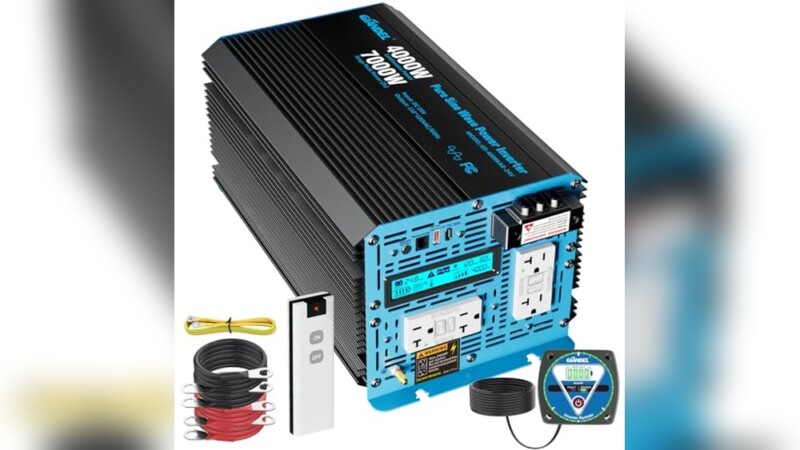
- Best for 24V heavy loads: GIANDEL 4000W, 7000W surge rating
- Best for simple 12V charging: Renogy inverter-chargers
- Best for advanced systems: Victron MultiPlus-II
Should I choose a 12V or 24V inverter for my solar backup system?
Choose 12V for loads up to about 1,500W, and 24V once your regular load or your inverter is larger. Doubling the voltage halves the DC current for the same power, which means thinner cable, smaller fuses and less heat at every connection.
Other points to weigh:
- Existing equipment: a 12V bank already in a van or RV usually stays 12V, because 12V lights, pumps and alternators all assume it.
- Scalability: a 24V bank built from two 12V batteries in series, or from 24V lithium units, leaves room for a bigger inverter later.
- Solar charging: 24V banks pair well with MPPT controllers because the same panel array pushes fewer amps into the battery.
- Fixed match: the inverter’s voltage must equal the battery bank’s nominal voltage. There is no flexibility here (see the 12V-on-24V section below).
How much DC current does a 2,000W or 3,000W inverter draw from a battery?
At 90% efficiency, a 2,000W AC load draws about 185A from a 12V battery or 93A from a 24V battery. A 3,000W load draws about 278A at 12V or 139A at 24V. The formula is DC amps = AC watts ÷ (battery volts × efficiency).
| AC load | 12V battery current | 24V battery current |
|---|---|---|
| 1,000W | about 93A | about 46A |
| 1,500W | about 139A | about 69A |
| 2,000W | about 185A | about 93A |
| 3,000W | about 278A | about 139A |
| 4,000W | about 370A | about 185A |
| 5,000W | about 463A | about 231A |
These figures assume 90% efficiency and a battery that holds its nominal voltage. Real batteries sag under heavy load, so the current is higher in practice. Renogy lists a 10.5-16.5V DC input range for its 12V inverter-chargers, and at the 10.5V low end a 3,000W load would pull roughly 317A. Check that your battery’s BMS or fuse can carry that current, because many 100A lithium batteries cannot support a 2,000W inverter at full load on 12V.
What inverter size do I need for my appliances?
Add up the running watts of everything that can be on at the same time, then add about 20 to 25% headroom. Check the nameplate on each appliance, since watts are usually printed there or can be found by multiplying volts by amps.
- List every load you want during an outage.
- Mark which loads run together and which can be staggered.
- Total the running watts of the simultaneous group.
- Find the largest motor surge and make sure running load plus that surge stays under the inverter’s surge rating.
- Add headroom, so the inverter is not running at its limit for hours.
Running continuously near the limit also shortens fan life and raises heat, and heat reduces output (see the derating section below). The Match inverter capacity to your total power needs page covers smaller 1,000W builds in more detail.
What surge rating is needed for motors, compressors, and power tools?
The inverter’s surge rating should exceed the largest startup draw on your list. Motor-driven loads such as refrigerator compressors, well pumps, air compressors and table saws typically draw several times their running watts for a fraction of a second. The exact multiple varies by appliance, so use the locked-rotor or startup figure from the nameplate or manual where one is given.
Two practical points: surge ratings are brief, usually seconds or less, and they assume a battery that can deliver the current. A 24V 4000W inverter listing 7,000W surge, like the GIANDEL below, needs a battery and cables that can supply roughly 324A at that moment (7,000 ÷ 24 ÷ 0.9). For reference, Renogy specifies 9,000W surge for its REGO 12V 3000W and Victron lists a 5,500W peak for its MultiPlus-II 3kVA.
Is a pure sine wave inverter necessary for refrigerators, pumps, medical devices, and electronics?
For a backup system, pure sine wave is the right choice. Compressors and pump motors run cooler and quieter on it, and electronics with switching power supplies, battery chargers, and many medical devices expect a clean waveform. Modified sine wave can cause buzzing, extra motor heat, and failure to run some devices at all.
For anything medical, follow the device maker’s guidance on power quality and keep a second power source. Renogy lists less than 5% THD for resistive loads on its 2000W/3000W 12V models, which is a useful figure to compare across brands that publish it. All ten roundup picks below are listed as pure sine wave.
What is the difference between an inverter and an inverter-charger?
An inverter only converts battery DC to AC. An inverter-charger adds a built-in battery charger and an AC transfer switch, so it can charge the bank from shore power or a generator and pass that power through to your loads. An all-in-one solar unit goes one step further by adding a solar charge controller.
| Type | Does | Does not | Good for |
|---|---|---|---|
| Inverter only | DC to AC | Charge from AC, switch sources | Systems with a separate charger and solar controller |
| Inverter-charger | DC to AC, charges from AC, transfers power | Solar charging (unless built in) | Cabins, RVs, and backup with a generator or grid |
| All-in-one solar | Inverter, charger and MPPT in one | Offer as much component-level flexibility | Compact, simple off-grid builds |
Victron describes the MultiPlus as a true-sine-wave inverter combined with a battery charger, with PowerAssist and system-integration features (MultiPlus specifications from Victron Energy). The ten roundup models below are inverters, and their listings do not describe a built-in charger, so you would need a separate charger and solar controller with them.
Can a 12V inverter be connected to a 24V battery bank?
No. Renogy states that its 12V inverter models cannot be used with a 24V battery system because doing so may damage the inverter and void the warranty (Renogy 2000W/3000W 12V inverter-charger listing). The same applies the other way around.
Victron’s MultiPlus-II 3kVA datasheet shows why: the DC input range is 9.5-17V for 12V systems and 19-33V for 24V systems, so a 24V bank sits well outside a 12V unit’s range. If you need to run a 12V device from a 24V bank, use a DC-DC converter for that device rather than tapping half the batteries, which unbalances the cells.
How much battery capacity is needed to run a 1,000W or 2,000W load?
Divide the AC load by inverter efficiency to get the battery draw, then divide the usable battery energy by that figure. A 1,000W load at 90% efficiency draws about 1,111Wh from the battery each hour, and a 2,000W load about 2,222Wh.
| Battery | Nominal energy | Usable at 80% | Load | Approx. runtime |
|---|---|---|---|---|
| 12V 100Ah lithium | 1,280Wh | 1,024Wh | 1,000W | about 55 minutes |
| 12V 200Ah lithium | 2,560Wh | 2,048Wh | 1,000W | about 1 hour 50 minutes |
| 24V 200Ah lithium | 4,800Wh | 3,840Wh | 2,000W | about 1 hour 44 minutes |
| 24V 400Ah lithium | 9,600Wh | 7,680Wh | 2,000W | about 3 hours 27 minutes |
These are calculations, not measurements. Lead-acid banks usually allow only about 50% depth of discharge, which halves the usable figures, and they lose capacity at high discharge rates. Runtime also ignores the inverter’s idle draw, which Renogy lists as under 12W for its 2000W/3000W 12V models.
Worked example: refrigerator plus networking backup
This example uses assumed figures; replace them with the numbers from your own appliances.
- Refrigerator: 150W while running, compressor on about 40% of the time: 150 × 0.4 × 24 = 1,440Wh per day.
- Modem and router: 25W continuous: 25 × 24 = 600Wh per day.
- AC energy total: 2,040Wh per day.
- Battery side at 90% efficiency: 2,040 ÷ 0.9 = about 2,267Wh.
- Inverter idle draw: up to 12W × 24 = 288Wh, bringing the total to about 2,555Wh, rounded to 2,600Wh per day.
Battery: for one day without sun at 80% usable, 2,600 ÷ 0.8 = 3,250Wh. That is roughly a 12V 280Ah bank or a 24V 140Ah bank.
Solar recharge: assuming 4 peak sun hours and 25% system losses, 2,600 ÷ (4 × 0.75) = about 870W of panels, so plan on roughly 900W to refill the bank in a day.
Inverter size: the running load is about 175W, and the fridge compressor surge might reach several hundred watts to around 1,000W. A 1,000W to 1,500W pure sine inverter would cope, and a 2,000W unit gives comfortable headroom for adding a microwave or a power tool later. The smaller the inverter, the lower its idle draw is likely to be, so check that figure on the spec sheet before oversizing.
Victron MultiPlus vs Renogy inverter-chargers: how do the specifications compare?
Victron targets integrated, expandable systems and Renogy targets simpler, lower-cost 12V builds with a charger and, on some models, solar input. All figures below come from the manufacturers’ published specifications, and “Not specified” means it was not in the source we used.
| Model | System voltage | Continuous | Surge / peak | Waveform | Charger and transfer | Solar input | Efficiency | Idle draw | Monitoring |
|---|---|---|---|---|---|---|---|---|---|
| Victron MultiPlus-II 3kVA | 12V or 24V (separate models) | 2,400W at 25°C, 2,200W at 40°C, 1,700W at 65°C | 5,500W peak | True sine wave | Built-in charger; PowerAssist | Not specified | 93% maximum | Not specified | System integration features |
| Renogy REGO 12V 3000W | 12V | 3,000W | 9,000W | Pure sine wave | Inverter-charger; about 10ms transfer time | Not specified | Above 90% | Not specified | LCD display |
| Renogy 12V 2000W inverter-charger | 12V | 2,000W | Not specified | Pure sine wave | 50A charger, up to 97% charging efficiency | 50V max, 660W max | Not specified | Not specified | Not specified |
| Renogy 12V 2000W/3000W listing | 12V (10.5-16.5V DC input) | 2,000W or 3,000W | Not specified | Pure sine wave, under 5% THD on resistive loads | Inverter-charger | Not specified | 90% peak | Under 12W | Not specified |
Specification pages: Victron MultiPlus range and Renogy REGO 12V 3000W inverter-charger. Renogy’s 12V models only work on 12V banks, while Victron offers both 12V and 24V versions of the MultiPlus-II.
Does heat reduce an inverter’s output (temperature derating)?
Yes, many inverters deliver less power as they get hot. The Victron MultiPlus-II 3kVA is rated at 2,400W continuous at 25°C, 2,200W at 40°C and 1,700W at 65°C, so a “3kVA” label does not mean 3,000W in a hot shed, engine bay or sunlit van.
Size against the derated figure for your worst-case temperature. If your load is 2,000W and the install location can reach 40°C, the MultiPlus-II 3kVA still fits with 200W to spare, but at 65°C it falls short by 300W. Mount the unit where air can circulate, keep it out of direct sun, and do not enclose it in an unventilated cabinet.
Which inverter features matter for solar backup: MPPT, transfer switch, UPS, Bluetooth, or remote monitoring?
A transfer switch and a charger matter most for backup; the others depend on how your system is built.
- Transfer switch: switches loads between shore or generator power and the inverter automatically. Renogy lists roughly 10ms transfer for the REGO 12V 3000W. Short transfer times help keep computers and networking gear running, but check the manufacturer’s UPS claims before trusting it for sensitive equipment.
- MPPT solar input: useful in an all-in-one. The Renogy 12V 2000W model lists a 50V maximum solar input voltage and 660W maximum solar input power. If you already own a separate MPPT controller, you do not need it built in.
- Battery charger: look for an amp rating that matches your bank, such as the 50A charger on the Renogy 2000W model.
- Remote or Bluetooth monitoring: helpful for cabins you are not at. Several roundup models include a wired or wireless remote with a display; Victron’s range offers system integration features.
What cable, fuse, ventilation, and battery-safety requirements apply to a high-power inverter?
Use the cable gauge and fuse size listed in the inverter’s manual, and keep the cable run as short as practical. At 185A or more, a thin cable overheats and wastes power as voltage drop, which many installers aim to keep to about 2 to 3%.
- Fuse: install a DC fuse or breaker on the battery positive, as close to the battery terminal as practical, rated for the inverter’s maximum current but not above the cable’s ampacity. Lithium batteries can deliver very high fault current, so choose a fuse with a suitable interrupt rating.
- Disconnect: add a DC isolator so you can fully cut power before servicing.
- Cables: use properly crimped lugs and tighten terminals to the torque in the manual. Loose lugs cause heat at high current.
- Grounding: bond the chassis as directed by the manual and local electrical code.
- Ventilation: leave clearance around the fan and heatsink, and keep the unit out of sealed boxes.
- Batteries: keep flooded lead-acid batteries in a vented space, and make sure a lithium BMS can support the inverter’s maximum draw.
- Polarity: double-check positive and negative before the first connection, since reverse polarity can destroy many inverters.
Which loads should the inverter run first during an outage?
Run the loads that protect food, communication and health first, and leave heavy heating loads on propane or the grid. The wattages below are typical ranges; verify each against the appliance nameplate.
| Priority | Load | Typical running watts | Notes |
|---|---|---|---|
| 1 | Medical devices | Varies by device | Check the manufacturer’s power guidance and keep a backup source |
| 2 | Refrigerator or freezer | About 100-300W running | Motor surge on startup; consider a soft-start approach for large units |
| 3 | Router, modem, phone charging | About 10-50W | Small but continuous, so it adds up over 24 hours |
| 4 | Well or water pump | Varies, often several hundred watts or more | High startup surge; size inverter to the nameplate |
| 5 | Power tools | Varies widely | Short runs, high surge; schedule when other loads are off |
| 6 | Microwave, kettle, heater | Often 1,000W or more | Use sparingly or avoid on small banks |
Decision checklist before you buy
- Battery voltage: confirm 12V or 24V, and buy the matching model.
- Maximum continuous load: total the running watts that can be on together, plus 20 to 25%.
- Motor-starting surge: check it against the surge rating and against what your battery can deliver.
- Desired runtime: work out Wh per day, then battery size at 80% usable (50% for lead-acid).
- Charging source: solar only, generator, shore power, or all three, and whether you want one box to do it.
- Transfer switch: needed if you want automatic switching from grid or generator.
- Installation environment: expected temperature range, ventilation and available space, with derating applied.
- Battery current: confirm that your cable, fuse and BMS can carry the full DC current from the table above.
What maintenance, monitoring and warranty points should I check?
Inspect DC terminals every few months for heat discoloration or looseness, and keep the fan intake and heatsink free of dust. Check the warranty terms before purchase, because installing a 12V unit on a 24V bank may void it, as Renogy states. If you are replacing a unit, confirm the new one matches the existing cable and fuse rating before ordering. For remote cabins, favor a model with a display or app so you can watch battery voltage and load without being on site.
Top 12V and 24V inverter picks for 2026
The models below are listed on Amazon. Based on the listings, they are inverters rather than inverter-chargers, so pair them with a separate charger and solar controller. The current figures are our calculations at an assumed 90% efficiency, since the listings do not state efficiency.
| Model | Voltage | Continuous | Surge (as listed) | Waveform | Monitoring / extras | Approx. full-load DC current |
|---|---|---|---|---|---|---|
| GIANDEL 4000W | 24V | 4,000W | 7,000W | Pure sine | Remote with battery level; UL458 GFCI outlets | about 185A |
| 4000W 24V (JARXIOKE) | 24V | 4,000W | Not listed | Pure sine | LCD display, remote, Type-C and USB | about 185A |
| LVYUAN 5000W | 24V | 5,000W | Not listed | Not stated in the description | LCD display, wireless remote | about 231A |
| XWJNE 4000W | 24V | 4,000W | Not listed | Pure sine | LED display, remote | about 185A |
| XWJNE 5000W | 24V | 5,000W | Not listed | Pure sine | LED display, remote | about 231A |
| MWXNE 3000W | 24V | 3,000W | Not listed | Pure sine | Remote, Type-C PD30W and QC3.0 USB | about 139A |
| JARXIOKE 2000W | 24V | 2,000W | Not listed | Pure sine | LCD display, remote, USB | about 93A |
| SUNWHEEL 2000W | 12V | 2,000W | Not listed | Pure sine | LCD display | about 185A |
| Tebrol 2500W | 12V | 2,500W | Not listed | Not stated in the description | Remote, hardwire port, 5V/2.1A USB | about 231A |
| Mcamgiczin 5000W (48V variant shown) | 12V, 24V, 48V or 72V by variant | 5,000W | Not listed | Pure sine | Hardwire terminals | about 116A at 48V |

1. GIANDEL 4000 Watt 24 V Pure Sine Wave Power Inverter 7000Watt Surge,UL458 Listed GFCI Outlets,Inverter 24V DC to 120V AC,FCC Approved,Remote with Battery Level for RVs Campers Off Grid Solar Setup
- Brand: Giandel
- Manufacturer: GIANDEL
- Color: Black
- Dimensions: Height: 6.7 inches Width: 8.1 inches Length: 14.6 inches Weight: 16.093745126 pounds
The GIANDEL 4000 Watt inverter converts 24V DC to 120V AC with a 7000W surge rating, UL458 listed GFCI outlets and FCC approval. A remote with battery level display lets you watch the bank from a distance. It is aimed at RVs, campers and off-grid solar setups that need pure sine wave power.
Advantages
- Provides clean and stable power with pure sine wave output.
- Supports heavy loads with 7000-watt surge capacity.
- Includes UL458 listed GFCI outlets for safety protection.
- Displays battery level on remote for easy monitoring.
- Ideal for RVs, campers, and off-grid solar systems.
Sizing note
Based on the specifications, a full 4,000W load draws about 185A from a 24V bank at an assumed 90% efficiency, and the 7,000W surge implies a brief draw above 300A. Use a battery with a BMS rated well above that and a fuse and cable sized from the manual. It is the strongest fit in this list for a 24V bank running a freezer, pump or power tools.

2. 4000 Watt Pure Sine Wave Power Inverter 24V DC to 110V 120V Converter for Family RV Off Grid Solar System Car with Type-C Ports 4 AC Power Outlets Dual USB Ports LCD Display and Remote Control
- Brand: JARXIOKE
- Manufacturer: JR-1
- Dimensions: Height: 6.02 inches Width: 8.07 inches Length: 11.02 inches
This 4000 Watt pure sine wave inverter converts 24V DC to 110V or 120V AC. It has four AC outlets, dual USB ports and Type-C ports, plus an LCD display for real-time power status and a remote control.
Advantages
- Powers multiple devices at once with four AC outlets and USB ports.
- Converts 24V DC to 110V/120V AC for home and travel use.
- LCD display shows clear information for easy monitoring.
- Remote control offers convenience from a distance.
- Supports off-grid solar systems, ideal for RV and car use.
Sizing note
Full load is about 185A at 24V (assumed 90% efficiency). The listing does not give a surge figure, so confirm it before pairing it with a compressor or pump. The multiple outlets and USB ports suit a mixed cabin load.

3. LVYUAN 5000 Watt Power Inverter 24V to 110V 120V for Vehicle, Solar Inverter System, Heavy Duty, RV, Truck, Off Grid,Camping with 4 AC Outlets, LCD Display, Wireless Remote Control, Car Power Inverter
- Brand: LVYUAN
- Manufacturer: Guangzhou LVYUAN Technology Co., Ltd.
- Color: Black
- Dimensions: Height: 5.51 Inches Width: 7.04 Inches Length: 16.3 Inches
The LVYUAN 5000 Watt inverter converts 24V to 110V/120V, with four AC outlets, an LCD display and a wireless remote. It is marketed for vehicles, solar systems, RVs, trucks and off-grid camping.
Advantages
- Powers multiple devices with four AC outlets for convenience.
- Displays real-time information clearly on the LCD screen.
- Operates wirelessly using the remote control for ease.
- Supports heavy-duty use in trucks, RVs, and off-grid setups.
- Converts 24V to 110V/120V efficiently for versatile power needs.
Sizing note
At 5,000W the full-load DC draw is about 231A at 24V (assumed 90% efficiency), which needs very heavy cable and a battery bank built for that discharge rate. The product description does not state the waveform, so check the listing before running motors or sensitive electronics.

4. XWJNE 4000W Pure Sine Wave Power Inverter 24V DC to 120V AC Converter with LED Display and Remote Controller for Home, RV, Truck, Off-Grid Solar Power
- Brand: XWJNE
- Manufacturer: XWJNE
- Color: Yellow
- Dimensions: Height: 25.0 Inches Width: 19.2 Inches Length: 12.0 Inches Weight: 19.2022630202 Pounds
This XWJNE 4000W inverter changes 24V DC power to 120V AC, with an LED screen showing power use and a remote control. It is listed for homes, RVs, trucks and off-grid solar setups.
Advantages
- Provides clean and stable power with pure sine wave output.
- Easy to monitor with a clear LED display and remote.
- Converts 24V DC to 120V AC for various home devices.
- Ideal for use in RVs, trucks, and off-grid solar setups.
- Protects appliances with built-in safety features and alarms.
Sizing note
Full load is about 185A at 24V (assumed 90% efficiency). The listed dimensions and weight look like packaging figures, so confirm the unit’s installed size in the manual before planning the mounting space.

5. 2025 Latest Upgraded Model 5000 Watt Pure Sine Wave Power Inverter 12V,24V,48V,72V DC to 110V 220V AC with Hardwire Terminals for Off Grid Solar System Boats Campers,48V-5000W
- Brand: Mcamgiczin
- Manufacturer: Mcamgiczin
- Color: 48V
This 5000 Watt pure sine wave inverter is sold in 12V, 24V, 48V and 72V variants and converts DC to 110V or 220V AC. Hardwire terminals are meant for a secure installation on boats, campers and off-grid solar systems.
Advantages
- Provides clean and stable power for sensitive electronics.
- Supports multiple input voltages: 12V, 24V, 48V, and 72V.
- Easy to connect with hardwire terminals for secure setup.
- Ideal for off-grid solar systems, boats, and campers.
- Delivers reliable 5000-watt output for heavy power needs.
Sizing note
The listing shown is the 48V-5000W variant, which draws about 116A at full load (assumed 90% efficiency) but does not suit a 12V or 24V bank. Each variant is a fixed-voltage unit, so select the variant that matches your battery voltage exactly before ordering.

6. MWXNE 3000W Pure Sine Wave Inverter 24V DC to 110V 120V AC Converter for RV Truck Home Off-Grid Solar Power Inverter with Type-C PD30W/USB Port QC3.0 Quick Charging, 4 AC Outlets, Remote Control
- Brand: MWXNE
- Manufacturer: MWXNE
The MWXNE 3000W pure sine wave inverter changes 24V DC to 110V or 120V AC for RVs, trucks, homes and off-grid solar systems. It has four AC outlets, Type-C PD30W and QC3.0 fast-charging ports, and a remote control.
Advantages
- Provides clean and stable power for sensitive electronics and appliances.
- Supports multiple devices with four AC outlets and fast USB charging.
- Offers remote control for easy operation from a distance.
- Converts 24V DC to 110V/120V AC, ideal for RVs and off-grid homes.
- Ensures reliable energy supply for trucks, homes, and solar setups.
Sizing note
A full 3,000W load draws about 139A at 24V (assumed 90% efficiency), which is manageable on a 200Ah-class lithium 24V bank. It suits a fridge, networking and small tool mix in a cabin or RV.

7. SUNWHEEL 2000W Pure Sine Wave Inverter, 12V DC to 110V/120V AC Power Inverter for RV、Microwave、Off Grid、Truck、Refrigerator、Air Conditioner with 2 AC outlets and LCD Display
- Brand: SUNWHEEL
- Manufacturer: SUNWHEEL
- Dimensions: Height: 5.91 inches Width: 7.09 inches Length: 11.8 inches
The SUNWHEEL 2000W Pure Sine Wave Inverter converts 12V DC to 110V/120V AC and is listed for RVs, microwaves, refrigerators and air conditioners. It has two AC outlets and an LCD display showing power and voltage status.
Advantages
- Provides clean and stable power for sensitive electronics.
- Supports multiple appliances like refrigerators and air conditioners.
- Features two AC outlets for convenient device connections.
- Displays real-time information on an easy-to-read LCD screen.
- Perfect for use in RVs, trucks, and off-grid setups.
Sizing note
Full load is about 185A from a 12V bank (assumed 90% efficiency), so it needs heavy cable and a battery whose BMS can deliver that current. Running a microwave and a fridge together will approach the limit; for 12V systems it is most comfortable with loads well under 1,600W.

8. XWJNE 5000W Pure Sine Wave Power Inverter 24V DC to 120V AC Converter with LED Display and Remote Controller for Home, RV, Truck, Off-Grid Solar Power
- Brand: XWJNE
- Manufacturer: XWJNE
- Color: Yellow
- Dimensions: Height: 25.0 inches Width: 22.0 inches Length: 12.0 inches Weight: 22.0021337476 Pounds
The XWJNE 5000W Pure Sine Wave Inverter converts 24V DC to 120V AC for homes, RVs, trucks and solar setups. An LED display shows real-time status and an included remote controller operates it from a distance.
Advantages
- Powers home, RV, truck, and solar systems smoothly.
- Converts 24V DC to 120V AC with clean output.
- Shows real-time data on the bright LED display.
- Remote control lets you operate it from afar.
- Handles high power needs safely and efficiently.
Sizing note
Full load is about 231A at 24V (assumed 90% efficiency). It only makes sense with a large lithium bank and short, heavy cabling; if your regular load is under 3,000W, a smaller unit will idle more efficiently and run cooler.

9. JARXIOKE 2000 Watt Pure Sine Wave Power Inverter, 24V dc to 110 Vdc to 120 Vdc, for Home, RV and Off-Grid Solar Systems, with 2 AC Outlets and USB Port, LCD Display, with Remote Control
- Brand: JARXIOKE
- Manufacturer: JARXIOKE
- Color: Blue
The JARXIOKE 2000 Watt pure sine wave inverter converts 24V DC to 110-120V AC, with two AC outlets, a USB port, an LCD display and a remote control. It is listed for homes, RVs and off-grid solar systems.
Advantages
- Power your devices safely with pure sine wave output.
- Enjoy flexible use at home, RVs, or off-grid solar setups.
- Charge gadgets easily using two AC outlets and USB port.
- Stay informed with the clear LCD display and remote control.
- Convert 24V DC to standard 110-120V AC efficiently and reliably.
Sizing note
Full load is only about 93A at 24V (assumed 90% efficiency), the same power that would take roughly 185A on 12V. This is the easiest model in the list to wire safely, and it fits the refrigerator-plus-networking example above with room for a small tool.

10. 2500W Inverter 12V DC to 120V AC Converter for Home, RV, Truck, Off-Grid Solar Power Inverter with Built-in 5V/2.1A USB, AC Hardwire Port, Remote Controller
- Brand: Tebrol
- Manufacturer: Tebrol
- Dimensions: Height: 9.0 inches Width: 25.0 inches Length: 26.5 inches
This 2500W inverter converts 12V DC to 120V AC for home, RV or truck use. It has a built-in 5V/2.1A USB port, an AC hardwire port and a remote controller.
Advantages
- Provides reliable power for homes, RVs, trucks, and solar setups.
- Converts 12V DC to 120V AC efficiently with minimal energy loss.
- Built-in USB port charges phones and small devices easily.
- Remote controller offers convenient control from a distance.
- AC hardwire port allows direct connection to home wiring safely.
Sizing note
Full load is about 231A from a 12V bank (assumed 90% efficiency), the highest current of the 12V models here. The listing does not state the waveform, so confirm it before running motors. For a bank of this size, a 24V system would cut that current to roughly 116A.
Frequently Asked Questions
What Is The Best Inverter Type For 12v/24v Solar Backup Systems?
Pure sine wave inverters work best for 12V/24V solar backup because they provide clean and stable power for motors and electronics. Choose an inverter-charger if you also want to charge the bank from a generator or shore power.
How Do I Choose Inverter Capacity For Off-grid Solar Backup?
Match inverter capacity to your total power needs in watts, with 20 to 25% extra for safety, and check the largest motor surge against the inverter’s surge rating.
Can I Use A 12v Inverter With A 24v Solar Battery System?
No. Use an inverter that matches your battery voltage. Renogy states that using its 12V inverters on a 24V system may damage the unit and void the warranty.
How Long Can A Solar Backup Inverter Run During Power Outage?
Runtime depends on battery size and load. As a guide, a 12V 100Ah lithium battery at 80% usable runs a 1,000W load for about 55 minutes, and a 24V 400Ah bank runs 2,000W for about 3.5 hours (see the runtime table above).
Do I Need A 24V Inverter For A 3,000W Load?
It is strongly advisable. A 3,000W load pulls about 278A at 12V but about 139A at 24V, which makes cable, fuse and connection requirements far easier to meet.
Will A 3kVA Inverter Deliver 3,000W In A Hot Location?
Not necessarily. Victron’s MultiPlus-II 3kVA is rated at 2,400W at 25°C, 2,200W at 40°C and 1,700W at 65°C, so always check the derating curve for your install temperature.
Conclusion
Pick the voltage first, then size the inverter for running watts, motor surge and the temperature where it will live. Prefer 24V once loads pass about 1,500W, and make sure your battery, cables and fuse can carry the DC current in the table above. Choose an inverter-charger if you need automatic charging and transfer switching, and an inverter-only model if you already have a separate charger and solar controller.
Sources