
A 10000 watt power inverter acts as the heart of massive off-grid electrical systems. It takes DC power stored in batteries and turns it into the AC electricity your home appliances need. This is not a small plug-in device for your car cigarette lighter. This is heavy industrial equipment capable of running central air conditioning, electric water heaters, and entire workshops.
Finding the right unit is critical. A failure here means your entire house goes dark. You need reliability. You need clean power. Most importantly, you need a unit that handles heat effectively without shutting down under load.
We have analyzed the specifications, build quality, and surge capabilities of the top units on the market. This guide breaks down the best 10000 watt power inverter options and explains why system voltage is the most important choice you will make.
Why You Need a 10000 Watt Inverter
Most standard RVs or small cabins run on 2000W or 3000W units. So, who needs 10,000 watts? You do if you are trying to replicate grid power completely. This size class is designed for:
- Whole-Home Backup: Running multiple high-draw appliances at once (fridge, microwave, AC, and lights).
- Mobile Businesses: Food trucks or mobile workshops with welders and compressors.
- Off-Grid Living: Large solar setups where the grid is not an option.
At this power level, you are dealing with serious electricity. Safety is the priority. Cheap components melt under this kind of load. You must prioritize build quality over the lowest price tag.
The Critical Decision: 12V, 24V, or 48V?
Before you look at brands, you must look at voltage. This is where many beginners make a dangerous mistake.
Do not use a 12V battery bank for a 10000 watt inverter.
Here is the math. Watts divided by Volts equals Amps.
10,000 Watts / 12 Volts = 833 Amps.
Managing 833 amps requires cables as thick as your wrist. The heat generated is immense. The resistance in the connections will cause voltage drops. It is inefficient and dangerous. For a 10000 watt system, we strongly recommend a 48V battery bank. This drops the current to roughly 208 amps, which is much easier to manage safely with standard 4/0 cabling.
Top Features to Look For
When reviewing these high-capacity units, we focus on three specific technical markers.
1. Pure Sine Wave vs. Modified Sine Wave
You will see “Modified Sine Wave” inverters selling for cheap. Avoid them for whole-home systems. Modified sine wave inverters produce “blocky” or “dirty” power. This causes motors (like in your fridge or fans) to run hot and buzz. It can destroy sensitive electronics like medical CPAP machines or laser printers.
Only buy Pure Sine Wave for a 10,000-watt setup. It replicates the smooth power you get from the utility company. It ensures your expensive appliances last longer.
2. Split Phase Capability (120V/240V)
In North America, standard outlets are 120V. However, large appliances like clothes dryers, well pumps, and ovens often need 240V. Many 10000 watt inverters are “Split Phase.” This means they can output 120V for your TV and 240V for your dryer simultaneously. If you are wiring this into a main breaker panel, a split-phase inverter is usually required.
3. Surge Capacity
Motors need a huge spike of power to start. An air conditioner might run at 1500 watts but needs 4000 watts for a split second to start up. A good 10kW inverter should have a surge capacity of at least 20,000 watts for up to 20 seconds. This prevents the system from tripping every time the fridge kicks on.
Comparison: High-Performance Inverter Specs
We have compared the typical specifications of top-tier industrial inverters versus budget consumer models. This table highlights what you get when you invest in quality.
| Feature | Top-Tier Industrial Unit | Budget Consumer Unit |
|---|---|---|
| Waveform | Pure Sine Wave (Clean) | Modified Sine Wave (Dirty) |
| Surge Duration | 20+ Seconds (High capability) | Milliseconds (Trips easily) |
| Internal Charger | Included (100A+) | Usually None |
| Weight | 100+ lbs (Large Transformers) | 20-30 lbs (High Frequency) |
| Typical Voltage | 48V DC Input | 12V DC Input |
Low Frequency vs. High Frequency Inverters
You will notice some 10,000 watt inverters are huge and heavy (over 100 lbs), while others are smaller and lighter. This is the difference between Low Frequency and High Frequency technology.
Low Frequency Inverters (Recommended): These use massive copper transformers. They are heavy. They are expensive. But, they are incredibly strong. They can handle massive surge loads from power tools and pumps without failing. If you live off-grid full time, this is what you want.
High Frequency Inverters: These use electronic switching. They are lighter and cheaper. However, they often struggle with surge loads. If you try to start a large air compressor, a high-frequency unit is more likely to shut down immediately.
Installation: Managing the Heat and Current
Installing a 10000 watt power inverter is not a DIY job for beginners. The amperage involved can weld metal instantly if you make a mistake.
Fuse Protection
You must install a catastrophic fuse (Class T or ANL) between the battery bank and the inverter. For a 48V system, a 300A to 400A Class T fuse is standard. This fuse is designed to stop an arc flash. Do not use cheap car audio fuses. They cannot handle the interrupt rating of a large lithium battery bank.
Wire Sizing
Undersized wires are a fire hazard. Even with a 48V system, you should use 4/0 AWG pure copper cable. Keep the cables as short as possible,ideally under 5 feet. This reduces resistance and keeps the voltage steady.
For more details on electrical safety standards, you can review guidelines from the Department of Energy regarding standalone systems.
Battery Bank Requirements
A 10000 watt inverter is useless without a massive battery bank to feed it. If your batteries are too small, the voltage will sag the moment you turn on a heavy load, and the inverter will turn off to protect itself.
To run a 10kW load for just one hour, you need 10kWh of stored energy. Accounting for efficiency losses and depth of discharge limits (don’t drain lead-acid below 50%), you would need:
- Lead Acid / AGM: A bank of roughly 8-10 large 200Ah 12V batteries wired for 48V.
- LiFePO4 (Lithium): A minimum of two or three server-rack style 48V 100Ah batteries.
Lithium is superior for these large systems. It maintains higher voltage under load, which keeps the inverter running cooler and more efficiently.
Top Brand Considerations
While models change, certain manufacturers have established a reputation for reliable 10kW units.
AIMS Power
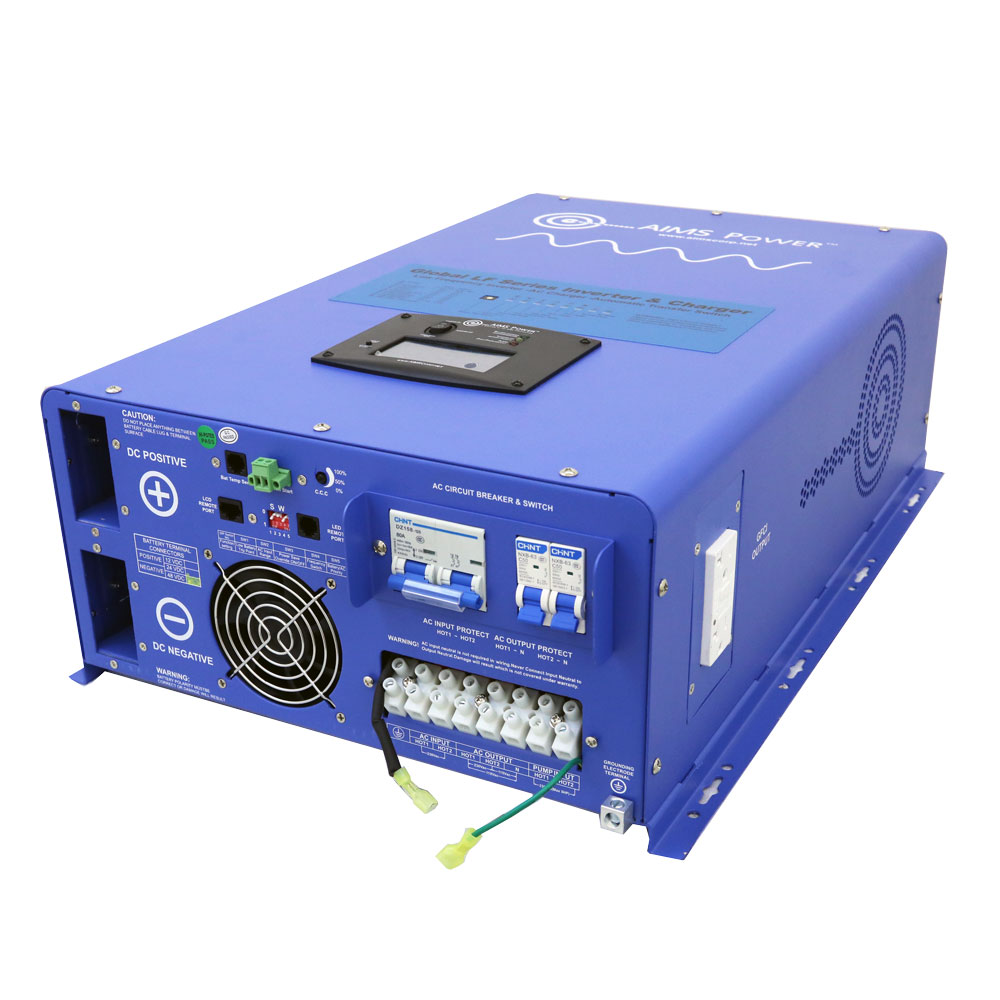
AIMS is well known for their split-phase, low-frequency inverters. Their units are heavy beasts built with large transformers. They are a go-to choice for off-grid cabins in the US. They handle surges exceptionally well.
Sigineer Power
Sigineer specializes in heavy-duty inverter chargers. Their units often allow you to charge your batteries from a gas generator or the grid when available. They offer strong 48V options that are directly compatible with Tesla battery modules or custom lithium banks.
Victron Energy (Alternative Approach)
Victron is the gold standard for marine and off-grid. They do not typically make a single “10,000 watt” unit. Instead, they allow you to stack two 5,000 watt “Quattro” inverters together. This is more expensive, but it offers redundancy. If one unit fails, you still have half your power. This is the professional route for critical systems.
You can read more about how inverters function technically on Wikipedia’s Power Inverter page.
Final Recommendation
Choosing the best 10000 watt power inverter comes down to your specific power needs. For most users, a 48V, Low-Frequency, Pure Sine Wave inverter is the correct choice. It offers the safety of lower amperage and the strength to start heavy motors.
Avoid 12V inputs at this power level. The cabling requirements are too difficult to manage safely. Spend the extra money on a proper split-phase unit if you plan to power a standard household breaker panel. This investment ensures your lights stay on, your food stays cold, and your life continues normally, even when the grid goes down.
Frequently Asked Questions
Can I run a 10000 watt inverter on a 12V battery?
Technically yes, but it is not recommended. It requires massive cables (likely multiple runs of 4/0 wire) to handle the 800+ amps of current. This creates significant heat and fire risk. A 48V system is much safer and more efficient for this wattage.
How many batteries do I need for a 10000 watt inverter?
It depends on how long you want to run your appliances. To run at full 10,000W load for one hour, you need at least 10kWh of usable battery capacity. For a lithium system, this is roughly two 48V 100Ah server rack batteries. For lead-acid, you would need double that capacity.
What is the difference between split-phase and single-phase?
Single-phase inverters usually output only 120V. Split-phase inverters output both 120V and 240V. If you want to power a home electrical panel that runs a well pump, dryer, or water heater, you almost certainly need a split-phase unit.
Does a 10000 watt inverter use power when nothing is plugged in?
Yes. This is called “idle consumption.” Large low-frequency inverters can consume 50 to 150 watts just by being turned on. It is smart to turn the unit off or use “power saver mode” when you are not using heavy loads to save battery life.
Can I weld using a 10000 watt inverter?
Yes, provided it is a high-quality low-frequency inverter with good surge capacity. Welders have high in-rush current. Cheap high-frequency inverters will often trip the moment you strike an arc.