
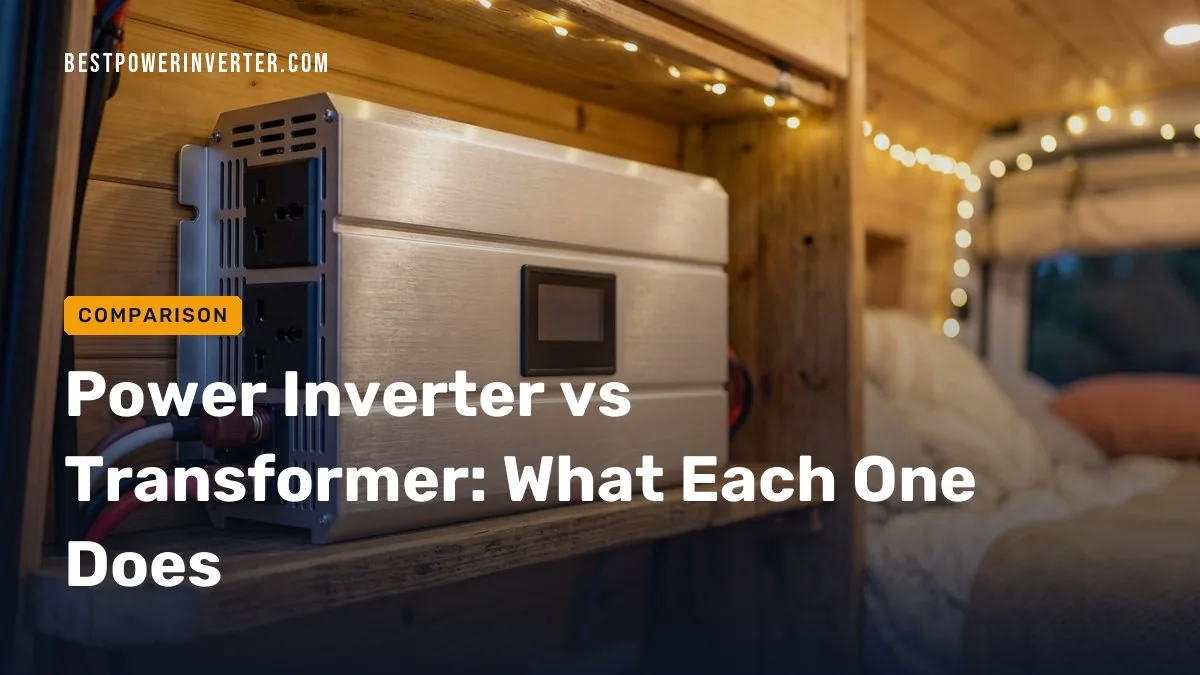
An inverter and a transformer are not interchangeable. A power inverter turns DC battery power into AC power, while a transformer only changes the voltage of power that is already AC. If you have a battery and need to run a pump, fridge, or TV, you need an inverter, and the right size depends on your load’s running and surge watts.
Quick answer
Use an inverter to get AC from a battery. Use a transformer only to step AC voltage up or down. Size the inverter to the load’s surge watts, not just its running watts, and add headroom for motors.
- Best for battery power: a pure sine wave inverter
- Best for AC voltage changes: a standard transformer
- Best for solar or wind plants: an inverter-duty transformer
- Inverters convert DC to AC. Transformers cannot do that.
- Inverter-duty transformers are a special type built for inverter-fed systems, not for your RV or truck.
- Motor loads like sump pumps and mini fridges need extra surge capacity.
- Current draw is roughly watts divided by battery volts, then adjusted for efficiency.
- Higher battery voltage (24V or 48V) means much lower current for the same watts.
- What is the difference between a power inverter and a transformer?
- When do you need an inverter-duty transformer?
- What does surge wattage mean?
- How big of an inverter do I need for common loads?
- How do you estimate current draw on 12V, 24V, and 48V?
- How big of a power inverter can my truck handle?
- What size makes sense for 4000W or 5000W setups?
- How much power does an inverter waste?
- Is a pure sine wave inverter better?
- What do owners say?
- Frequently Asked Questions
What is the difference between a power inverter and a transformer?
A power inverter converts DC to AC. A transformer changes AC voltage from one level to another and does not convert DC to AC. That is the whole split.
An inverter uses electronic switching to turn battery power into an AC waveform. A transformer uses coils and a magnetic core. It needs AC input to work at all. Plug one into a battery and nothing useful happens.
Many inverters do contain a transformer or a similar magnetic part inside. That is why people mix the two up. The inverter is the complete device. The transformer is one possible part.
| Feature | Power inverter | Standard transformer | Inverter-duty transformer |
|---|---|---|---|
| Input | DC (battery) | AC | AC from an inverter |
| Main job | DC to AC conversion | Step AC voltage up or down | Step up voltage from inverter output |
| Handles distorted waveforms | Creates them | Not designed for them | Yes, built for them |
| Typical use | RV, truck, off-grid, backup | Power grid, wall adapters | Solar and wind plants |

When do you need an inverter-duty transformer instead of a standard power transformer?
You need one when the transformer is fed by inverters, such as in a solar or wind project. Most homeowners and RV owners never buy one.
According to the technical sources behind this guide, inverter-duty transformers are built for non-sinusoidal waveforms, harmonics, switching stress, and voltage transients from inverter-based systems. A standard power transformer expects a clean grid waveform. Feed it harmonic-heavy power and it can run hotter and wear out sooner. For a deeper look at the utility side, see this comparison of inverter-duty and power transformers for wind projects.
What does surge wattage mean and why does it matter for motor loads?
Surge wattage is the brief spike of power a load pulls when it starts. Motors, compressors, and pumps can draw several times their running watts for a moment.
An inverter has two ratings: continuous watts and surge (peak) watts. One manufacturer lists a 4000W pure sine wave inverter with up to 8000W peak output, which is a common two-to-one pattern. If your sump pump needs more surge than the inverter can supply, the inverter shuts down or never starts the pump.
Small inverters often struggle to start motor loads like pumps or fridges. The running watts looked fine on paper. The startup spike was the problem.
How big of an inverter do I need for a sump pump, mini fridge, drill, printer, or 32-inch TV?
Add up the running watts, find the largest surge, then pick an inverter whose continuous rating covers the total and whose surge rating covers the biggest start. Add about 20% headroom.
These are typical ranges, not measurements. Check each nameplate.
| Load | Typical running watts | Typical surge | Sensible inverter |
|---|---|---|---|
| Sump pump (1/3 hp) | About 800W | About 1,500 to 2,000W | 1500W or larger, 3000W surge |
| Mini fridge | About 100W | About 300 to 500W | 600 to 1000W |
| 32-inch TV | About 30 to 50W | Low | 300W |
| Inkjet printer | About 20 to 50W | Low | 300 to 500W |
| Laser printer | Higher while warming up | Can reach 1000W or more | 1500W |
| Corded drill | About 500 to 1000W | Moderate | 1500W |
Worked example
Say you run a sump pump (800W running, 2,000W surge) and a mini fridge (100W running, 500W surge). Running total: 900W. Worst-case start: 2,000W plus the fridge’s 100W if it is already running, or about 2,100W. A 1500W continuous, 3000W surge inverter handles that with room to spare. Add a 40W TV and the running total is about 940W. Still fine.
On a 12V battery, the pump alone pulls about 74A at 90% efficiency (800 ÷ 12 ÷ 0.9). On 48V it pulls about 18.5A. That gap is why bigger loads favor higher voltage.
How do you estimate inverter current draw on 12V, 24V, and 48V systems?
Divide the load watts by battery volts, then divide by efficiency. A 1500W load at 90% efficiency draws about 34.72A from a 48V bank, according to the 48V sizing sources used for this guide.
The table below shows the raw DC amps (watts ÷ volts) before losses. Add roughly 10% on top for a realistic number.
| Load | 12V | 24V | 48V |
|---|---|---|---|
| 1000W | 83.3A | 41.7A | 20.8A |
| 2000W | 166.7A | 83.3A | 41.7A |
| 3000W | 250A | 125A | 62.5A |
| 4000W | 333.3A | 166.7A | 83.3A |
| 5000W | 416.7A | 208.3A | 104.2A |
The 48V figures for 4000W (83.3A) and 5000W (104.2A) match the current table cited in the sizing research. One sizing guide reports a 1000W 48V inverter using roughly 22 to 26A in practice, which shows how losses push real draw above the raw number. For more on 48V design, see this 48V inverter sizing and battery bank guide.

How big of a power inverter can my truck handle?
Most trucks can handle a small inverter plugged into a socket and a mid-size inverter wired to the battery. Beyond about 1000 to 2000W, the battery, alternator, and cables become the limit.
Look at the whole chain:
- Socket circuit: Cigarette-lighter and accessory sockets are usually fused for only 10 to 15A. At 12V that is roughly 120 to 180W. Check your fuse.
- Battery: A starter battery is not built for deep, repeated discharge. A 1000W load pulls over 80A from 12V.
- Alternator: Output varies by truck, so check yours. Keep the engine running for anything large, or the battery will not start the truck later.
- Cables and fuse: High current needs thick cable, short runs, and a fuse close to the battery.
- Under about 150W (phone, laptop, TV): use the socket.
- Up to about 1000W with the engine running: wire directly to the battery with proper fusing.
- Above that, or running overnight: add a separate deep-cycle or lithium battery, or move to 24V or 48V.
What inverter size makes sense for a 4000W model or a 5000W battery bank?
A 4000W inverter suits whole-cabin or workshop loads, but it wants a 48V bank. At 12V it would try to pull over 330A, which is impractical for most setups.
For “5000W battery” questions, check what you mean. A 5000W inverter at 48V draws about 104.2A before losses. A 5 kWh battery is a different thing: it stores energy, not power. At a 4000W load with 90% efficiency, 5,000Wh lasts a little over an hour in theory, and less if you do not use the full capacity. Battery drain is faster than many owners expect at high wattage.
A 3000W continuous, 6000W surge inverter is described as a baseline size in a 48V sizing guide. It is a sensible starting point for a well-equipped off-grid home. The 48V sizing sources behind this guide can be found in this DC to AC off-grid sizing guide.
How much power does an inverter itself consume or waste?
Expect to lose about 5% to 15% of your energy in conversion. Inverter efficiency is commonly about 85% to 92% under heavy load, according to the sizing research for this guide.
There is also idle draw. Even with nothing plugged in, the inverter uses a little power to stay ready. The amount varies by model, so check the spec sheet. Left on for days, even a small idle draw can flatten a small battery. Turn the inverter off when you are not using it.
Is a pure sine wave inverter better for sensitive electronics and motor loads?
Yes, for most buyers it is the safer choice. Pure sine wave output matches household power, so electronics, pumps, and fridges run more smoothly.
Modified sine wave units cost less and work for simple loads like basic lights and some tools. Motors can run hotter or noisier on them, and some chargers and audio gear may hum or fail to work. Owners generally favor pure sine wave models for sensitive electronics.
What do owners say?
Owners like
- Quiet operation compared with generators
- Convenient for RV, truck, and backup use
- Pure sine wave models are favored for sensitive electronics
- Good for short-duration high-surge loads when properly sized
Common complaints
- Unexpected shutdowns when surge load exceeds the inverter rating
- Battery drain is faster than expected at high wattage
- Fans can be noisy under heavy load
- Small inverters struggle to start motor loads like pumps or fridges
Summarised from owner reviews and long-term user reports; individual experiences vary.
Frequently Asked Questions
What is the difference between a power transformer and an inverter duty transformer?
A standard power transformer expects clean AC from the grid. An inverter-duty transformer is built for the harmonics, switching stress, and voltage spikes that inverters produce. Use the second type when inverters feed it directly.
How big power inverter to run sump pump?
Start with the pump’s nameplate. A typical 1/3 hp pump runs near 800W and can surge to about 2,000W. A 1500W continuous inverter with 3000W surge is a common fit. Pure sine wave is the safer pick.
What is a 48 volt power inverter?
It is an inverter that runs from a 48V battery bank. Higher voltage means lower current for the same watts, so cables stay thinner and losses drop. A 3000W model draws about 62.5A before losses.
How big of a power drain is an inverter?
Conversion loses about 5% to 15% of the energy, and the inverter also draws a small amount when idle. Switch it off when not needed.
How big an inverter to power a 32 tv?
A 32-inch TV typically uses about 30 to 50W. A 300W inverter covers it, plus a streaming box or small game console.
What can a 4000 watt power inverter run?
It can run several household loads at once, such as a fridge, lights, a TV, and a power tool, as long as the total stays under 4000W and the surge fits the peak rating. Plan on a 48V battery bank, which would draw about 83.3A before losses.
How big inverter to power printer?
An inkjet needs only about 300 to 500W of inverter. A laser printer can spike to 1000W or more while the fuser heats, so choose about 1500W.
Sources
