
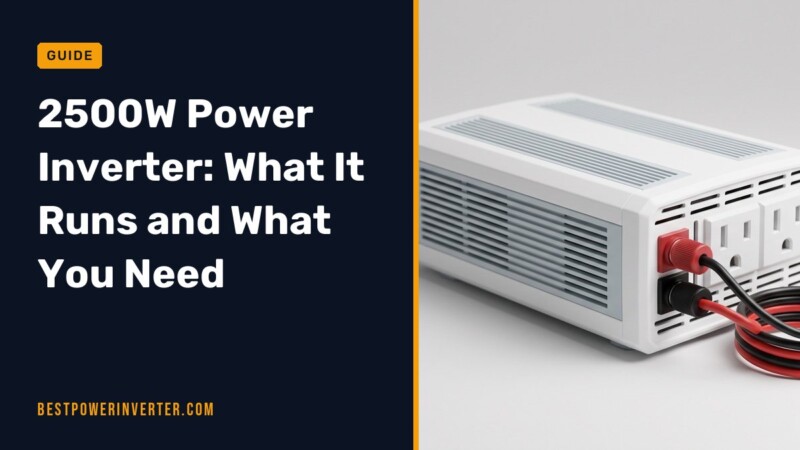
Pick a 2500W inverter for RVs, work trucks, small cabins or backup power, but only with a battery bank, cables and fuse sized to match. It turns DC battery power into household-style AC, typically 2500W continuous with about 5000W surge.
- 2500W is the continuous rating. Surge (often 5000W) lasts only a moment.
- At 12V, a full 2500W load pulls roughly 200-230 amps from the battery.
- 24V halves the current and is usually the smarter choice for heavy daily use.
- Choose pure sine wave for electronics, medical gear, and motor loads.
- Cables, fuse, and battery capacity matter as much as the inverter itself.
- What Does 2500W Actually Mean?
- How Big of a Surge Can It Handle?
- 12V vs 24V vs 48V Input
- Pure Sine Wave vs Modified Sine Wave
- What Appliances Can a 2500W Inverter Run?
- Battery Sizing, Amps, and Runtime
- Wiring, Fuse, and Safety
- RV, Vehicle, Solar, and Home Backup
- Buyer Checklist and Reviews
- Frequently Asked Questions
What Does 2500W Actually Mean on a Power Inverter?
It is the most AC power the inverter can deliver without stopping, measured in watts. A DC to AC power inverter takes battery voltage (12V, for example) and switches it into 120V or 230V AC. Models sold in the US usually output 120V. Many European listings show 220-240V. Always check the output voltage for your market.
Efficiency also matters. Based on the specifications in published listings, one 2500W 12V-to-120V model lists efficiency of 88% or higher, and a pure sine wave 12V-to-230V model lists up to 94%. The lost power turns into heat, so the battery has to supply more than the load uses.


How Big of a Surge Can a 2500W Inverter Handle?
Most 2500W units advertise a 5000W peak or surge. For example, Cobra describes its PRO 2500W inverter as delivering up to 2500W continuous and 5000W surge from a 12V system. Surge is for startup only. Motors and compressors pull several times their running watts for a fraction of a second.
What can that surge start? A 1/2 hp pump, a small refrigerator compressor, or a circular saw are realistic. A large well pump or a 13,500 BTU RV air conditioner may not start, even if the running watts fit. Check the startup rating of the device, not just its label.
What DC Input Voltage Do 2500W Inverters Use?
Most are 12V or 24V. Some are 48V. Higher voltage means less current for the same power, which allows thinner cables and less heat.
| Input | Approx. DC Amps at 2500W* | Typical Battery Setup |
| 12V | About 210-230A | Two to four 12V 100Ah lithium batteries in parallel |
| 24V | About 105-115A | Two 12V batteries in series, or one 24V battery |
| 48V | About 52-58A | Four 12V batteries in series, or a 48V pack |
*Includes roughly 88-94% efficiency losses. Real draw varies with battery voltage and load.
The math is simple: watts divided by volts, then adjusted for efficiency. 2500W / 12V is about 208A before losses. That figure is what many product pages leave out, and it drives every wiring decision below.
What Is the Difference Between Pure Sine Wave and Modified Sine Wave?
Pure sine wave output matches the smooth AC from a wall outlet. Modified sine wave is a stepped, blocky approximation. Both types are sold in the 2500W class, so the waveform is a key purchase decision.
- Laptops, TVs, CPAP machines, battery chargers, variable-speed tools: choose pure sine wave.
- Microwaves and induction motors: pure sine wave runs them cooler and quieter.
- Simple resistive loads (a basic heater, incandescent bulbs): modified sine wave usually works.
- Unsure: pure sine wave. It costs more but avoids buzzing, heat, and damaged gear.
What Appliances Can a 2500W Inverter Run?
Add up the running watts of everything on at the same time. Keep the total under 2500W, and under your surge limit at startup.
| Device | Typical Running Watts | Fits 2500W? |
| Laptop | 45-90W | Yes |
| LED TV (40-55 in.) | 50-120W | Yes |
| Full-size refrigerator | 150-300W (higher at startup) | Yes |
| Microwave (1000W cooking) | 1400-1600W input | Yes, alone |
| Coffee maker | 600-1200W | Yes |
| Electric kettle | 1200-1800W | Yes, alone |
| Hair dryer | 1200-1875W | Yes, alone |
| Large RV air conditioner | 1500-2000W running, higher on start | Risky |
Wattage figures are typical ranges. Check each appliance label.
Worked Example: Microwave, Laptop, and TV on 12V
Say you run a 1500W microwave, a 65W laptop, and a 100W TV together. The total is 1665W. At about 90% efficiency, the inverter draws roughly 1850W from the battery. Divide by 12V and you get about 154A.
That is within a 2500W inverter’s limit, but it pulls 154A from a 12V bank. A single 100Ah battery would be drained in under 40 minutes at that rate. A microwave used for five minutes is fine. Running all three for an hour is not.

How Much Battery Power Is Needed, and How Long Will It Run?
Use this formula: runtime (hours) = battery watt-hours x usable fraction / load watts. A 12V 100Ah battery holds about 1200Wh. Lithium (LiFePO4) can use about 80-100% of that. Lead-acid should be used to about 50%.
| Load | Battery | Approx. Runtime |
| 2000W | 12V 200Ah LiFePO4 (2400Wh) | About 1 hour |
| 1000W | 12V 200Ah LiFePO4 | About 2 hours |
| 500W | 12V 200Ah LiFePO4 | About 4 hours |
| 1000W | 12V 200Ah AGM (50% usable) | About 1 hour |
Runtimes include rough allowance for inverter losses. Idle draw adds up too. Listings show no-load current of 0.7A on one 2500W model and under 1.5A on another. Left on all day, even 1A at 12V costs about 24Ah.
What Wire Size, Fuse, and Battery Setup Does It Need?
This is where most failed installs begin. At 12V and about 210A, you need very thick copper cable and a class-T or equivalent high-amp fuse placed close to the battery positive terminal. Many manufacturers recommend 2/0 AWG or larger for short runs, and some call for 4/0. Follow the manual for your model, and keep the cable run as short as possible.
- Fuse: Size it to the inverter manual, usually around 250-300A at 12V. Install it within a few inches of the battery.
- Cables: Use pure copper, properly crimped lugs, and tight terminals. Loose connections cause heat and fire.
- Ventilation: Leave open air around the unit. Do not bury it in a closed cabinet.
- Grounding: Follow the manual’s chassis ground instructions.
- Disconnect: Add a battery switch for service and emergencies.
Using a 2500W Inverter for RV, Vehicle, Solar, and Home Backup
RV and Vehicle
A 2500W inverter handles a microwave, coffee maker, and electronics. Running it from a car or truck needs the engine on for heavy loads, since a starter battery cannot supply 200A for long. Use a dedicated house battery bank instead.
Off-Grid Solar
It pairs well with a 24V or 48V battery bank and enough panel capacity to recharge daily. Match solar and charge controller size to your daily watt-hour use.
Is a 2500W Inverter Safe for Home Backup Power?
Yes, for selected circuits, when installed correctly. It can keep a refrigerator, lights, internet, and phones running during an outage. It cannot run a whole house or central air. Never backfeed a house panel through a regular outlet. A transfer switch installed by a licensed electrician is required for any panel connection.
From the Shop
A common buyer mistake is spending on the inverter and cheaping out on cable. A 2500W unit with thin wire will sag, overheat, and shut down at the first heavy load, which looks like a faulty inverter when it is really a wiring problem.
What Should Buyers Check in Power Inverter Reviews and Listings?
Many search results are product pages, so read claims carefully. Buyers frequently mention fan noise, low-voltage shutdowns, and loose outlets. Look for how the unit behaves under real load, not just the headline wattage.
Buyer Checklist
- Waveform: pure sine wave or modified sine wave.
- Continuous vs surge: confirm 2500W continuous, not just 2500W peak.
- Input voltage: 12V, 24V, or 48V to match your battery bank.
- Output voltage: 120V or 230V for your region.
- Outlets and ports: number of AC outlets, plus USB or USB-C if needed. Count varies by model.
- Protections: low-voltage, overload, over-temperature, short-circuit, and reverse polarity.
- Efficiency and idle draw: higher efficiency and lower no-load current save battery.
- Warranty and support: check length and what it covers.
Compare specs against listings like the VEVOR 2500W pure sine wave inverter or the TITAN 2500W pure sine wave unit to see what a complete spec sheet looks like.
Common Mistakes
- Buying a 12V unit for daily heavy use when 24V would cut current in half.
- Using jumper-style cables or undersized wire.
- Skipping the main fuse.
- Running a high-surge appliance without checking its startup draw.
- Ignoring battery capacity and expecting hours of runtime from one small battery.

Frequently Asked Questions
What is a 2500w power inverter?
It is a device that converts 12V, 24V, or 48V DC battery power into AC power, rated for 2500W continuous output and usually about 5000W surge.
What is the difference between a DC to AC power inverter and a DC-AC power inverter?
Nothing. Dc to ac power inverter, dc-ac power inverter, dc ac power inverter, and power inverter dc ac all describe the same device. It changes direct current from a battery into alternating current for standard appliances.
What is the best power inverter?
The best one matches your use. For electronics and motors, pick pure sine wave. For heavy daily use, pick 24V or 48V input. Check surge rating, protections, and warranty before price.
Is a 1000 watt power inverter enough instead?
If your loads are laptops, TVs, and small appliances under about 800W, yes. A 1000 watt power inverter is cheaper and draws less current. You need 2500W for microwaves, kettles, and power tools.
Can I build a DIY power inverter?
Small DIY inverters exist as hobby projects, but a 2500W unit involves high current and safety risks. A tested, certified commercial unit with built-in protections is the safer choice.
What is a DC power inverter versus an AC power inverter?
People use dc power inverter and ac power inverter to mean the same product. Both refer to a unit that takes DC input and outputs AC power.
