
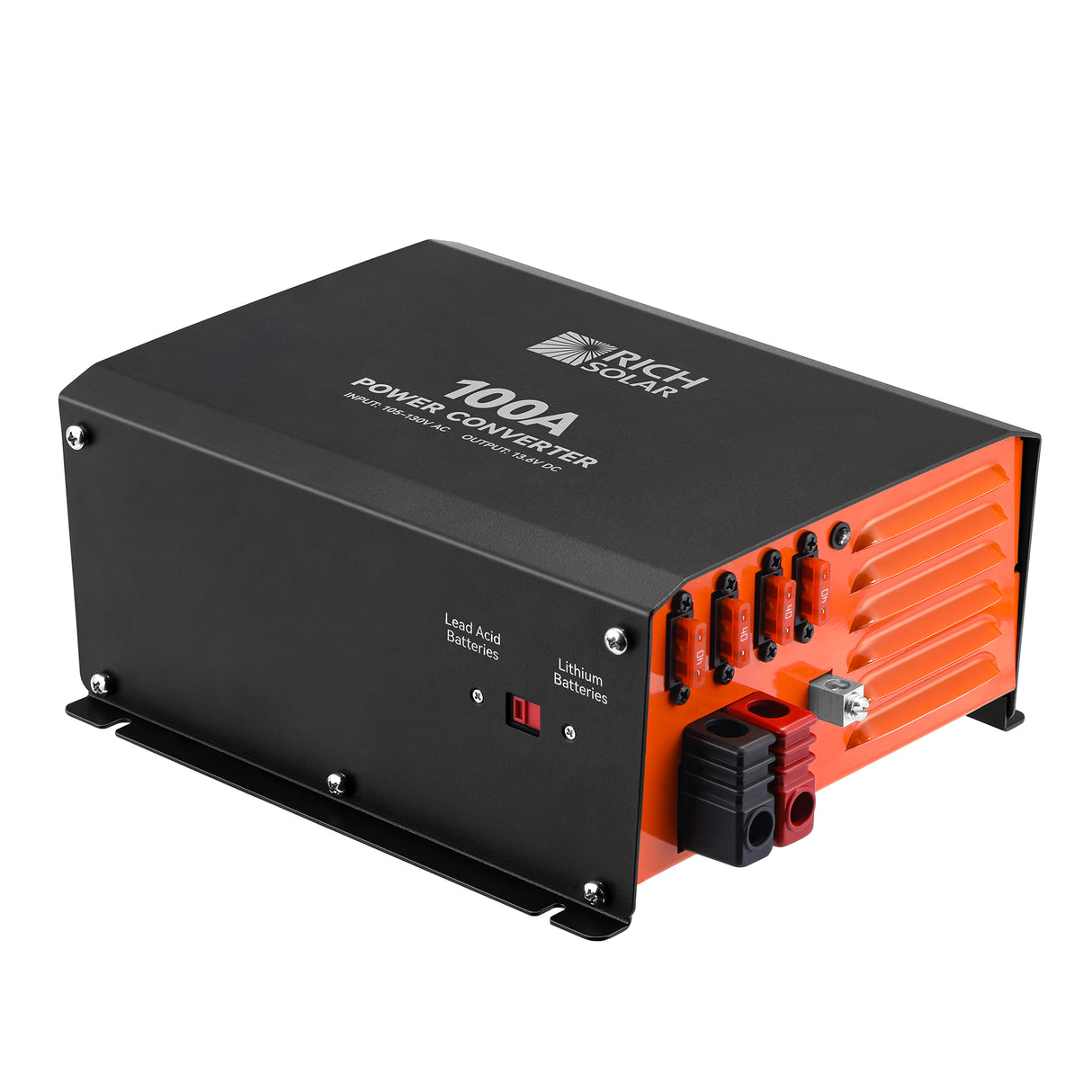
A 100 amp AC to DC power supply serves a specific, high-demand purpose. It takes standard 110V household electricity and converts it into 12V DC power, delivering up to 100 amps of current. This is the equivalent of a very strong car battery that never runs out of juice as long as it is plugged in. Mechanics, RV owners, and car audio enthusiasts use these units to power 12V electronics without draining a physical battery.
Buying the wrong unit can lead to melted wires, damaged electronics, or a power supply that simply shuts off under load. You need to understand duty cycles, voltage adjustment, and proper wire sizing before you plug anything in.
- Know the Difference: A 100 amp unit converts wall power to 12V DC. It is not an inverter.
- Wire Size Matters: You must use 2 AWG or 1/0 AWG wire for the DC output to prevent fire hazards.
- Fixed vs. Adjustable: Some units stay at 13.8V; others let you adjust voltage for specific testing needs.
- Cooling is Critical: 100 amps generates significant heat. Ensure the unit has active fan cooling.
What is a 100 Amp Power Converter?
A 100 amp power converter acts as a bridge. It changes high-voltage AC (Alternating Current) from your wall outlet into low-voltage DC (Direct Current). Most automotive and marine electronics run on DC. While a small battery charger might offer 10 or 20 amps, a 100 amp unit provides massive continuous power.
Think of it as a virtual battery. When you turn on a heavy load, like a large amplifier or RV leveling jacks, the converter supplies the current instantly. It maintains a stable voltage, usually between 13.2V and 14.4V, which keeps your electronics running smoothly.
Primary Uses for High Amperage
You generally do not need 100 amps for simple tasks like charging a phone or running LED lights. This equipment is for heavy-duty applications.
RV Power Converters
Modern RVs are packed with electronics. When plugged into shore power at a campground, the converter runs the 12V lights, fans, water pump, and slide-outs. Simultaneously, it charges the house battery bank. A 100 amp unit ensures you can run everything at once while quickly recharging a depleted battery bank.
Car Audio Testing and Tuning
Car audio shops use these supplies on the test bench. High-end subwoofers and amplifiers draw massive amounts of current. A standard battery charger cannot keep up. If the voltage drops too low during a test, the amplifier can distort or fail. A 100 amp supply keeps the voltage rock solid.
From the Shop
We once had a customer try to tune a 1500-watt monoblock amplifier using a standard 10-amp battery charger. As soon as the bass hit, the voltage dropped to 10V. The amp went into protect mode instantly. We hooked up our bench 100 amp supply set to 14.4V. The amp ran cool, the signal stayed clean, and we could set the gains perfectly. You cannot tune high-power gear without high-power supply.
Critical Specifications
Not all power supplies are built the same. Here is what to look for when reading the spec sheet.
Ripple and Noise
AC power moves in waves. When converted to DC, it should be a flat line. Cheap units leave “ripples” in the power. This looks like wavy lines on an oscilloscope. High ripple can cause humming noises in audio equipment and can overheat sensitive electronics. Look for a unit with low ripple noise (measured in millivolts).
Duty Cycle
This rating tells you how long the unit can run at full power. A 100% duty cycle means it can output 100 amps 24/7 without overheating. A 50% duty cycle means it can only run at full power for a short time before needing a break. For RVs, you want a high duty cycle.
Which Unit Do You Need?
- If you are charging RV batteries: Choose a “Smart Charger” or “Multi-Stage Converter.” It varies voltage to prevent overcharging.
- If you are testing Car Audio: Choose a “Fixed Voltage” Power Supply with low ripple noise.
- If you are doing electronics repair: Choose a “Variable Voltage” unit where you can dial in 0-15V.
Wiring and Safety
Moving 100 amps of current requires thick copper wire. If the wire is too thin, it acts like a heater element. It will get hot, melt the insulation, and could start a fire.
Wire Gauge Requirements
For a short run (under 5 feet), you should use at least 4 AWG wire. For runs longer than 5 feet, upgrade to 2 AWG or even 1/0 AWG. Never use standard speaker wire or household extension cords for the DC output.
You also need a fuse. Place a 100 amp or 120 amp ANL fuse on the positive wire as close to the power supply as possible. This protects the wire if a short circuit occurs.
How We Evaluated This
To understand the quality of these units, we look at performance under stress. We do not just read the box.
- Load Testing: We apply a carbon pile load tester to draw exactly 100 amps. We monitor the voltage. A good unit stays above 13.0V. A bad unit sags to 11V or shuts down.
- Thermal Imaging: After 30 minutes of load, we use a thermal camera. We check the temperature of the internal capacitors and the output terminals. Excessive heat indicates poor internal components.
- Oscilloscope Review: We check for “dirty” power. We look for voltage spikes that occur when the unit is plugged in or unplugged. Clean power is essential for modern vehicle computers.
According to safety standards from UL Solutions, power supplies must have internal protections against overheating and short circuits. We verify these protections actually work by intentionally creating fault conditions in a controlled environment.
For further reading on electrical safety standards, the NFPA (National Fire Protection Association) provides guidelines on low-voltage wiring which applies to these high-amperage setups.
Frequently Asked Questions
Can I use a 100 amp power supply as a battery charger?
Yes, but be careful. A standard power supply pushes constant voltage. If you leave it connected to a battery for weeks, it can boil the battery fluid. For long-term connection, use a unit specifically labeled as a “Smart Charger” or “RV Converter,” which lowers the voltage once the battery is full.
Will a 100 amp supply hurt my 10 amp device?
No. Current is “drawn,” not “pushed.” Your 10 amp device will only take the 10 amps it needs. The 100 amp rating is simply the maximum available capacity (headroom).
Why does the fan run loudly?
Converting AC to DC creates heat. To produce 100 amps, the internal transistors get very hot. The fan is necessary to prevent failure. If the fan stops, the unit will likely overheat and shut down.
Can I link two 50 amp supplies to get 100 amps?
Generally, no. Unless the power supplies are specifically designed to be “bridgeable” or “parallel capable,” connecting them together can cause them to fight each other, leading to failure. Always buy a single unit rated for your required amperage.
What is the difference between this and an inverter?
An inverter takes battery power (DC) and makes wall power (AC). This unit does the opposite: it takes wall power (AC) and makes battery power (DC).