
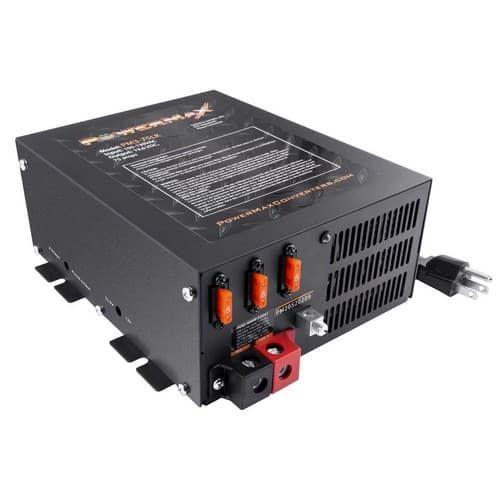
Anyone running power tools, small kitchen appliances, or mobile office gear from a vehicle or battery will likely land on a 10 amp inverter, which delivers 1200 watts of AC from DC battery power. It sits between small cigarette-lighter inverters and whole-home systems. That middle position suits work sites, vans, and small off-grid setups.
Understanding the difference between 10 amps of AC output and the DC amps required from your battery is critical. While the output is only 10 amps, the input from your 12V battery can exceed 100 amps. Getting this math wrong leads to blown fuses, melted wires, and equipment failure.
This guide breaks down exactly what a 10 amp inverter can run, how to size your cables, and the correct way to install one.
- Watts Conversion: A 10 amp inverter at 120V equals roughly 1200 watts of power.
- High DC Draw: To produce 10 amps of AC power, the inverter pulls 100+ amps from a 12V battery.
- Wire Gauge Matters: You cannot use thin wire. 2 AWG or 1/0 AWG cable is standard for the battery connection.
- Pure vs. Modified: Use Pure Sine Wave inverters for sensitive electronics like laptops and medical devices.
Understanding the “10 Amp” Rating
In the world of power inverters, terminology can get confusing. When you see a unit described as a “10 amp power inverter,” it almost always refers to the AC output current. In North America, standard household voltage is 120 Volts.
To find the wattage, you use the basic electrical formula: Volts x Amps = Watts.
120 Volts x 10 Amps = 1200 Watts.
Therefore, when shopping or planning, you are looking for a 1000W to 1200W inverter. This distinction is vital because the current on the battery side (DC) is totally different.
Technicians often use a simple rule of thumb for 12V systems. For every 1 Amp of AC output, you need roughly 10 Amps of DC input from the battery. If your inverter is pushing 10 Amps AC, your battery is supplying 100 Amps DC. Plan your fuses accordingly.

What Can a 10 Amp Inverter Run?
A 1200W (10 Amp) unit is a workhorse size. It is strong enough to handle resistive loads like heating elements and inductive loads like small motors.
Common Compatible Devices
- Power Tools: Drills, jigsaws, and sanders (usually 3-6 amps).
- Kitchen: Coffee makers (6-9 amps), small microwaves (7-10 amps), toasters.
- Electronics: Laptops, TV screens, gaming consoles (combined load usually under 3 amps).
- Comfort: CPAP machines, fans, electric blankets.
Surge Capability
Motors require a spike of power to start turning. This is called “surge” or “peak” power. A 10 amp continuous inverter can usually handle a surge of 20 amps (2400 Watts) for a fraction of a second. This allows it to start a small refrigerator or a power tool.
Battery Bank Requirements
You cannot run a 10 amp load on a standard car starter battery for long. Starter batteries are designed for short bursts, not deep discharge. You need a Deep Cycle battery. The two main chemistry types are Lead-Acid (AGM/Gel) and Lithium Iron Phosphate (LiFePO4).
Calculating Runtime
If you pull the full 10 amps (1200W), you are drawing roughly 100 amps from the battery.
- 100Ah Lead Acid Battery: You can only use 50% of its capacity safely. This gives you about 30 minutes of runtime at full load.
- 100Ah Lithium Battery: You can use nearly 100% of the capacity. This gives you about 1 hour of runtime at full load.
For a reliable setup, we recommend at least 200Ah of battery capacity if you plan to run the inverter at full power regularly.
Installation and Wiring Guide
Proper installation prevents fire hazards. The most common failure point in inverter setups is undersized wiring.
From the Shop: The “Hot” Cable
A customer brought in a work truck with a 1200W inverter that kept shutting down. He claimed the inverter was broken. I looked at his wiring. He had used 10-gauge wire, similar to what you’d use for a household extension cord. He thought, “It’s a 10 amp inverter, so 10-gauge wire is fine.”
He missed the DC conversion. The wire was trying to carry 100+ amps from the battery. The insulation was melted, and the voltage drop was so severe the inverter saw less than 10 volts and shut off to protect itself. We swapped it for 2 AWG welding cable, and it ran a heat gun perfectly.
Step 1: Wire Sizing
Distance matters. As the wire gets longer, resistance increases. For a 10 amp (1200W) inverter:
- Under 3 feet: Use 4 AWG wire.
- 3 to 6 feet: Use 2 AWG wire.
- 6 to 10 feet: Use 1/0 AWG wire.
Always keep the inverter as close to the battery as possible. Run an extension cord on the AC side if you need length.
Step 2: Fusing
You must install a fuse on the positive cable, as close to the battery terminal as possible. This protects the wire from catching fire if there is a short circuit. For a 1200W unit, a 150 Amp ANL or Class T fuse is appropriate.
Step 3: Grounding
Connect the chassis ground lug on the inverter to the vehicle chassis or earth ground. This provides a safe path for electricity if there is an internal short.
Decision Matrix: Pure Sine vs. Modified Sine
If you are running:
- Lights, Fans, Old Power Tools, Heaters:
Choose Modified Sine Wave. It is cheaper and works fine for simple electronics. - Laptops, CPAP Machines, Cordless Tool Chargers, Audio Gear:
Choose Pure Sine Wave. It produces clean power identical to your home outlet. Modified sine wave can overheat or damage these devices.
Troubleshooting Common Issues
Even with a good 10 amp power inverter, issues arise. Here is how to fix them.
Continuous Beeping (Low Voltage)
This is the most frequent complaint. It means the voltage at the inverter input has dropped below 10.5V or 11V.
The Fix: Check your battery charge. If the battery is full, check your connections. Loose terminals or thin wires cause voltage to drop under load.
Overload Shutdown
The inverter shuts off immediately when you turn on a device.
The Fix: The device likely has a high startup surge. A saw rated for 8 amps might surge to 25 amps briefly. If your inverter cannot handle the surge, you need a larger unit or a “soft start” device.
Frequently Asked Questions
Can I plug a 10 amp inverter into my cigarette lighter?
No. Cigarette lighter sockets are usually fused at 10 to 15 amps DC. This provides roughly 120 to 150 watts of power. A 10 amp AC inverter (1200W) requires direct connection to the battery terminals using thick cables.
Will a 10 amp inverter run a refrigerator?
Usually, yes. A standard residential fridge runs at 1-2 amps but surges to 10-12 amps to start. A 1200W inverter can handle this surge. However, you must ensure your battery bank is large enough to run the fridge overnight.
How fast will this drain my car battery?
If you run a 1200W load on a standard car battery while the engine is off, you will drain the battery dead in 10 to 15 minutes. It is highly recommended to use a separate deep cycle battery bank or keep the engine running for short durations.
What size fuse do I need for a 1200W inverter?
We recommend a 150 Amp fuse. While the continuous draw is around 100-110 amps, the inverter may surge higher briefly. A 150A fuse prevents nuisance blowing while still protecting the wire.
Why is my inverter hot?
Inverters generate heat while converting power. It is normal for the casing to reach 100°F-140°F (40°C-60°C). Ensure the cooling fan is not blocked and there is airflow around the unit. If it is too hot to touch, reduce the load.
For more information on wire sizing standards, refer to the Blue Sea Systems Circuit Wizard resources. To understand the safety implications of DC battery systems, visit the OSHA Electrical Safety guidelines.
