
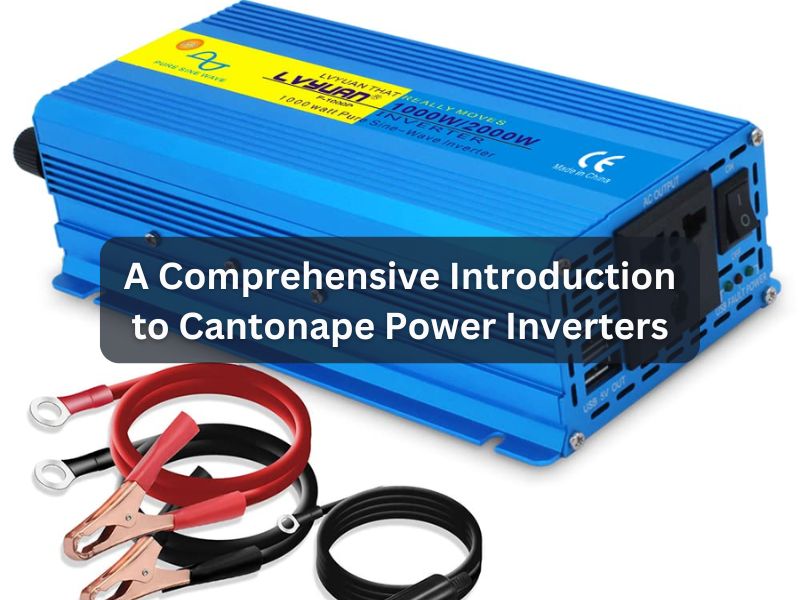
Cantonape Power Inverters provide portable, reliable power by converting DC electricity into AC, enabling seamless operation of appliances and devices anywhere.
Cantonape inverters are DC-to-AC converters sold in several wattage classes, in both modified sine wave and pure sine wave versions. Listings commonly mention LCD displays, USB charging, multiple AC outlets, and protection against overload, over/under-voltage, overheating, and short circuits. The commonly listed models run from about 1000W to 5000W continuous output and are aimed at cars, trucks, RVs, boats, and solar or off-grid setups. This guide is based on manufacturer listings, user manuals, and general electrical practice, not our own bench testing.
Our Top Picks
| Cantonape Model | Details |
|---|---|
| 3000W Power Inverter | Check price on Amazon |
| 2500W Power Inverter | Check price on Amazon |
| 4000W Power Inverter | Check price on Amazon |
| 1000W/2000W Power Inverter | Check price on Amazon |
What Are Cantonape Power Inverters?
Cantonape Power Inverters transform direct current (DC) from batteries into alternating current (AC). This allows the use of standard appliances, tools, and gadgets even in places without traditional power sources.
What does a Cantonape inverter actually do?
It takes low-voltage DC from a battery bank, alternator-charged vehicle battery, or solar battery system and produces household-style AC. The 1000W models, for example, are listed as 12V DC input and 110V/120V AC output, with 1000W continuous and 2000W peak power (see the 1000W listing). It does not create energy. It only converts what the battery holds, so battery capacity decides how long it runs.
Key Features of Cantonape Power Inverters
- Efficiency: High conversion rates minimize energy loss.
- Safety Measures: Protection against overheating, short circuits, and overload.
- Compact Build: Lightweight, easy-to-carry designs.
- Universal Use: Compatible with various devices, from small electronics to power tools.
Ports, display, and protection features
- USB and Type-C: Listings show USB outputs rated at 3.1A, and some models add Type-C ports.
- AC outlets: The count varies by model. Check the specific listing, because a higher wattage does not always mean more sockets.
- LCD display: Several models show voltage or load status, which helps you spot a sagging battery before the inverter shuts down.
- Protections: Listed models commonly include overload, short circuit, overheating, reverse polarity, and under/over-voltage protection.
- Efficiency: Several listings advertise conversion efficiency above 90%. Treat that as a peak figure, since real efficiency drops at very light loads.
How Do Power Inverters Work?
Power inverters change DC power, typically from car batteries or solar panels, into usable AC power. They employ an oscillator to alternate current direction, mimicking the standard household power supply.
Technical Overview
| Component | Function |
|---|---|
| Oscillator | Converts DC to oscillating AC. |
| Transformer | Adjusts voltage for output. |
| Cooling System | Prevents overheating. |
| Circuit Board | Regulates and stabilizes output. |
Types of Cantonape Power Inverters
Pure Sine Wave Inverters
Perfect for sensitive devices like computers and medical equipment. They offer clean, consistent power similar to grid electricity.
Modified Sine Wave Inverters
Cost-effective and suitable for robust devices like power tools and basic appliances. Not recommended for highly sensitive electronics.
Which devices need pure sine wave power?
Some Cantonape models are modified sine wave and others are pure sine wave, so confirm the wave type on the exact listing before buying. As a general rule:
- Choose pure sine wave for: CPAP and other medical devices, laser printers, variable-speed or inductive motors, dimmer-controlled lights, audio gear, and battery chargers for tool packs or cameras.
- Modified sine wave is usually acceptable for: basic universal-motor power tools, incandescent bulbs, simple heating elements, and many phone and laptop chargers. Some chargers still hum or run warm, so read the device label.
If a device’s manual says “pure sine wave only,” follow it. A fridge compressor motor typically runs cooler and quieter on pure sine wave.
Benefits of Cantonape Power Inverters
- Portability: Ideal for camping, travel, or outdoor activities.
- Emergency Preparedness: Reliable backup during outages.
- Versatility: Supports a wide range of devices.
- Durability: Built for long-term performance.
Comparative Power Output
| Inverter Type | Efficiency (%) | Recommended Use Cases |
| Pure Sine Wave | 85-95 | Sensitive electronics, medical gear |
| Modified Sine Wave | 70-85 | Tools, basic household appliances |
Cantonape Model Tiers Compared
The table below uses only figures from the product listings and manuals. Where a detail is not confirmed, it says to check the listing.
| Tier | Continuous / Peak | Input | Wave type | Ports and protection |
|---|---|---|---|---|
| 1000W | 1000W / 2000W | 12V DC to 110V/120V AC | Varies by model | USB (3.1A) on listed units; overload, short circuit, overheating, voltage protection |
| 3000W | 3000W / 6000W | Check listing and manual | Varies by model | Reverse polarity, overload, short circuit, overheating, under/over-voltage listed |
| 4000W | 4000W / 8000W | Check listing and manual | Varies by model | USB and Type-C on some models; same protection set |
| 5000W | Check listing | Check listing and manual | Check listing | Check listing |
Practical Applications
- Camping: Power lights, fans, or portable coolers.
- Road Trips: Charge laptops, phones, and small gadgets.
- Emergency Power: Keep refrigerators, medical devices, and communication tools running.
- Small Businesses: Operate tools and machines in remote areas.
Use cases by setup
- Cars and trucks: A 1000W unit on a 12V system covers laptops, chargers, and a small cooler. Run the engine for anything heavy.
- RVs and boats: A larger unit on a dedicated house battery bank handles a fridge, TV, and small kitchen appliances. Keep it in a dry, ventilated spot, especially on boats.
- Solar and off-grid: The 3000W to 5000W tiers suit larger battery banks. Higher battery voltage means lower current and thinner, cheaper cabling, so check which input voltages your chosen model supports.
Daily Usage Tips
- Monitor power requirements to prevent overload.
- Use recommended cables for secure connections.
- Ensure proper ventilation to avoid overheating.
| You May Like: Why Does the Inverter Have a Fan?
Choosing the Right Model
Key Factors to Consider
- Power Needs: Match the inverter wattage to your devices.
- Port Features: Look for USB ports or dual AC outlets.
- Warranty: Choose models with extended coverage.
Sample Wattage Requirements
| Appliance | Wattage Needed (Approx.) |
| Laptop | 50-100 |
| Refrigerator | 600-800 |
| Power Drill | 800-1200 |
| LED Light | 10-50 |
Continuous watts vs startup surge
The first number on a listing is continuous output, which the inverter can hold indefinitely. The second is peak or surge output, which it can deliver only for a moment. Motors in fridges, drills, and pumps draw a short burst when they start, often a few times their running wattage. A 1000W/2000W model can therefore start a motor that briefly pulls up to 2000W, but only if everything else on the inverter is light. Size by continuous load first, then check that the surge fits under the peak rating.
Sizing table: devices to wattage tier
| Load | Typical running watts | Suggested tier |
|---|---|---|
| Phone, laptop, LED lights | 10-100 each | 1000W |
| TV and small fan | Roughly 50-150 combined | 1000W |
| Compact refrigerator | 600-800 (per table above) | 1000W if little else runs; 2500W-3000W for headroom |
| Power drill | 800-1200 | 2500W-3000W |
| Several tools or appliances at once | Add them up | 3000W-5000W |
Worked example: laptop, fan, and small fridge together
These figures are illustrative. Read the nameplate on your own devices.
- Laptop charger: 90W (within the 50-100W range above).
- Fan: 40W.
- Small fridge: 700W (within the 600-800W range above).
- Running total: 90 + 40 + 700 = 830W.
- Keep the continuous load near 80% of the rating: 830 ÷ 0.8 ≈ 1040W. A 1000W unit is marginally too small.
- Startup check: if the fridge motor briefly draws about three times its running watts (a common rule of thumb, not a Cantonape figure), that is about 2100W, plus 130W for the laptop and fan, roughly 2230W. That exceeds the 2000W peak of a 1000W model.
The better fit is a 2500W or 3000W unit. A 3000W model lists 6000W surge, which clears the startup load comfortably. Battery current matters too: at 12V, 830W draws roughly 77A at 90% efficiency (830 ÷ 12 ÷ 0.9), which is a heavy load for a small battery.
Installation and Usage Tips
- Select a Proper Location: Ensure a cool, ventilated area.
- Secure Connections: Tighten cables to prevent sparking.
- Test Devices Gradually: Start with lower-wattage devices.
- Avoid Overuse: Allow cooling intervals for long operations.
| You May Like: Can a Power Inverter Jump Start a Car?
Safe installation and battery checklist
- Match the battery voltage to the inverter’s stated DC input. A 12V inverter must not be wired to a 24V bank.
- Connect positive to positive and negative to negative. Reverse polarity protection is listed on several models, but do not rely on it.
- Use the cable gauge and length given in the manual. Higher wattage means much higher current: a 3000W load at 12V draws well over 250A, so the cables must be short and thick.
- Fit a fuse or breaker on the positive cable close to the battery, rated per the manual.
- Switch the inverter off before connecting or disconnecting cables, and connect the final terminal last to limit sparking.
- Choose a deep-cycle or lithium battery bank for sustained loads. A starter battery drains quickly under heavy draw.
- Leave clearance around the vents and keep the unit away from fuel, moisture, and flammable materials.
- Learn the low-voltage cutoff point in the manual. On 12V inverters it is commonly around 10-10.5V, but confirm the exact figure for your model.
For model-specific wiring and specifications, read the manual before purchase. Cantonape manuals are collected at Manuals+, including the 3000W power inverter user manual. Look for the input voltage range, cable and fuse requirements, wave type, outlet layout, and the alarm and shutdown behavior.
Maintenance and Troubleshooting
Maintenance
- Dust off cooling vents regularly.
- Inspect connections and cables for wear.
- Store in a dry, temperature-controlled space.
Troubleshooting Issues
Overheating
- Check for blocked vents.
- Reduce connected devices.
Device Malfunction
- Ensure proper voltage compatibility.
- Confirm secure wiring.
Power Drop
- Recharge the battery.
- Test for circuit board issues.
Comparing Cantonape to Other Brands
| Feature | Cantonape | Competitor X |
| Price Range | Affordable | Mid-range |
| Safety Features | Extensive | Limited |
| Ease of Use | User-Friendly | Moderate |
| Portability | Lightweight Design | Heavier Models |
Trade-offs of budget inverters
- Wave type varies: Cheaper units may be modified sine wave, which is unsuitable for some electronics and motors.
- Peak is not continuous: A “2000W” headline on a 1000W unit is a short surge rating.
- Efficiency claims are best-case: Above 90% is advertised on several listings, but light loads and heat reduce it.
- Installation is on you: Cables, fuses, and the battery bank are usually separate purchases and have a large effect on safety and runtime.
- Specs differ between listings: Resellers may describe the same product differently, so verify against the manual.
Availability and Pricing
Cantonape Power Inverters can be purchased on platforms like Amazon, eBay, and authorized retail stores. Prices range from $50 to $300, depending on wattage and features.
User Feedback and Ratings
Users highlight Cantonape’s reliability and ease of operation. Common praises include compact design, durability, and excellent customer support. One reviewer stated, “It powered all my essential devices during a camping trip without any issues.”
Frequently Asked Questions
Can a Cantonape inverter run a fridge, laptop, TV, or power tools?
Yes, if the continuous and surge ratings cover the combined load. Laptops and TVs are small loads. A fridge (roughly 600-800W) and a drill (roughly 800-1200W) need a larger unit, and a pure sine wave model is the safer choice for a fridge compressor.
What input and output voltage do Cantonape models support?
The 1000W models are listed as 12V DC input and 110V/120V AC output. For other tiers, confirm the input voltage (12V or 24V) in the listing and manual before buying.
What safety protections do Cantonape inverters include?
Listed models commonly include overload, short circuit, overheating, reverse polarity, and under/over-voltage protection. These reduce risk but do not replace correct fusing and cabling.
Can I add two inverters or run one continuously at full load?
Running continuously at the rated maximum leaves no margin and builds heat. Aim for about 80% of the continuous rating, and split large loads across separate units only if the manual allows it.
Is the 1000W model enough for a camping setup?
For lights, phones, laptops, and a fan, yes. Add a fridge or power tools and you will likely want the 2500W or 3000W class, as shown in the worked example above.